Blue Star Tattoos / Nautical or Not

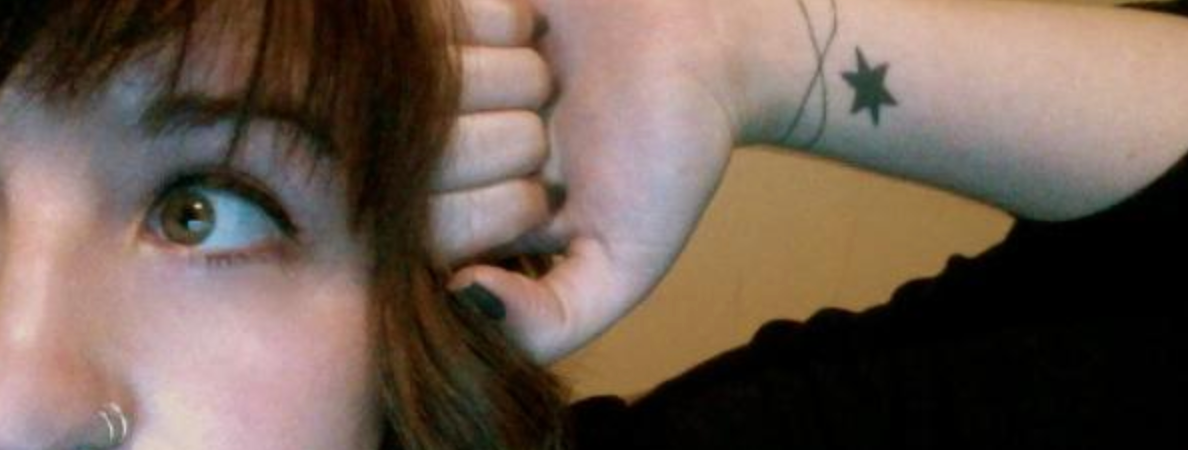
Blue star tattoos. She took off her watch and I saw my first. An inked symbol on the wrist of a bisexual woman from the West Coast. It was 1998 and we were both students at my New England women’s college. The next sighting was a set of stars, spotted as I got up to stretch on a flight to Tokyo and met two cuddling dykes from LA in 2001. The couple had matching blue stars on their forearms. Two years later, in 2003, I was more than tipsy late one night in a gay bar on New York City’s Lower East Side dancing with trans Southerners when I spotted another, and there would be more in the years to come. Even as lesbian and queer spaces began to disappear, on arms with sleeves rolled up, blue stars shined in flashing lights, sweaty crowds, busy streets, and a sea of queer bodies.
In the summer of 2008, I began to lead group interviews with lesbians, bisexuals, queers, and trans (lezbiqueertrans) people about their spaces in New York City, and at least two of my research participants had visible blue star tattoos. These stars shone differently to me in my research. I asked both women what inspired their tattoos and both said they had heard them described as “a lesbian thing to do.” Wide- eyed at its historical connection, I immediately described Elizabeth Kennedy and Madeline Davis’s important history of a mid- twentieth- century Buffalo, New York, lesbian community, Boots of Leather, Slippers of Gold. Neither of them had heard of how Kennedy and Davis recorded the rich and complex lives of Buffalo lesbians, including how a group of them got blue star tattoos on their wrists that they could keep hidden behind their watchbands and embraced as a symbol of “community identity.” Suddenly, I realized that invisible lezbiqueertrans lives and spaces materialized, concretized, and could be traced through lezbiqueertrans bodies across the urban landscape and beyond, generation after generation. ...
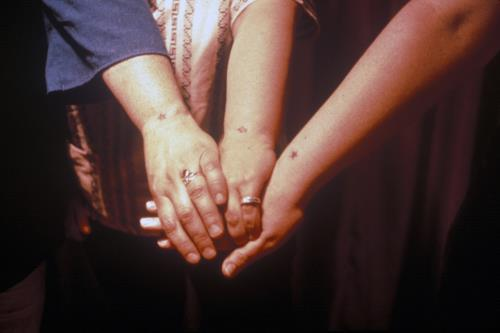
I met activist and writer Madeline Davis, who co-authored Boots of Leather (the lez shorthand title) with Kennedy, in 2010 when I was beginning to write this book. I told her my blue star tattoo story and her whole body shook with laughter as she pulled her watch back and showed me her blue star tattoo. “My friends and I got drunk one night and I convinced them to do this! Then I put the story in the book!,” Davis said with a smile. I told her that many, many lezbiqueertrans people had these tattoos. Some of these blue star-tattooed lesbians, dykes, and queers have read Kennedy and Davis, some have not, but many feel their tattoos (or piercing or protest shirts or innuendo buttons or rainbow paraphernalia) afford meaning and connection.
That's the opening to my book A Queer New York.[1] I share it because I'm working on a reading guide series on dyke bars* for the Lesbian Herstory Archives, and I re-found Madeline Davis' unpublished memoir and nearly keeled over in clapping glee. In it, she shares:
In many lesbian communities around the country, gay women have been getting tiny blue stars tattooed on their wrists. The tattoo is usually on the wrist where a watch is worn and therefore the star can be hidden. The first blue stars were obtained one night when a group of fairly drunk dykes went to “Dirty Dick’s” Tattoo Parlor on Chippewa St. Each had a tiny blue five-pointed star tattooed on the wrist where the watch would temporarily cover it. They knew it would identify them as lesbians but it was an act of resistance in an oppressive era. An in-your-face statement to the police, who recognized that the stars meant they were gay. One by one, a few lesbians, including myself and my friend Bobbi, followed suit in the mid-sixties.
She adds that, "By the 1980s the fad had spread to lesbian communities around the U.S. This phenomenon is documented with photos, videos and interviews in the Lesbian Herstory Archives in Brooklyn, NY." I haven't seen those but I will someday soon.
In A Queer New York, I went on to say, "These stars trace an embodied and spatiotemporally interdependent history— for a people with so little history— that runs over half a century from one evening among friends in 1950s Buffalo, to the years Kennedy and Davis spent researching, writing, and publishing Boots of Leather in 1992, to the passing on of this story through that text and by word of mouth among lesbians and queers over generations, to the decade I spent researching and writing this historical geography of lezbiqueertrans New York City"...and even to the moment I wrote this post for you.
My own blue star tattoos are on my back. One for every place I've lived, geographically ratioed. 🤗 I'll draw the lines between my constellation for my 50th.
Oh. But, Jack. What about nautical stars?!?!?!?
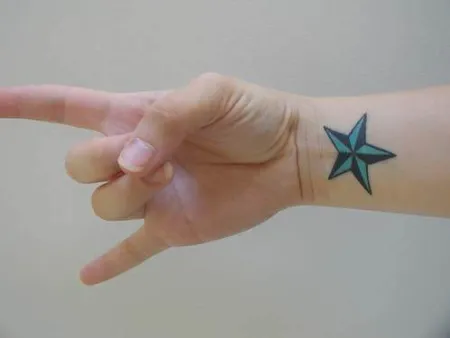
As for the fascination with nautical stars, Autostraddle claims this is 1940s trend but I've yet to find a source.
It's more likely the blue star tattoo—common until the 2000s—got repurposed as the nautical blue tattoo.
Do you feel you need a different discreet tattoo with a good dyke heritage? In fact, many years later, Davis also got a
small, discreet tattoo on my left breast, a phoenix rising out of flames, an image I had already embroidered on a velvet vest. I love the phoenix; it signifies resilience, never being kept down, being reborn out of destruction, everlasting.
Happy tattooing, friends.
[1] Some wee edits have been made to the original.