(Data) Visualizing the Lesbian Herstory Archives
On archival materials and uteri as backup gear and primary materials, and what comes from drinking a tea for a year in the Lesbian Herstory Archives.

I didn't know we had that much history. - a research participant when I showed her my spreadsheet of LGBTQ+ organizational
I've always loved data, particularly queer data. I love queer stories and, to me, when the stories add up and add up, they become another type of proof of our lives. I am always and forever a qualitative researchers, but the quantitative is hot too! I mean, c'mon: I love seeing the forest and the trees. You can't queer the binary anymore than that!
But not so long ago, say the 2000s-ish, the idea of queer and data being together didn't make sense. "Data" was a claim to objective-ish truths. Queerness thrived in the fuck you to assumptions, norms, and fixity. It demanded that flux and unknownness be centered and recognized.
Eventually, many queer theorists–me included!–found out that the concepts of queer + data belonged together. They're a superb couple. They're surely both solo poly and dating openly, but I also think they're quite in love.
Plus, this newsletter is a very lovely place to discuss the wonders of queer data. Since I've been writing on queer data for 15 years (gadzooks!), it feels important to reveal how I got here in the first place.
I came into consciousness as a kid in the midst of the AIDS epidemic's early years in the early 1980s,when the Religious Right was calling queer diseased and deviant on TV everyday. After a wonderful stint in a very affirming women's college, I landed in New York City and then started my research in the midst of 2000s when we were all watching The L Word and the LGBTQ movement had atrophied to focus primarily on marriage. As my kids say: what the?!?!
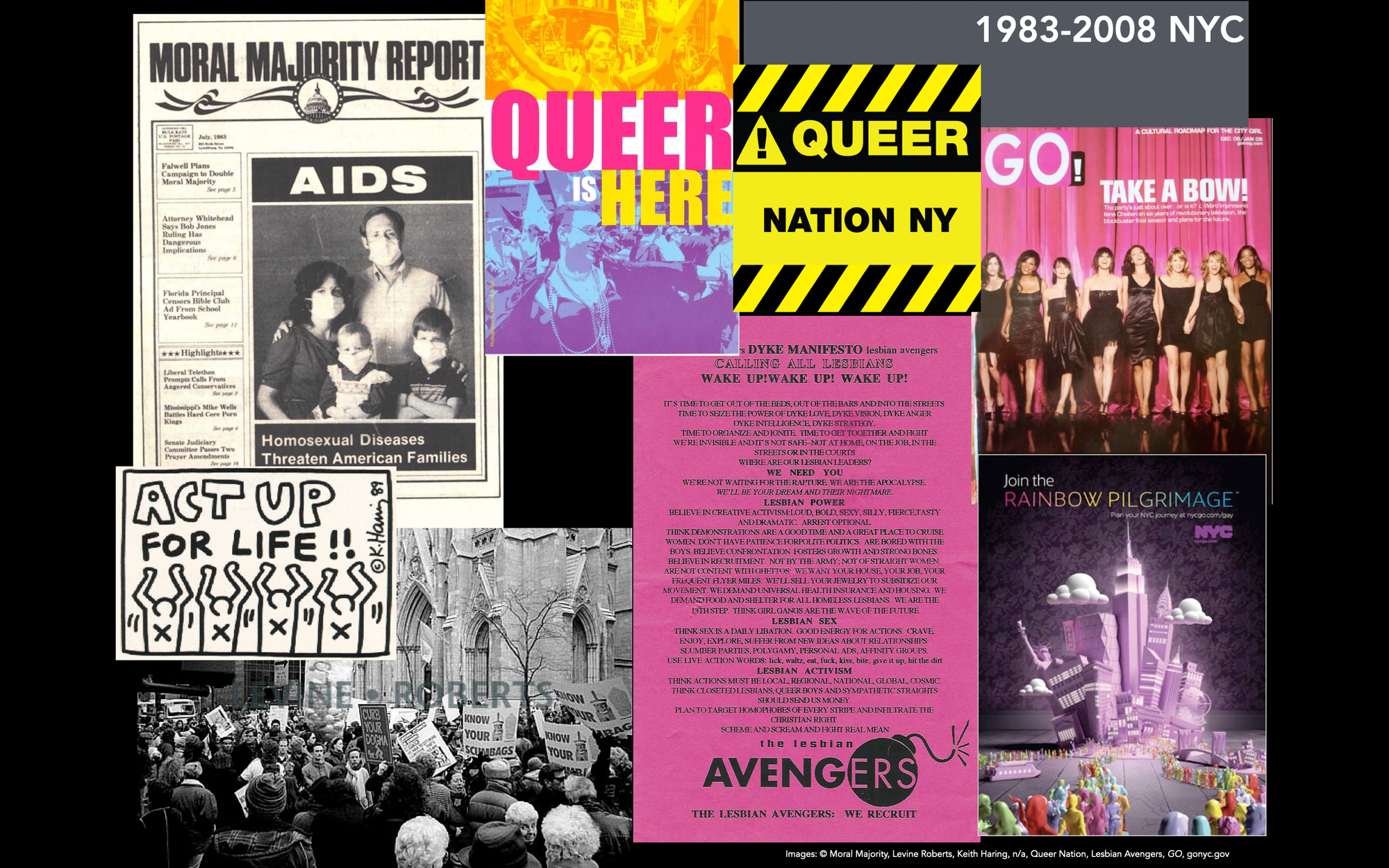
The inspiration to conduct archival research–alongside my primary commitment to multigenerational group interviews of lezbiqueertrans people–came from persistent questions from academics and activists alike: Could women who came out in 1983 really remember what it was like at that time and express it clearly? Could those trans folks who joined the Lesbian Avengers in 1992 really portray a fair representation of those experiences 15 years after the fact?
I admit these concerns scared the crap out of me as I was attempting to get a PhD and be a Real Academic (whatever that is, we all wonder). Eventually, I decided the archival research would fill the gap. At first, it was just how I imagined my butch uterus in the event my partner's didn't give us the kids we desired: the archival materials were backup gear.
But, over time, I came to realize that unlike my uterus (emergency histerectomy; glorious stepdad life), these archival materials took the spotlight.

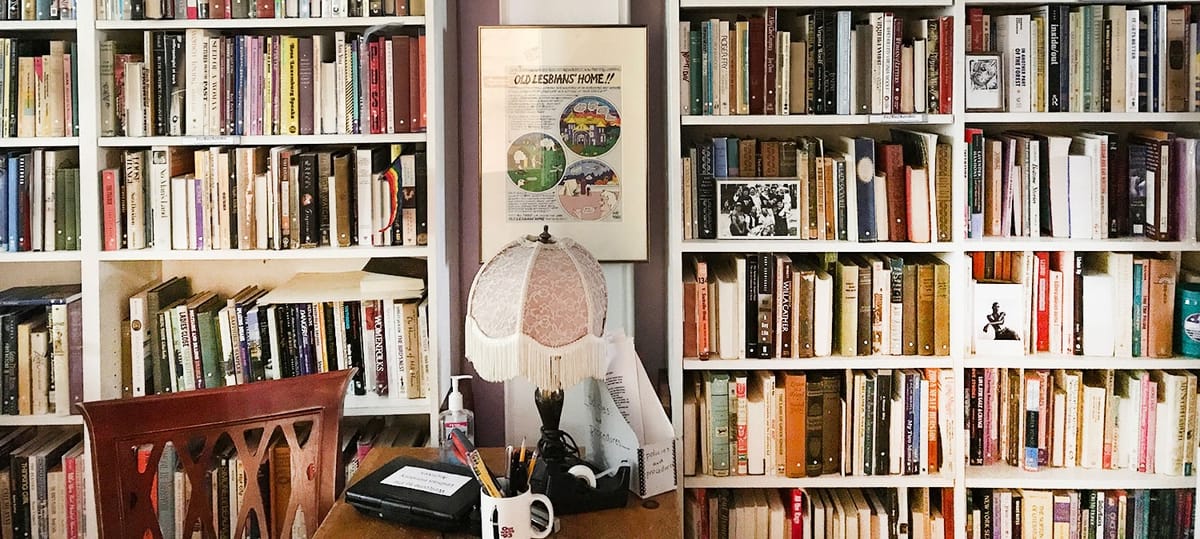
So I spent a year in the Lesbian Herstory Archives digging through their collections. This research at the LHA framed all of my ideas for my first book A Queer New York.
I drank so much tea.
At some point, I had the Excel file open on my laptop after one of my multigenerational group interviews. I was chatting with a dyke participant who, when she saw the black and white boxes, asked what the heck was on my laptop. I zoomed out in Excel to show her (the image on your right), and said, "This is what lesbian-queer history looks like: the detailed notes on 381 lesbian-queer organizations look like in a spreadsheet. The white means the organization was existent; the black means it did not yet exist or closed."
And then tears welled up in her eyes and she said: "I didn't know we had that much history."
Over the span of a year (2007-2009), I surveyed the complete collection of 2,300+ organizational records at the Lesbian Herstory Archives (LHA). Rarely there was just one piece of paper or a small handful of flyers. Often there was an inch or two or three of material. When it came to larger organizations, there were 47 boxes of Lesbian Avengers materials and 21 boxes of ACT UP documents, notes, and ephemera. Yep. I was swimming in it.
These 2,300+ organization records represent a 36-year slice of queer history then from 1973 to 2009.Because most organizations had gone online by the 2000s and keeping on top of them via printouts – can you even print out an Facebook account with any detail for flyers, etc? – the number of materials started to slow. I stopped collecting materials in 2009 and the LHA was founded in 1973.
What you see (to the right) is all 381 of those LHA organizational records and my detailed notes on each, year by year from before 1983 through 2008. Each white space, an organization existed. Each black space means an organization had not yet opened or had closed. A range of around 80 to 120 organizations existing at any given time, and purpose statements were available for around two-thirds of those organizations, around 55 to 80 organizations. (I also analyzed the hell out of 25 monthly publications spanning 25 years, but that's for another dyke day.)
This is what our urban lesbian-queer organizing existence in New York City looks like in one place.
For queers with little to no history, to see it all in one place is magical. Like this participant reflected back to me, it's breathtaking and worth crying over, even nearly twenty years later.
The more I sat and drank tea and read and typed, read and typed, secretly napped, then read and typed, I realized there were more patterns in here than I could account for when taking in these materials over the span of a year. The minutiae of politics, places, and people’s everyday lives was available in the stories of lesbian and queer organizational records and publications in ways there was no time to elaborate in my group interviews with participants.
Future posts will do more digging and analysis of these posts, updating previous, early thinking on these organizational files. I remain hopeful about them, just like I was not long after I really dug into thinking about queer data, I earnestly wrote in 2013 and deeply in the style of academ-ish as I call the academic language:
My sincere hope is that these ways of seeing our histories and spaces anew will bring light and connection to the seemingly disparate generational experiences as well as the diverse communities within lesbian-queer New York and elsewhere. I am sharing these data publicly in order to create not only to share our stories through more varied methods but also to provide for a more encompassing analysis.
And here we are again and again, me trying to share our stories more widely. How else do we build our queer futures without our queer histories?