It's Closed Now: Our Decades-Long Fixation with Lost Dykedom
A meditation on the it's-closed-now rhetoric of lezbiqueertrans spaces--why it's true and how it traps anyone wanting to build a better world.

Why are dykes so fixated on the closure of their spaces? On the hand, most of the thousands of lezbiqueertrans spaces have closed over the decades, ever since the advent of lesbian feminist IRL worldbuilding. On the other hand, it's a rhetoric of absence that the media repeats back to us that leaves us in a sense of loss. It also makes cis-heteropatriarchy feel super, annoyingly secure.
Paying attention to the closure of dyke spaces is important for anyone who cares about social justice. If they close our spaces, they're coming for yours.
So then, how the hell did we get here talking about loss and closure?
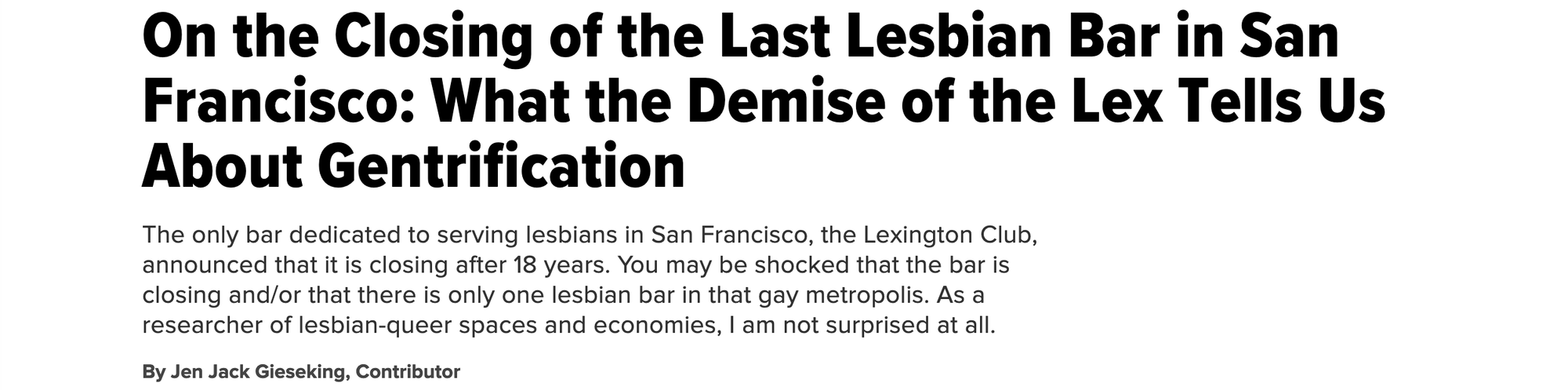
In 2015, the lezbiqueertrans world lost their fricking minds: the last lesbian bar(!) in San Francisco(!) was closing(!) (I admit that I was one of those people.)
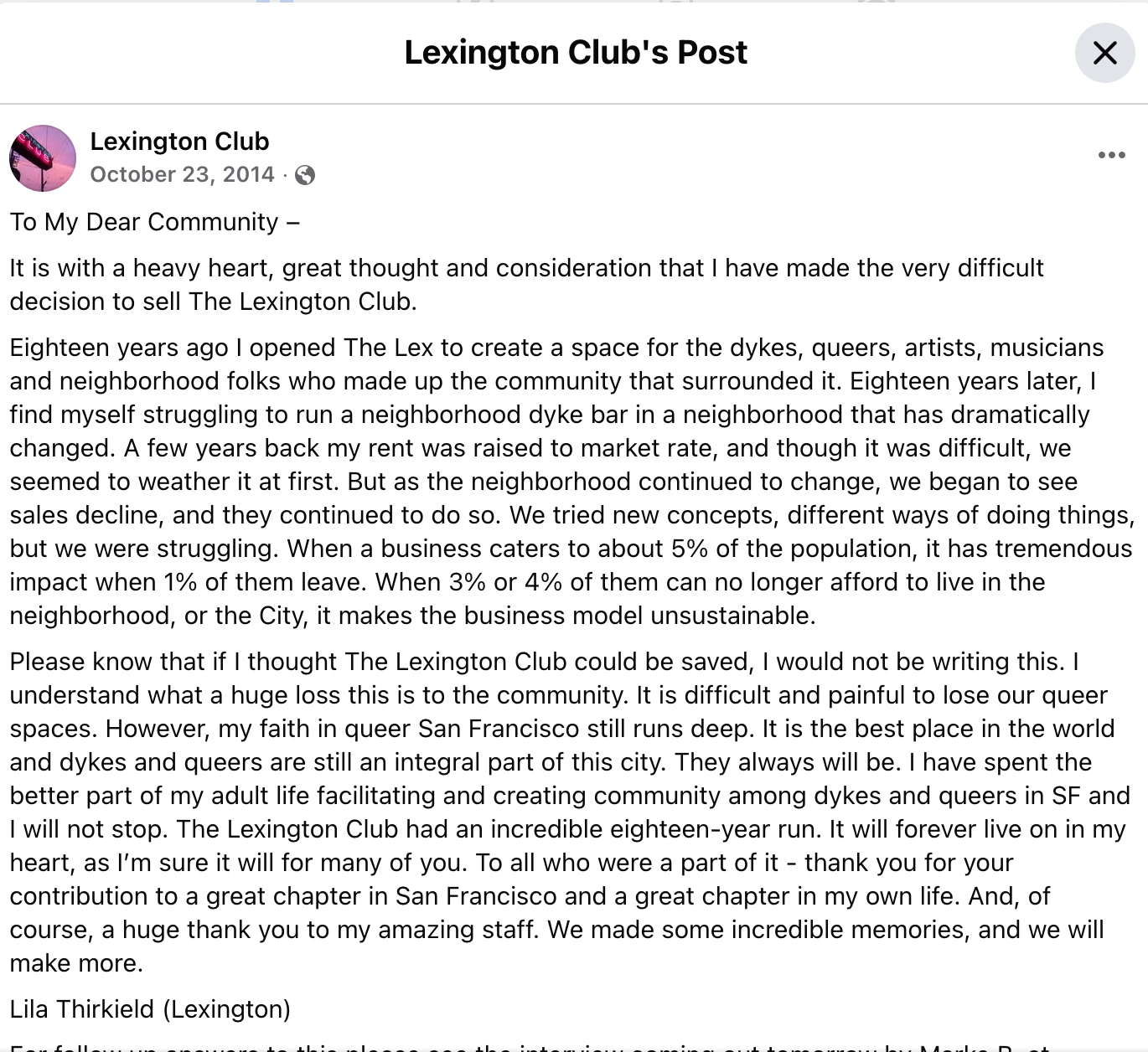
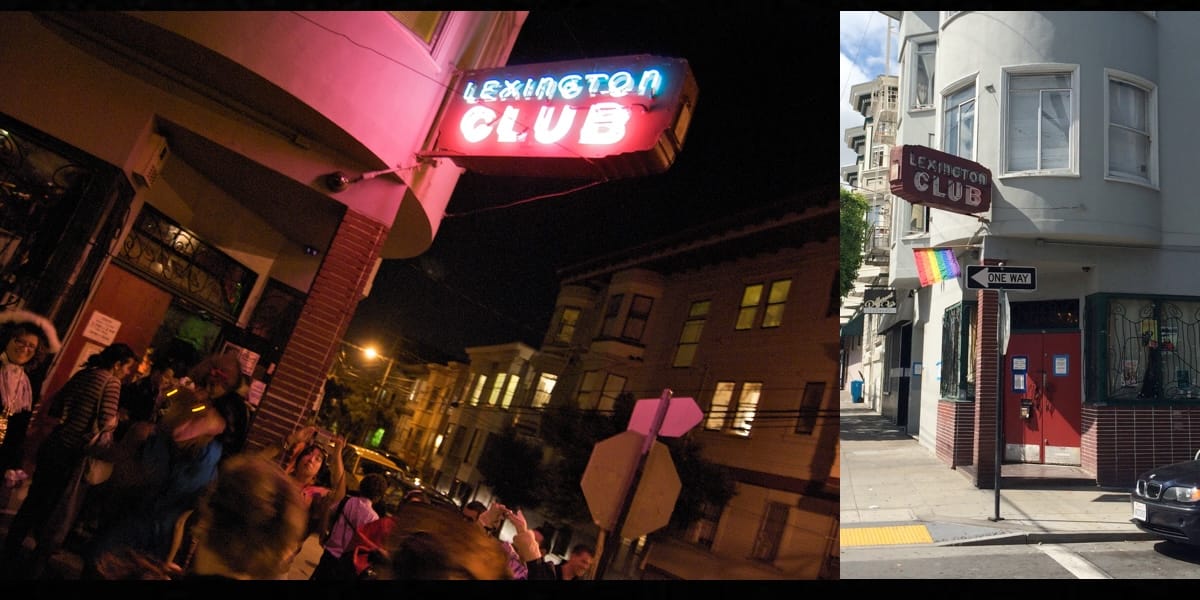
The Lexington Club–or the Lex among dykes–was an institution. Whether you queer pilgrimaged yourself to the West Coast or grew up there, the Lex was where everydyke went. As the SF Eater reported: "For the local lesbian community, and the Mission in general, this is undeniably a huge loss." The SF NPR our KQED added: "To some people, 'The Lex' is more than a bar – it's a community space, billed as 'Your Friendly Neighborhood Dyke Bar.'" The conversations in person and online included shock and awe with confused homotranses wondering: Where will we go now???
Funny enough, lezbos had already sung this song before! In 1992, the "last lesbian bar in San Francisco," Amelia's closed. Y'all, we're on repeat here.
Beyond the eternal return of dyke memory (which needs its own post), what was most interesting about this moment is that the national, mainstream media picked it up and it went viral. The decades of lesbian bar closings since the 1990s were always reported by local LGBTQ news outlets (when those existed), and often in local gay-friendly newspapers. Then, suddenly!, these closures became mainstream, cis-het news because the "last" lesbian bar in hella gay San Francisco closed. I even wrote about the larger dynamics of queer geographies and gentrification related to it.
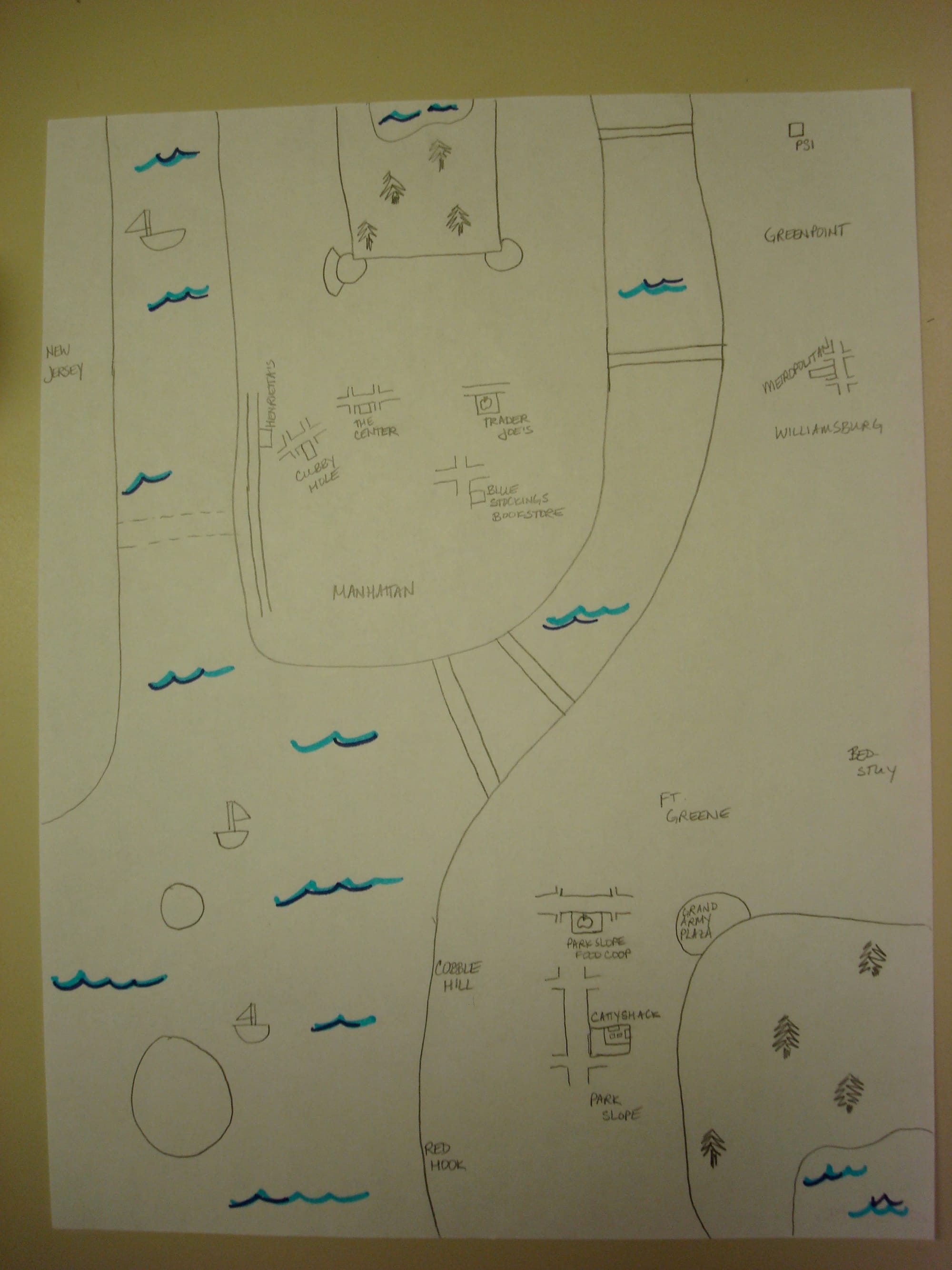
And it's not just a fixation on very gay San Francisco. The undercurrent of profound spatial loss was everywhere. Here's me in my first book A Queer New York quoting Faith, who had come out in 2003, in our 2008 multi-generational group interview:
Later on, Faith looked at the places she included in her [hand-drawn, mental] map [of lezbiqueertrans places in New York City, pictured below] and added, “These are almost all bars [the Cubbyhole, Henrietta Hudson, and Metropolitan, and the Heathers party] . . . with the exception of the LGBT Center and Bluestockings.” When she found out that Cattyshack, the first lesbian bar she went to in the city, had just closed a few weeks prior, she was in shock: “Shut. Up. I was just there, like, for, for— are you serious?! Cattyshack closed?!! . . . Oh my God!!!!!”
In fact, I did 22 lezbiqueertrans multigenerational group interviews with folks who came out between 1983 and 2008, and the agony of the loss of lezbiqueertrans spaces, particularly lesbian bars, was shared as a constant. It was also one that surprised younger queers (there's the dyke memory of eternal return). The decades of multigenerational loss were reported sometimes in mourning, sometimes in anger, and sometimes with a sense of inevitability about the shooting-star-like quality of many if not most lezbiqueertrans places. This inevitable-loss sensibility among those who had been out more than five years came up in every group interviews independently. Interviewees often dropped the phrase and then repeated it throughout their conversations: "It's closed now."
Oof da.
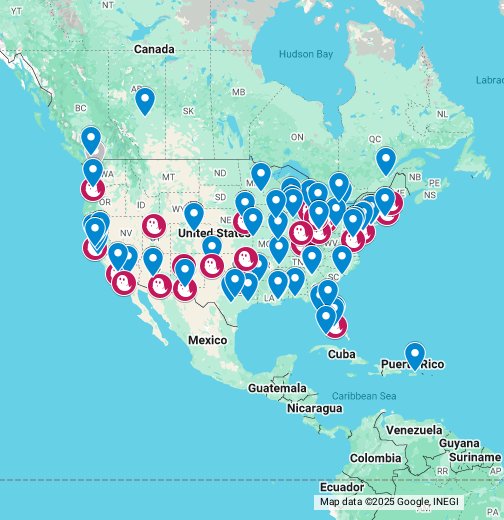
And it's just very queer New York City with very San Francisco. Here is sociologist and dear friend Greggor Mattson's 2016 map of 100 closed lesbian bars he had in his research. Of note, my guess is this number is in the thousands but the records are so dispersed that it would take eons to accumulate them:

Bringing up back to the 2010s moment of the Lex: importantly, very few–if any?–mainstream news outlets equally reported on the closure of LGBTQ, feminist, lesbian, and queer bookstores, gyms, co-ops, cafés, coffeshops, restaurants, or communes. Or the collapse of social groups, sports teams, radical organizations, among other collectives. Or the effect on queer life. The appearance (but untruth) that gay men's bars remained open at their same numbers often covered up the gendered elements to sexuality. As usual, the race, class, and disability parts were left out.
Lately, I find myself weirdly worrying about generations of people who won't even get to say "it's closed now" from their own experience. They will never experience these spaces beyond the stories of their elders. Sociologist and my friend Japonica Brown-Saracino has written about those younger generation folks who focus on commemoration of lost dyke spaces (namely lesbian bars, go figure) to celebrate the "material spaces rooted in place" and "cultivate mobile and inclusive space." It's a relief to hear too that: "Commemorators repair and critique the situated bar – not to restore it, but to harness it for their forward-facing efforts – by using memory to advocate for a move from specificity to generality; from situated to mobile and inclusive social spaces."
If anyone wants to have these sorts of spaces–dyke or otherwise!–they remain to be built. This "it's closed now" sensibility speaks oodles about both the political economy of cis-heteropatriarchy, and the whiteness, ableism, and colonialism entwined within it. It tells us what we're up against, and who gets scapegoated when we live without these worlds. It also tells us the kinds of places we need and want to still build to make a better world.
Here's the Fb post from The Lex's owner announcing the closing, so beautiful and so true–