"Love, Bulldaggers, and the Birth of Lesbian Research"
The lushness of Jonathan Ned Katz on Eve Adams doesn't quit. Here's the E1S4 transcript in full.

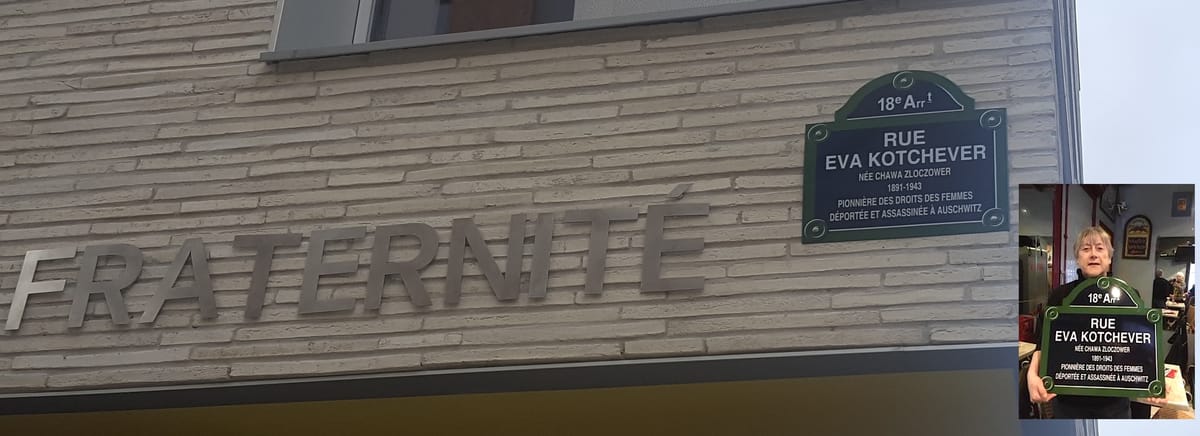
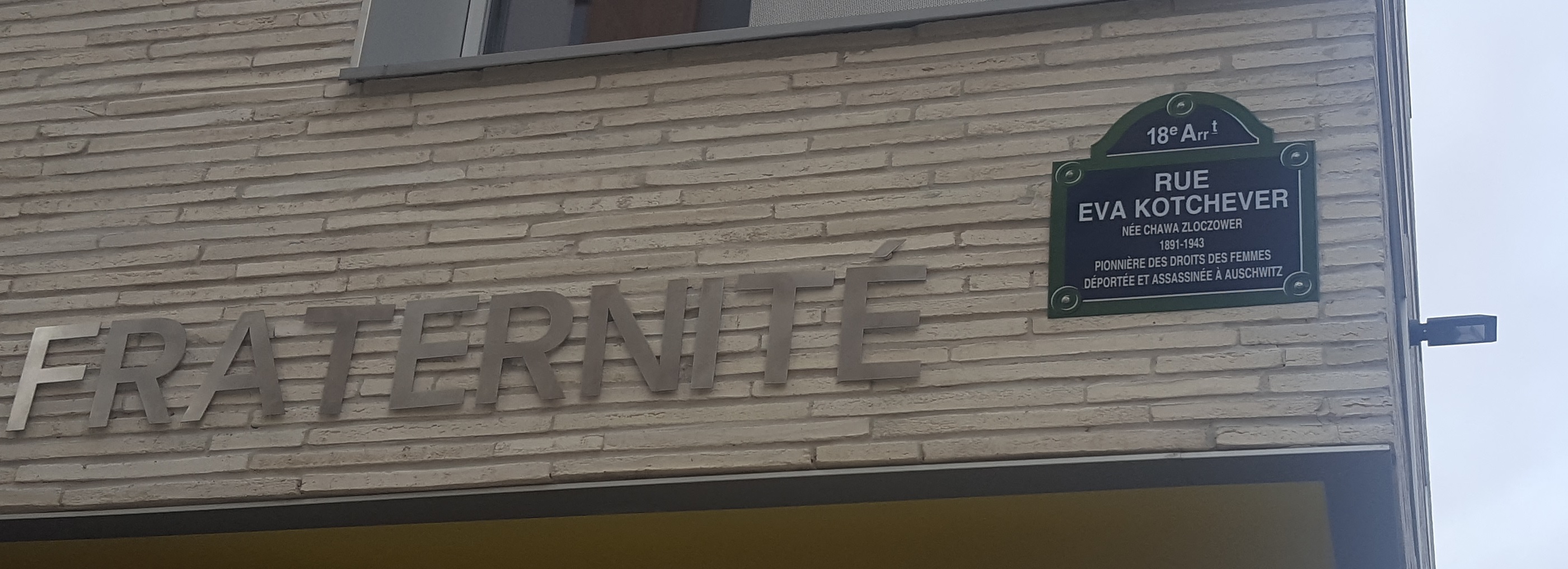
From now on, my Our Dyke Histories podcast transcript shares need some zhuzh – so bring on the images. (My girlfriend said so, and she's damn wise.) I've also gotten mixed feedback on including the full transcripts of ODH here. Some of you are grateful that a Google led you to those transcripts that landed you here; some of you want a newsletter post and to move the heck on. I feel both!
Lez split the different. Wayyyyyy below this bevy of images, you get the full transcript. It's TL;DR for those who don't feel it. But everyone loves the photos. Hell yeah!
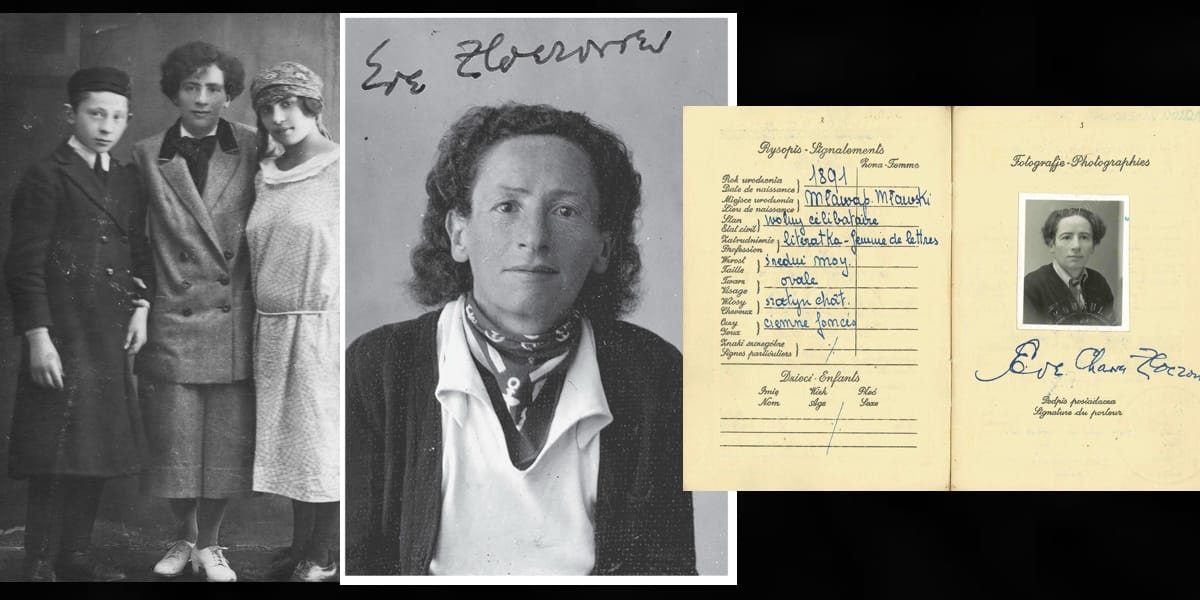
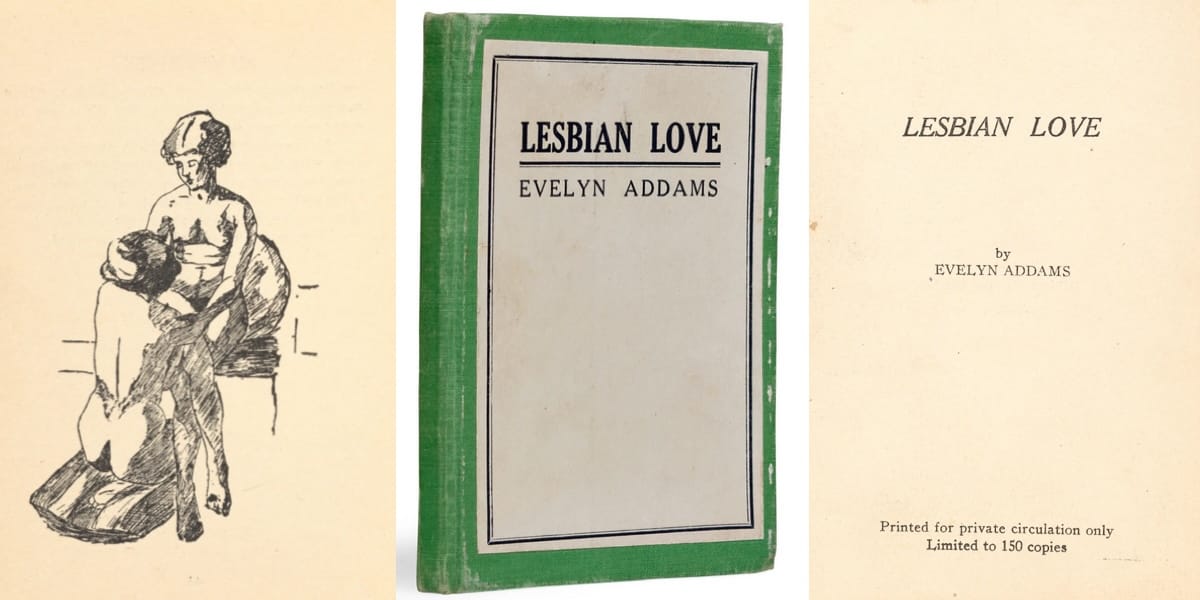
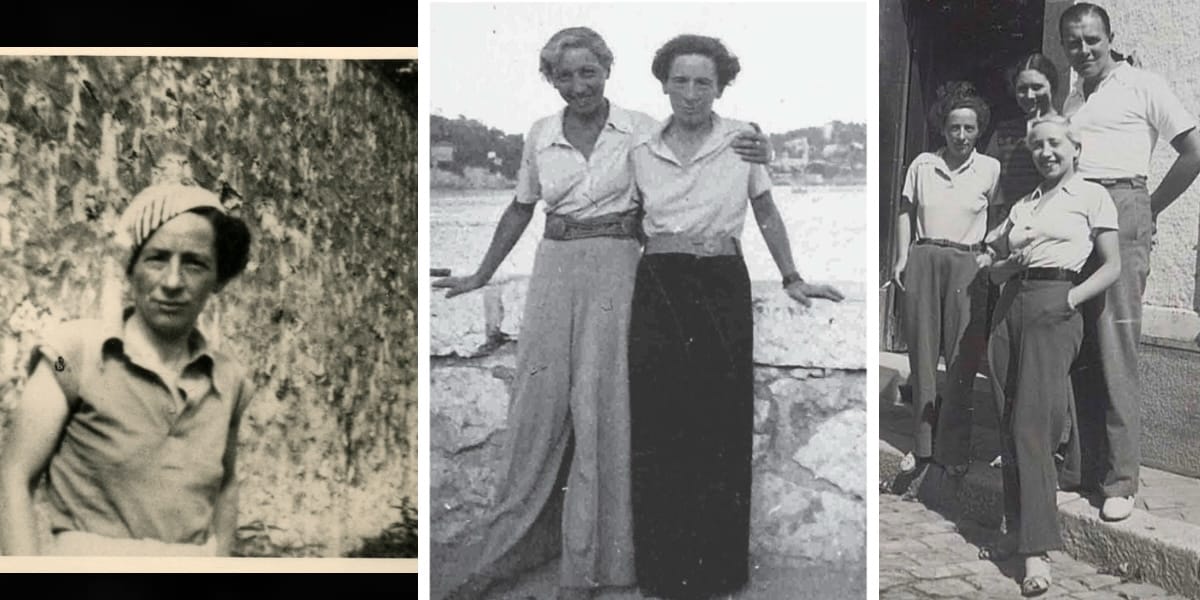
In our most recent episode, Julie Enszer and I finished our chat with Jonathan Ned Katz, author of a swath of important LGBTQ+ history texts. Most recently: The Daring Life and Dangerous Times of Eve Adams. Friend to Emma Goldman and Anias Nin, immigrant and Jewish gender bender, author of the first lesbian community study, her self-published Lesbian Love, as well as owner of what I call one of the first proto-lesbian bars in the U.S., Eve's Hangout. She did all of this in her 20s! Epsiodes 3&4 of Our Dyke Histories trace the wild life of Eve from Poland to NYC, to LA and SF back to NYC, and then back to Poland and Paris, and, sadly and eventually, Auschwitz. She is a kween among kweens.
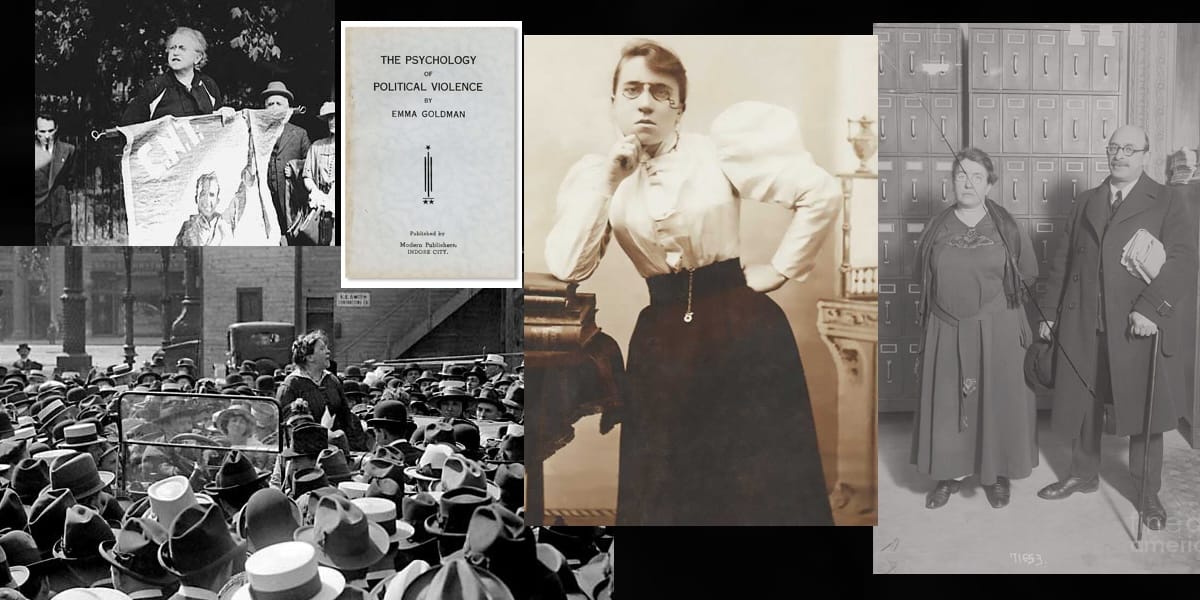
"Love, Bulldaggers, and the Birth of Lesbian Research"
OUR DYKE HISTORIES - EPISODE 1 SEASON 4
Introduction
Welcome to Our Dyke Histories. I'm your host, Jack Gieseking, historian, geographer, and environmental psychologist. We dive into the past and present of lez, bi, queer, trans, sapphic, nb communities, decade by decade in collaboration with multicultural, lesbian, literary and art journal, Sinister Wisdom. This season, we're all about dyke bars* with an asterisk: lesbian bars, queer parties, and trans hangouts– the structures that made them necessary, the lives they made possible, and the worlds we made from them.
Our Dyke Histories come for the history, stay for the revolution, gossip and desire that built us.
Jack Gieseking - Narrator: If you've ever heard of Eve Adams in an LGBTQ history class, you might've heard the Mythologized story that Eve created, a sign that read, men are admitted, but not welcome and hung it in the front of the bar. Katz says, that isn't true. It still gives people joy and agita, and absolutely worth talking about in this episode.
In this episode, we'll again be talking with Jonathan Ned Katz and Julie Enszer. We are back talking about the fabulousness of the life of Eve Adams. They're incredibly brilliant historians and scholars of LGBTQ lives, and we met in the summer of 2024 to talk about his book, The Daring Life and Dangerous Times of Eve Adams.
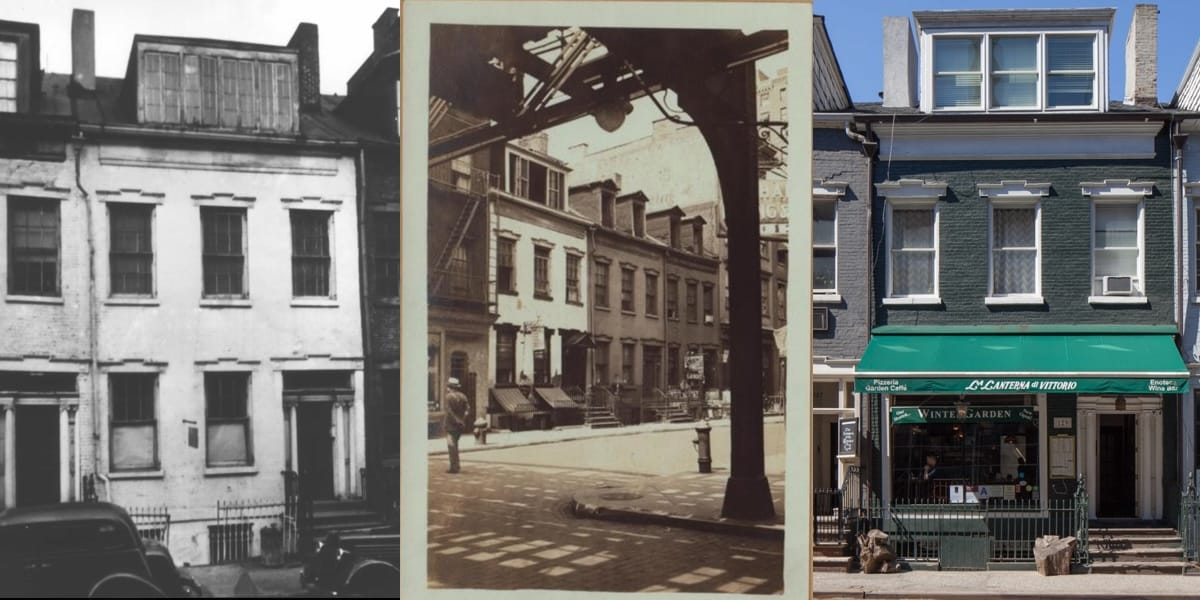
This is Greenwich Village of New York City. This is the home of Stonewall. This is really the first time we start to get a cluster of LGBTQ spaces happening in Greenwich Village in the 1920s, on MacDougal Street on the block where Eve opens her tea room. She's a huge part of that.
We're gonna hear more about how Eve was friends with people like Anias Nin, Mae West. How she was targeted by both national and local police. How she lived across the world and lived her life exactly the way she wanted it.
As a reminder, it is the hundredth anniversary of Eve's Hangout here in 2025, and also the hundredth anniversary of her book, Lesbian Love, which we're gonna be digging into much more the first lesbian community study in the U.S. if not the world.
I also have amazing tidbits about the history of calling cards, which are the equivalent of airdropping your phone number at the club. [00:02:00] As well about how important Eve is to the history of Jewish dykes, and all dykes and trans people.
As a reminder, this is part two of two. Eve Adams is such an incredible figure in the history of dykedom, She needed two full episodes to cover her life.
Lets dive in.
Content warning: we are gonna talk about the worst parts of World War II, incarceration, and deportation.
The First U.S. Proto-Lesbian Bar
Jack Gieseking: Did you get the sense that this was a precursor to a lesbian bar?
Jonathan Ned Katz: Yeah, sure. And it wasn't only a lesbian though, but that's a perfect description of a scene that i'm sure happened in Eve's. Place. I don't know if there was a piano there. There's no documentation of that.
I think it's important to realize it wasn't just a lesbian bar. Lots of men felt comfortable going there who weren't uptight, there's a description of, a poetry reading with lots of aggressive men talking, yelling, and carrying on. But, who knows?
Jack Gieseking - Narrator: So right here the tape gets fuzzy, but . It's when I told Katz about the 1928 Lesbian Berlin Guide, which I personally translated and read some of in the '20s and '30s episodes, One of the things you need to know for our conversation here is that lesbians in the 1920s in Berlin were holding lectures in their bars . There were violinists. There were very sexy dances. There's been so much change and so much has remained the same all along.
Jack Gieseking: So it wasn't open very long though.
Jonathan Ned Katz: No. Eve made a big impression. Even though her place wasn't open a very long time. Less maybe than a year.
Jack Gieseking: One other– the thing that I wanna talk about at this moment there are no lesbian bars in New York City. Right. We have tea rooms. Because women can't drink in public.
Jack Gieseking - Narrator: Also, in case you don't get a chance to listen to the other episode, [00:04:00] there's sort of these spaces happening in Berlin, but there are plenty of salons. There are infinite number of parties that will never know about.
And while Jimmie over at the Mad Hatter Tea Room, likely had a lot of dikes and queers and tons of artists hanging out there, the first women's bar, or really an entire ladies section of a bar opened in 1911 in New York City, Café de Beaux Arts created this entire ladies section reserved exclusively for women per Gwen Stegel, and men were allowed in only when accompanied by women, which was the opposite of most restaurants at the time.
The reason it took so long for women to have bars is because it wasn't a respectable thing for women to drink alcohol, let alone for women to be in public to allow women to come in who weren't sex workers.
Before we jump back to the conversation that Julie and I are having with Jonathan, I just wanna say, there were sober spaces before we even imagined them now. How amazing.
Jack Gieseking: And so then we have prohibition. The mafia steps in and they're gonna open up their own establishments and get kickbacks. What you mostly have at this point is speakeasies. And so having something like a tea room where you're coming in for your setup or maybe you're actually drinking tea.
The Haunting of Hoover
Jonathan Ned Katz: And because she opens Eve's Hangout and then gets arrested for publishing her book.
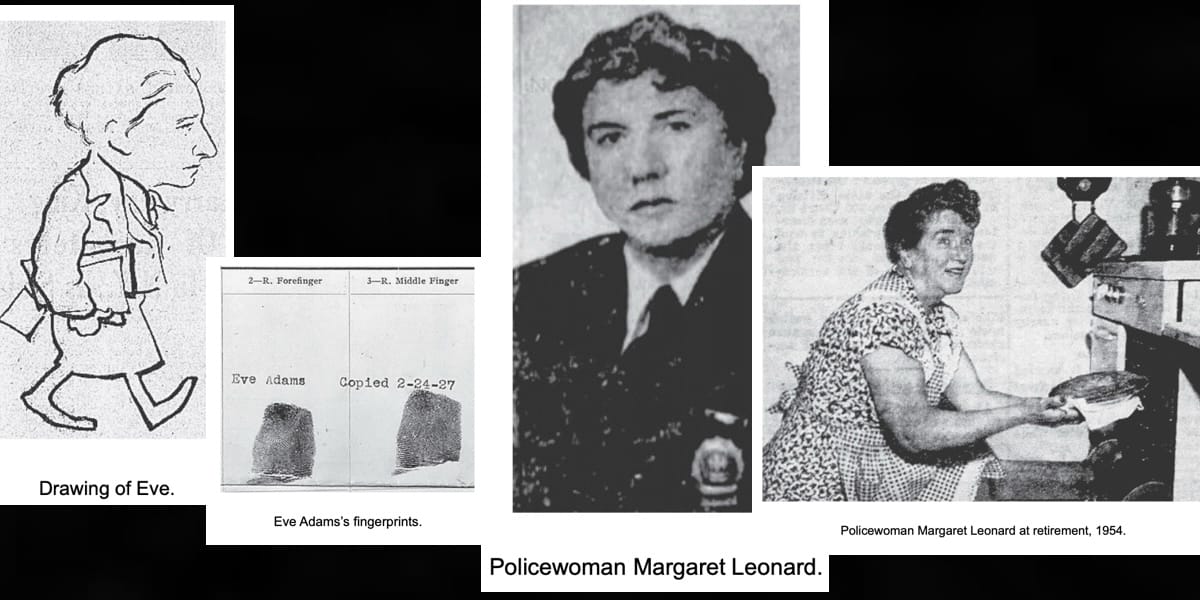
The police in New York City cooperate with the federal authorities. It's clear, and New York City police send in a police woman to entrap Eve. And Eve takes a liking to this woman and asked her to go to the theater, and they go on a date and then go back to Eve's place.
And that night, I believe at 10:00 PM that there's a raid on Eve's place.
Eve is arrested. She's charged with coming [00:06:00] onto the police woman in her room. It says her bedroom. Well, she only had one room, so if you just said her room, it wouldn't sound so sexual.
She's also charged with publishing an obscene book. She has two different trials and is then sent to prison for a year and a half. The federal authorities actually start a deportation hearing, with a transcript. So we hear how Eve responded, in many important ways.
The threat of being thrown out of this country that she had grown to love.
Jack Gieseking - Narrator: It's important to know that when Eve gets deported, one of the people who's instrumental in deporting her is this incredibly annoying, presumably cis, het dude who lives in the area. According to Katz: Fitzpatrick swore he had first seen Eve's quote, illicit relations with another girl end quote, about a year earlier in '24.
And here's Fitzpatrick talking about Eve: I have seen her take girls into her apartment, serve them drinks, and within a short space of time, had the girls stripped and lying on her bed where she practiced her habits as a conen linguist.
Y'all. It moves me that this is so tragically misspelled, C-O-N-E-N, linguist. I don't know what that is, but I'm sure many of us could handle it.
Of course people in this time linked any kind of lesbian sex, any kind of trans sex, any woman who's not having sex with her husband is somehow deviant, wrong, incorrect, broken, and likely involved in sex work.
This is one of the things that propels her out of the country.
Jonathan Ned Katz: I think of her as her early patriot. She loved America and she says that, and she wanted to [00:08:00] make it better. So the authorities, you know, oh, that's subversive. She's criticizing the us. You can't do that. Young j Edgar Hoover, and everyone else in the Bureau of Investigation, the forerunner of the FBI, were out to get her and the various judges and higher ups.
Jack Gieseking: We should also say that after Eva's arrested. She's in prison, there's a lesbian play on Broadway. It's the first lesbian play on Broadway. And she uses that at her case. Yes. She's defending herself.
Jack Gieseking - Narrator: The play that we're talking about here that Eve used for her defense is The Captive. Let me read you the summary :
Irene is a lesbian, tortured by her love of Madame d'Aiguines, but pretending engagement to Jacques. Though Irene attempts to leave Madame d'Aiguines and marry Jacques, she returns to the relationship saying that it is "a prison to which I must return captive despite myself." Madame d'Aiguines is not seen in the play, but leaves behind nosegays of violets for Irene as a symbol of her love.
Now in the 1920s, violets are a coded dyke symbol. Either they were exported from Berlin to Paris or Paris to Berlin, but then they're brought to the United States in this play. Wearing a violet meant that you were a dyke. In fact, last episode, I forgot to say. But the very famous, fabulous Damenklub Violetta that I discussed in Berlin– this club of hundreds and hundreds of, of lesbians and trans folks– was actually named after the violet dyke symbol.
As we also discussed in our first two episodes this season, 1920s and 1930s lezbiqueertransness was marked by these sorts of things, the Eton haircut, the short, short haircut, slicked to the side by wearing a monocle (a single eyeglass), and walking sticks, tuxedos, as well as slacks and short hair of all kinds were also [00:10:00] celebrated Dyke symbols.
Dang, it sounds hot.
Back to our fabulous Eve.
So in the 1920s, Eve is really fair to say, Hey, you're really targeting me in this book about lesbian love.
But Not "Privacy Could Only Be Had in Public"
Because white people are leaving wealthy white areas in order to participate in what is known as slumming in places like Harlem. This is actually where it even starts in the 1920s. Slumming is the idea of going to a place of a different race and a different class and being exotic, being racialized, being sexualized.
These rent parties that I talk a lot more about with Cookie Woolner and Lillian Faderman in the 1920s to 1930s episode are not where these white people are headed to. Those tend to stay primarily black parties. There's also these salons.
Whatever's happening, eve knows that there's a lot of sex going on. It is the jazz age, and when you have something like Prohibition where you try to squash people and you try to limit their agency and their identity, they rise up even harder.
Next Katz is gonna talk about Mae West, a very famous actress that you've probably heard in reference to the quote, Come up and see me sometime, big boy. He's going to say that they're actually two very different people, and he'll explain why, but I think you should think of them as very similar. This is how women who enjoy their bodies and enjoy sex are treated. They're treated as criminals. And if you think this is what happened to white women– and it is important to note that Eve is Jewish, which is not actually a white identity yet in the United States– but this is happening to somebody like Mae West, very famous actress and Eve Adams.
Black women are absolutely being targeted, incarcerated, and treated in more vile ways at the Women's Court down in Greenwich Village. We'll talk more in our 1940s to 1960s episode about the whole history of incarceration located in Greenwich Village. The really fabulous [00:12:00] historian, Hugh Ryan, argues that the Women's Court was really the beginning of bringing queerness and centering queerness in the Village.
The city created a public court where people could view women on display in these court trials, marking them as deviant, depraved, ignorant. And these were really targeting Black women, disabled women, queer women, gender non-conforming women.
Lesbian, bi, queer, and trans history is deeply embedded in and central to the history of incarceration prisons in jails. And we will keep talking about that.
Jonathan Ned Katz: She, yes, she does. Yeah. And in jail she meets Mae West and it's a very unlikely to, two very different people meeting. And she tells Mae West has produced a play called Sex on Broadway and it got closed and I've called up scene as well.
And she spent, she ppent a few days in jail as opposed to Eve, who spent a year and a half. She tells Mae West about what happened to her and Mae West commiserates. It's an amazing meeting.
Jack Gieseking: Yes. It's funny.
Jonathan Ned Katz: Two very different types.
Jack Gieseking: Yeah. So when Eve Adams closed , it's also kind of the same media that happens to every lesbian bar when it close.
It was the best place everyone ever hung out at quote, one of the most delightful hangouts the Village ever had, made it into the paper. Sapphic sisters scram was a headline. There was Discussion of The Boat Boys, and these were butch lesbians who performed oral sex on women. And of course this being a smooth tongue kind of place, also delusional lesbians.
Jack Gieseking - Narrator: The quotes I just read are directly from Jonathan Ned Katz's books, and we can think about the same sort of headlines that we're seeing about why lesbian bars [00:14:00] closed from the 2000 tens through the 2020s.
Notably around the same time Eve's being targeted by the police in this way, gay men are being arrested in cruising grounds of Central Park, known as Vaseline Alley or Bitches' Walk. And that's a wild juxtaposition: men are going out in public space and women can't drink. Our spaces are so segregated gender-wise.
One of the ways to think about this period is through George Chauncey's really brilliant point . He writes that for gay men, privacy could only be had in public. I've always loved this quote. What he means is that two gay men walking into a boarding house together would've been arrested in the 1920s. Why would two men ever need to go into a room alone? What were they doing? Obviously something deemed deviant or evil.
And so this is actually why gay men were going out to piers and waterfronts and into parks, beaches, all these sorts of marginal spaces, these dark spaces with– there's not lighting yet guys, right?– Where they can hook up and hang out. And so gay men, even in the 1920s and earlier than that aren't allowed to have these sort of long-term relationships. But if you think about where women are, most of us are forced into private spaces and we don't meet a lot of each other.
I often wonder how we created these. Ideas of gay men and lesbians. For example, what does a lesbian bring in a second date? A U-Haul. What does a gay man bring in a second date? What second date?
So if we take that joke apart and we think about it a hundred years ago, friends. Actually, there's so many layers when we think about race and class to this, but it's also just worth sitting in: we were socialized into these spaces, by the ways we were policed and gender was segregated. It's a lot to think about.
Jack Gieseking: One thing you said in the book that really struck me too, was in the 1920s, most of these spaces being opened up by Greenwich Village, these small businesses were by women.
Jonathan Ned Katz: Yeah, I was surprised that it was something you could [00:16:00] do: start a small business, a cafe. they were good managers.
Jack Gieseking: Do you think it was also part of post World War I? Do you think that there's some sort of shift where they like have more income or more power?
Jonathan Ned Katz: I'm still learning about this period. I am fascinated by the '10s and the '20s and Eve's context, I think that's so important.
There were bohemian of bars in the village that lesbians went to and gay men went to, and cisgender people went, and transgender people went. So maybe that's a way to think of what Eve's place was like.
She Did It All for Lesbian Love
Jack Gieseking: It's great to even conceptualize: what was the geography? What were your options? What were the possibilities of meeting other queer people? Where would you be recognizable, as a butch person?
Where could you live your life and be seen? What was public space?
She spoke publicly about lesbians and "lesbian love." Her book was titled Lesbian Love.
Jonathan Ned Katz: Yeah. She uses the words as her title, Lesbian Love, she was saying these prohibited words out loud and that was so important. Her book was called obscene.
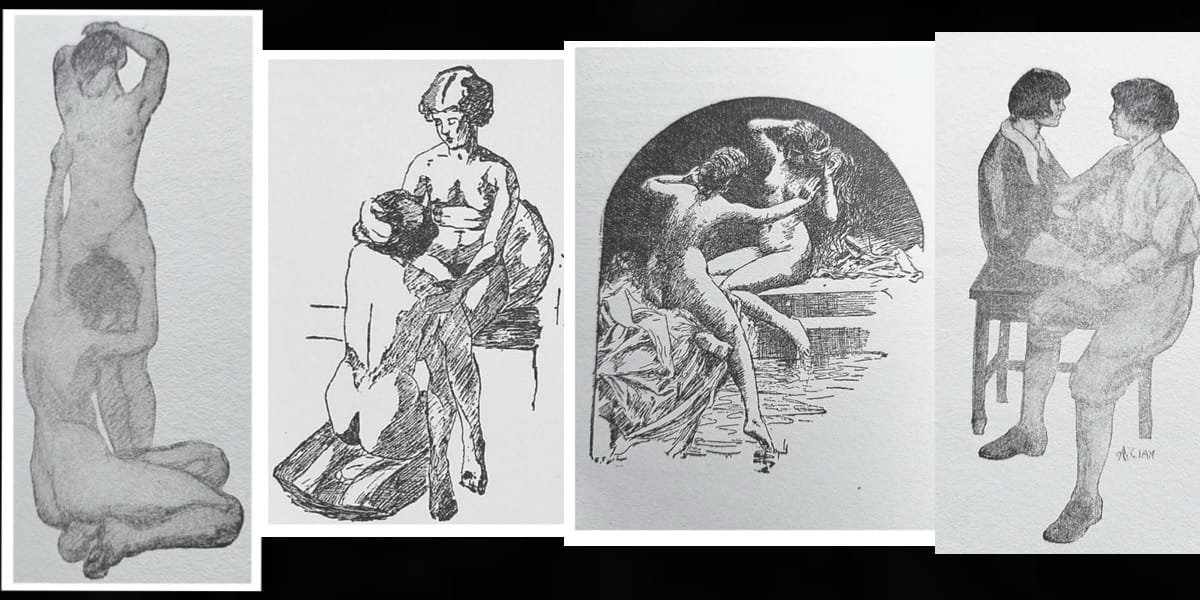
Even the way things were judged in the 1920s, it's wasn't in obscene. There's nothing in it. There are some pictures of naked women with each other, but--
Jack Gieseking: They're drawings.
Jonathan Ned Katz: They're so romantic and not explicitly sexual. Maybe they're naked, but, even that they were out to get Eve.
Jack Gieseking: I feel like you're definitely peaking everyone's interest about these naked images. Thanks. That's great.
Jonathan Ned Katz: Well, okay. Yeah.
Jack Gieseking: Just a another great reason to read this book.
Jonathan in the Early Lesbian Herstory Archives
Jack Gieseking - Narrator: Now we're about to quickly change topic 'cause Jonathan Ned Katz [00:18:00] is gonna talk about visiting the Lesbian Herstory Archives in the 1980s. And I didn't wanna delete this because he's actually talking about going to Joan Nestle and Deb Edel's apartment on the Upper West side.
So when Joan founded the Lesbian Herstory Archives– and god bless Deb Del for letter bringing all that stuff home and then joining in her in the effort to archive all of lesbian history. It was in an apartment on the Upper West side in 1974.
By the 1980s, there was just stuff everywhere. It was overflowing. And that's why dykes started to raise money and eventually bought the space in Park Slope. That's the Lesbian Herstory Archives we know today.
The LHA is on a new fundraiser now because there's been more generations of dykes who need more archival infrastructure.
Also, we're gonna hear all about calling cards as the equivalent of airdrop meets your dating profile. In fact, the first calling cards I ever saw were for lezbiqueertranssapphic people, by lezbiqueertranssapphic people in the Lesbian Herstory Archives. Joan Nestle was actually collecting them at this time that Jonathan is visiting, least one of which was from Mabel Hampton.
Mabel Hampton seems to come up in all of our episodes. Maple Hampton is a Black 1920s Harlem Renaissance dancer who was out for her entire 80- some year old life. She was one of the core people to donate to the Lesbian Herstory Archives. Her collection means so much to so many of us– and she was a huge partier, going to rent parties, pay parties, salons.
Her stories are incredible and so much of what we know from this period comes from her.
Jonathan Ned Katz: I remember early on getting to know them and going to their house and meeting Mabel Hampton and seeing that, oh, they're letting people from all over the world come into their house?? And I mean, I could never do that. But they were able to, their personalities were such that they could deal with [00:20:00] that.
It amazed me that their house was this bigger and v Lesbian Herstory Archives. So finally, you know, they've got this house, which is fabulous.
Take My Card, Darling
Jack Gieseking: You mentioned Mabel Hampton, and I had wanted to ask I thing that I forgot, which is that Eve has a calling card, right?
That she's giving him. Yes. And Mabel Hampton had those, Oh yeah, she did.
Hugh Ryan talks about this in When Brooklyn was Queer. Yeah. That she gives out a calling card. Oh yeah. And that's how she meets her partner. Is this like a butch thing of the twenties and thirties?
Jonathan Ned Katz: Oh, is this just like a, well, she's also getting people to come to her cafe. It's a business card.
Jack Gieseking: Ah.
Jonathan Ned Katz: And also, you know, and the police woman accuses her of coming onto the chorus girls and probably in some cases she was, a combined business and pleasure.
Julie Enszer: I think calling cards become very popular in New York after the Civil War, around the 1870s.
Jonathan Ned Katz: Oh.
Julie Enszer: Because you don't have phones.
Jonathan Ned Katz: Yes.
Julie Enszer: You go visit people you know. It's very much an upper crust kind of thing. Early on you--
Jonathan Ned Katz: Leave your card.
Jack Gieseking: And then you get imitated by the middle and working classes and
Julie Enszer: Yes, yes. Everybody, because that way somebody knows you were there, right?
Yeah. And they can then, then, you know, to expect them the next time you're receiving.
Jonathan Ned Katz: Yeah. She goes to see a play and. Give some of the chorus girls say, up to my cafe. Mm-hmm. And maybe we can go on a date too.
Romance or Money – a Queer Theorist's Interlude
Jack Gieseking: Yeah. There was something else about Eve had hooked up with so many women, like the implication, like her cis guy friends, thoughts of–
Jonathan Ned Katz: There is.
Jack Gieseking: And the odds of having a successful relationship were so much harder at that point, yeah. Many people did succeed in doing that, but yeah. Yeah.
Eve also seems very [00:22:00] fixated in a very endearing way on love.
Jonathan Ned Katz: Yeah. That's interesting.
Jack Gieseking: That's how I was in the, in my twenties, in New York City.
Jonathan Ned Katz: Yeah. Too, even like, too.
Jack Gieseking: Oh, that's sweet, Jonathan.
Julie Enszer: I wasn't. I was fixated on money.
Jonathan Ned Katz: I was looking for romance.
Jack Gieseking: Me too!
Jonathan Ned Katz: So.
Jack Gieseking: And Julie rolls her eyes at us. I was absolutely looking for romance. And then everyone was poly. It was the 2000s.
Julie Enszer: It was like how old was, how old was Eve when she was running each hangout though? She was older than that. So then, she was in her mid thirties . She, she's in her mid, she looking for love? No. Oh.
Jack Gieseking: Yeah.
Julie Enszer: Ah, love schmove.
Jack Gieseking: Oh my God. Oh my gosh. I was still looking in my thirties too.
Jonathan Ned Katz: One of Eve's romantic partners was Ruth Olson Norlander, who was an artist. I suspect that one or two, or all of those romantic drawings are by her. But there's no way to know.
Jack Gieseking - Narrator: When we finished the interview and thought we were done, you know, right after the tape goes off, we actually go back to talking about how we're either a Jack or a Jonathan, or a Julie, whether we're looking for romance or sex or both– and whichever one you are, we're all in this journey together.
The Only Copy in the Village
Next up we get to hear all the juicy details about the book Lesbian Love.
It still moves me that Jonathan finally found a copy after writing for so long about Eve without one near .
Jack Gieseking: Another thing that's absolutely amazing: besides Eve Adams having this amazing life, was where you found the copy of Lesbian Love? 'cause you didn't even have a copy of this book.
Jonathan Ned Katz: Yes, the book, Eve's book, Lesbian Love, is really, really rare. She says at different times there were 150 copies published.
Another time she says there were 200 copies published. One copy that was at the Yale Library disappeared mysteriously the '90s. [00:24:00] So what to do? I needed to find a copy of this book!
So it turned out because Barbara Kahn had done the publicity for her plays, people contacted her who were interested in Eve's story. A woman contacted Barbara and said, I found a copy of Eve's book in the lobby of my building 25 years ago and I picked it up 'cause it looked interesting.
I was able to make contact with this woman and she was very gracious. I took photos of the pages, and I was able to reproduce Eve's book with all the typos and everything. 'Cause that was important because it shows that nobody edited Eve's book. It's a mess of typos and, weird English occasionally. So I insisted on the reprint that they keep every mistake in the original in the reprint.
Jack Gieseking: When I was reading , I did not read that Lesbian Love would be at the end. And I finished reading what happens to Eve-- we'll talk about that in a second. I absolutely started bawling that you had reprinted this. I was so moved. I was so touched that this work exists that I would get to read it because I'm dying to like, know what this was like.
Jack Gieseking - Narrator: Let me be profoundly clear: Jonathan reprinted the book Lesbian Love, which was clearly out of copyright, in his book. So you too can read Lesbian Love and even as I talk about it now, it makes me emotional to know that we all have access to this book too, that it wasn't lost.
Eve in Paris
Now many things are gonna get sad and hard and we'll come to the end of her life in a few short years. Yeah, that's a record scratch and WTF is gonna happen to our dear Eve.
Jack Gieseking: That this woman is deported and in how she lives her life and acts and that [00:26:00] it gets to be printed again. That it lives again is amazing. I'm really grateful that you did that.
Jonathan Ned Katz: I too have feelings about Eve.
I feel like she got to be a friend, a deep friendship kind of feeling, as I did all the research on her. She was such a character and lively and active. I think that's what it's important to stress: her daring, daringness.
Jack Gieseking: Yeah. Mm-hmm.
She is deported to Poland . Escapes, gets out of Poland as, as a Jew it's horrible at this point in the late 1920s , gets herself to Paris where she befriends--
Jonathan Ned Katz: Henry Miller and Anias Nin.
Jack Gieseking: As you do, hanging out.
Jack Gieseking - Narrator: But before we go ahead, you're gonna need to know who Henry Miller and Anias Nin are. So Henry Miller and Anias Nin are very famous authors. It's worth knowing that Anian Nin financially supported Henry Miller, that he was still married to his wife, June, who Anias Nin also had an affair with. Anias Nin wrote very dirty, fabulous, sexy books, which in the 1990s we passed around all the time.
Jonathan Ned Katz: She sells their books and she makes a living selling these-- they were thought of as dirty books. You couldn't buy them in the us so people who spoke English had to go to Paris to buy copies. Eve made a living, she was able to make a living by going around to the cafe and say, I have these books. It's a great story. Yeah. So she becomes quite close to Henry Miller.
Jack Gieseking: She falls in love.
Jonathan Ned Katz: Yes. She meets a woman who had just arrived in 1927, from Türing. She was a singer and made a living as a [00:28:00] singer. Hella Olstein is her real name, Jewish name, and she sang under a different, non-Jewish sound name. Nora Warren was her singing name. So they meet and they are together for about 10 years. It's some kind of deep intimacy.
There's no evidence of exactly what kind of relationship, which bothered me. I wanted to know, because I'm a nosy historian of sexuality and gender, and I wanna know what people did. And felt. And how they thought of themselves, how they judged themselves, what other people were saying about them, how they were being judged. All of that is what I study.
So they were together and then the Nazis invade in 1940. And they're in Paris.
So all the anti-Nazi people and Jews flee to Niece, which was briefly under Italian control. And the Italians, apparently, didn't have as harsh an antisemitic policy. But they– it was much better than being around the Nazis.
The End of Eve's & Hella's Lives but Never Their Living
For three years, Eve and Hella were able to evade arrest by the Nazis. Until finally, the Nazis caught up with him and I guess discovered that Hella had a Jewish name, under her singing name.
And Eve probably didn't go outta the house much during [00:30:00] those three years. So Hella was making a living singing and supporting both of them. That's really important that she was singing in some cases probably before Nazi officers. It's really weird to think about that. It must have been terrifying. And it was brave, very brave. And she must have been afraid, of being found out to be Jewish.
Jack Gieseking: That this woman is deported and Will, will, will soon lose her life over this book and over everything she believes in.
Jack Gieseking - Narrator: I just wanna sit here with Eve, with Hella, with you. We too are in this moment of rising authoritarianism and fascism, and I'm sure many of you're thinking: What is life? Well, this was recorded in 2024, Jonathan, Julie and myself were very much in tune about what was about to happen.
Today we're seeing our immigrant sisters, brothers, and themsters disappeared, and those who stand for justice exiled from higher ed, from jobs, being haunted and hunted. But we are not alone, and Eve was never either.
Jonathan Ned Katz: They are finally arrested by the Nazis. And they are taken on these horrible, horrible train, which is overcrowded and not enough food. Not enough places to go, any place to go to the bathroom except some pot and for a whole crowded– they were cattle cars.
Jack Gieseking: Mm-hmm.
Jonathan Ned Katz: And, then they're taken to Auschwitz, where they die.
So there is this terrible, terrible ending to Eve's story. And we certainly need to recognize that and talk about it.
And yet, I say in the book that I don't think Eve would want to be [00:32:00] remembered only as a victim. She was a victim of the Nazis, but that's not her whole life.
She was this really active person, the agent of her own life– until finally she wasn't the agent of her own life. I think it's important to say that.
Jack Gieseking - Narrator: What a loss. What a queen. What a king. What a reminder in this era to feel invigorated, to live, to embrace the very gay quote from Auntie Mame that I love: live, live, live life as a banquet and some poor suckers are starving to death.
And Eve didn't just lived, she lived for justice.
Jewish Dyke Genealogies
So let's get back to Julie, who brings us around to our imagined queer ancestors and how Eve makes so many of them real for Jewish lesbians.
Julie Enszer: One of the things I just love about this book is it feels like it gives a genealogy, to kind of radical Jewish lesbians. Where I feel like there's different literary genealogies, maybe Muriel Rukeyser.
There's lots of that, but Eve seems so early and not only so early, but also just so embedded in an activist genealogy.
Jonathan Ned Katz: There were lots of Jewish--
Julie Enszer: Yes!
Jonathan Ned Katz: Women were involved in the anarchism and the Lower East Side was hopping. I think of the parties at Emma Goldman's on 13th Street.
Julie Enszer: Yeah. And the '70s Jewish lesbian writers, novelists like Elana Dykewomon are imagining lesbianism among these groups of young Jewish immigrants who are doing union organizing and all of this. And then, but Eve seems, through your book, because you trace it as a historian, the missing piece that they were all wanting to create when they were writing their imaginative work.
Jonathan Ned Katz: Yeah. That novel is really [00:34:00] interesting.
Julie Enszer: Beyond the Pale.
Jonathan Ned Katz: Beyond the Pale, yeah.
Julie Enszer: So, and that's one of the wonderful things that I was speculating in an article I'm working on about black lesbian periodicals, about Eve's book, Lesbian Love, you found it and brought it to us. And I was speculating: maybe there are things in the archive or out there in the world created by black lesbians. There have been black lesbian periodicals being published pretty consistently since 1979.
Jonathan Ned Katz: Mm-hmm.
Julie Enszer: But there's not earlier ones. I'm hoping that your book inspires other archival findings like this.
Words & Queers We Don't Even Know Exist Yet
Jonathan Ned Katz: Yes. I do think that there are other remarkable, undiscovered queer people, lesbians, gays, trans, bisexual. There's just so much more research needs to be done. I think there are others. They're out there someplace.
Jack Gieseking: It's so right too. ' cause they have to exist. They always existed.
Jonathan Ned Katz: In some form.
Jack Gieseking: In some form, yes. Yeah. Yeah. And words we didn't even know yet. And so many words that won't exist yet for us.
Jonathan Ned Katz: Yeah. The words will change.
Jack Gieseking: All the time.
Jonathan Ned Katz: Yes, yes.
I have a hypothesis that by mid- 19th century, people, men in particular, but maybe women too, men around Walt Whitman. The working class network that he was in touch with, especially had a consciousness of– somehow they were– I had no idea what they called among themselves. It hadn't come down to us.
But I have a hypothesis that they had some names for it. There's some amazing work on 19th- century sailors who were with [00:36:00] other men on ships. And they had all these different terms for doing different sexual things. Going chaw for chaw, was mutual masturbation. So they, oh, we're on a ship. Well, we have, there's no women around. So, that was their excuse, you know? And of course some of them were publicated.
That's a little example where some terms have come down, have been reported to us. I would love to put together everything that we know, make a list of all the evidence we have from the 19th- century. Just, it's a grand project, but I'm thinking about it.
Jack Gieseking - Narrator: Which reminds me again, I really wanna be clear that the word butch doesn't really happen till the 1940s. It's not something Eve would've used, but it is another way to understand her as an agent of her own life.
Maybe Eve was trans, maybe Eve would be a dyke, maybe Eve would be queer, non-binary. Goddess knows what words we'll create next, but they got to change their name as many did, and they clung to it.
And most importantly, they defined and were definitively themselves. That was the core of Eve.
Jack Gieseking: You say at the end of the book what she would say, don't mourn, organize. I love that.
Jonathan Ned Katz: It's from a Joe Hill song. It's a phrase that I grew up hearing, I grew up with a left, his father and I listened to left folk songs and that's one of them. Joe Hill says: get political. Organize. Mm-hmm. Get together with other people, do something.
It's like what we need to do now. Something, some way of expressing art. Situation. This frightening, frightening present situation that we're in with a real threat to democracy.
I lived through the McCarthy period. This is more scary to me ' cause it's more total [00:38:00] and the threat seems more totalitarian as a takeover of this government. It's really terrifying to me.
Jack Gieseking: It is to me, too.
Julie Enszer: Yeah. Me, too.
Jack Gieseking: One of the quotes that you used that she says is, that she writes Lesbian Love to show them the truth of their lives, talking about these women's lives. And I just think. you did a great job by Eve too, showing us the truth of her life. So thank you. And thank you for talking to Julie and I a gift.
Jonathan Ned Katz: Yeah, it's fun.
Jack Gieseking: It's fun. What an amazing person. She gives me agency to, to act against authoritarianism too.
Julie Enszer: Yes, yes, yes.
Conclusion & Credits
Jack Gieseking: Yes. Fantastic. Yes. Okay. Jonathan, do you have anything else to say, sweetheart, before I hit stop?
Jonathan Ned Katz: I said a lot. Yeah.
Jack Gieseking: Okay. We all did.
Julie Enszer: Yes. It's gonna be great. Thank you. It's gonna be great.
Jack Gieseking: Thank you. Thank you.
Julie Enszer: Thank you. Thank you.
Jack Gieseking - Narrator: Indeed. Thank you listeners. I hope you've really enjoyed this exploration of the beautiful, tragic, brilliant, extraordinary, and not a victim life of Eve Adams.
Head to 129 McDougall Street in Greenwich Village, New York City, if you too would like to see where the magic happened and touch the fireplace and andirons of olde.
In the meantime, we're gonna share tons of photos about Eve and her life on our Instagram at @ourdykehistories.
Have a terrific day and enjoy living your life the way you want to too.
Thanks for tuning into Our Dyke Histories in collaboration with Sinister Wisdom.
Follow, support, and connect with me Jack Gieseking via my newsletter at ourdykehistories.com. And connect with us on Instagram and Facebook at @ourdykehistories. All this is where we pack everything we could fit into this podcast!
Our Dyke Histories is run by a queer, dykey, and mighty team.
ODH is hosted, edited, and produced by Jack Gieseking, co-produced and co-edited by Cade Waldo, co-edited by Mel Whitesell.
Our social media manager is Audrey Wilkinson, and our fabulous interns include Michaela Hayes, Sid Guntharp, Paige LeMay, Sophie McClain, and Sarah Parsons.
Our theme song “Like Honey,” was graciously gifted to us from Kit Orion who you can find at https://www.kitorion.com/.
We're forever grateful to Julie Enszer, director of Sinister Wisdom. Publishing since 1976, Sinister Wisdom recognizes the power of language to reflect diverse, multicultural lesbian experiences, and to enhance our ability to develop critical judgment as lesbians evaluating our community and our world.
We share Our Dyke Histories so we know more about who we are, how we were and yet could be, and who and what we fight to never forget.
Lez keep doing it, y'all.