Reading Guide: Eve’s Hangout, Greenwich Village, 1925

Welcome to the second installment of the Dyke Bar* History Reading Guide Series! We begin with a dyke urban legend:
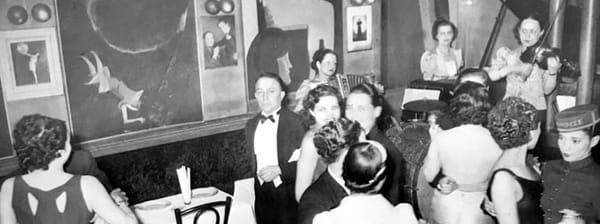
Lesbians managed several of the speakeasies there in the twenties. The most famous of the lesbian proprietors was Eva Kotchever, a Polish Jewish emigre who went by the name Eve Addams (also spelled Adams), an androgynous pseudonym whose biblical origins her Protestant persecutors might well have found blasphemous. Called the "queen of the third sex" by one paper and a "man-hater" by another, after the police crackdown of 1925 she opened a tearoom at 129 MacDougal Street that quickly became popular with the after-theater crowd. A sign at the door announced "Men are admitted but not welcome." -George Chauncey
Since the famed historian George Chauncey wrote these lines in the truly delicious Gay New York in 1992, the famed (and likely apocryphal) story of sign hanging in Greenwich Village that read “Men are admitted but not welcome” has circulated all the more widely. It remains one of our favorite urban legends of queer history.
But its imagined presence gestures to something real: Eve’s Hangout was the first recorded, proto-lesbian bar. In fact, Eve Adams' famed tea room was the first proto-lesbian bar in 1920s Greenwich Village, in NYC, and in the U.S.
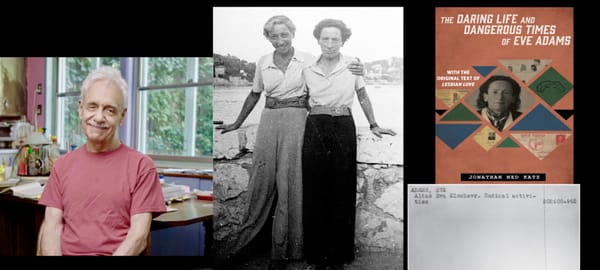
Katz's book pays special attention to discuss her self-publication of Lesbian Love – arguably the first lesbian community study in the U.S. While only 100-200 copies were ever printed, Katz luckily came upon one and was able to republish the entire short, 60-page text. At the time, the idea of lesbians claiming love was beyond radical!
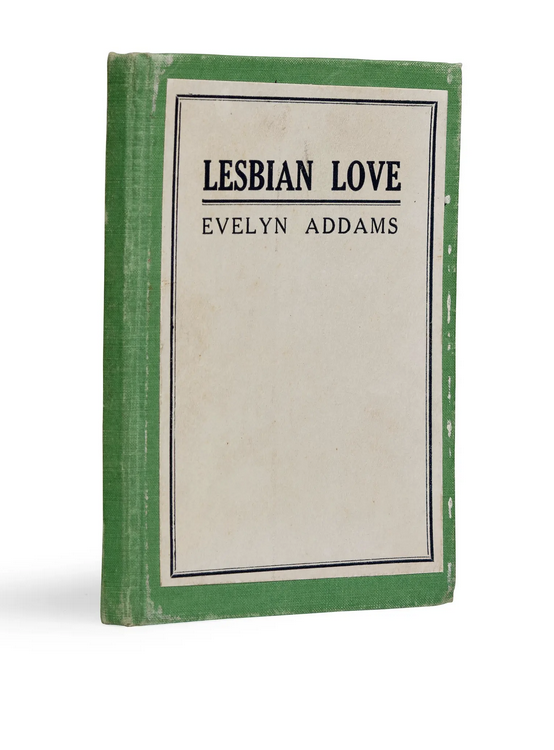
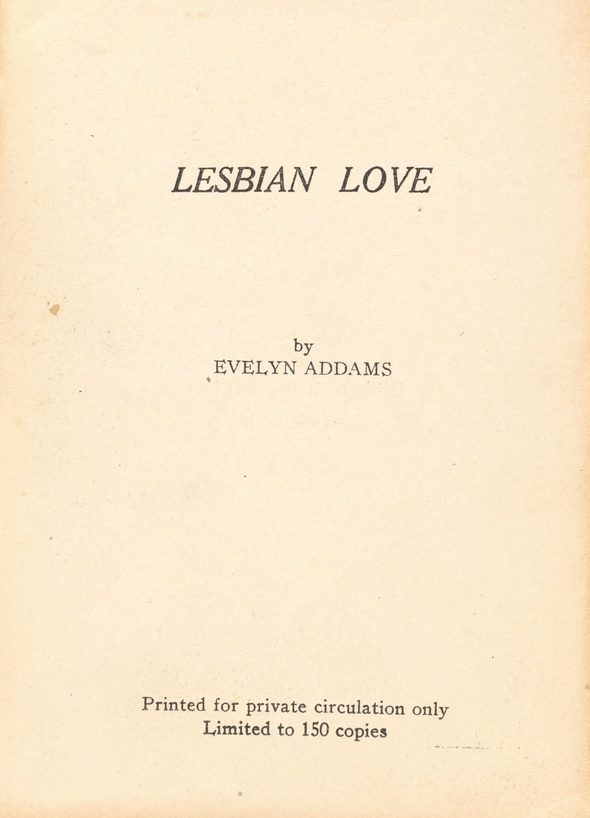
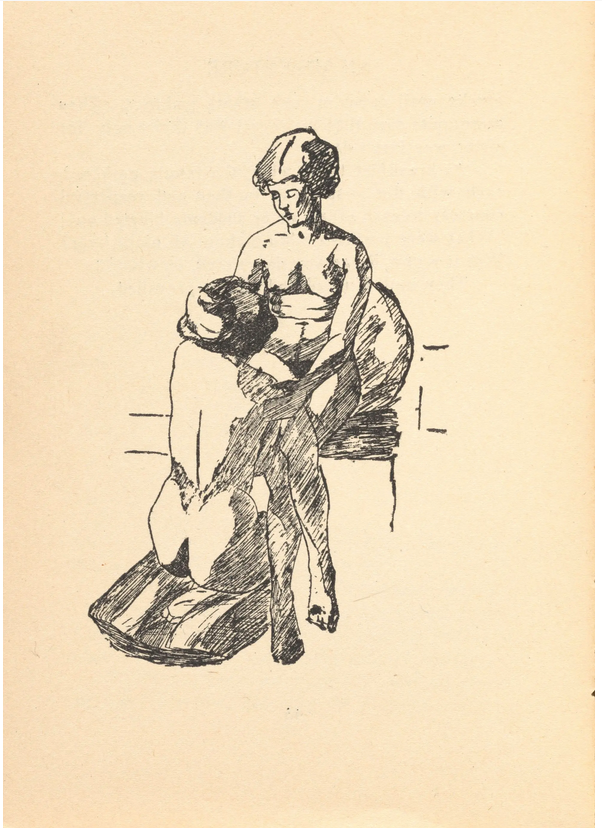
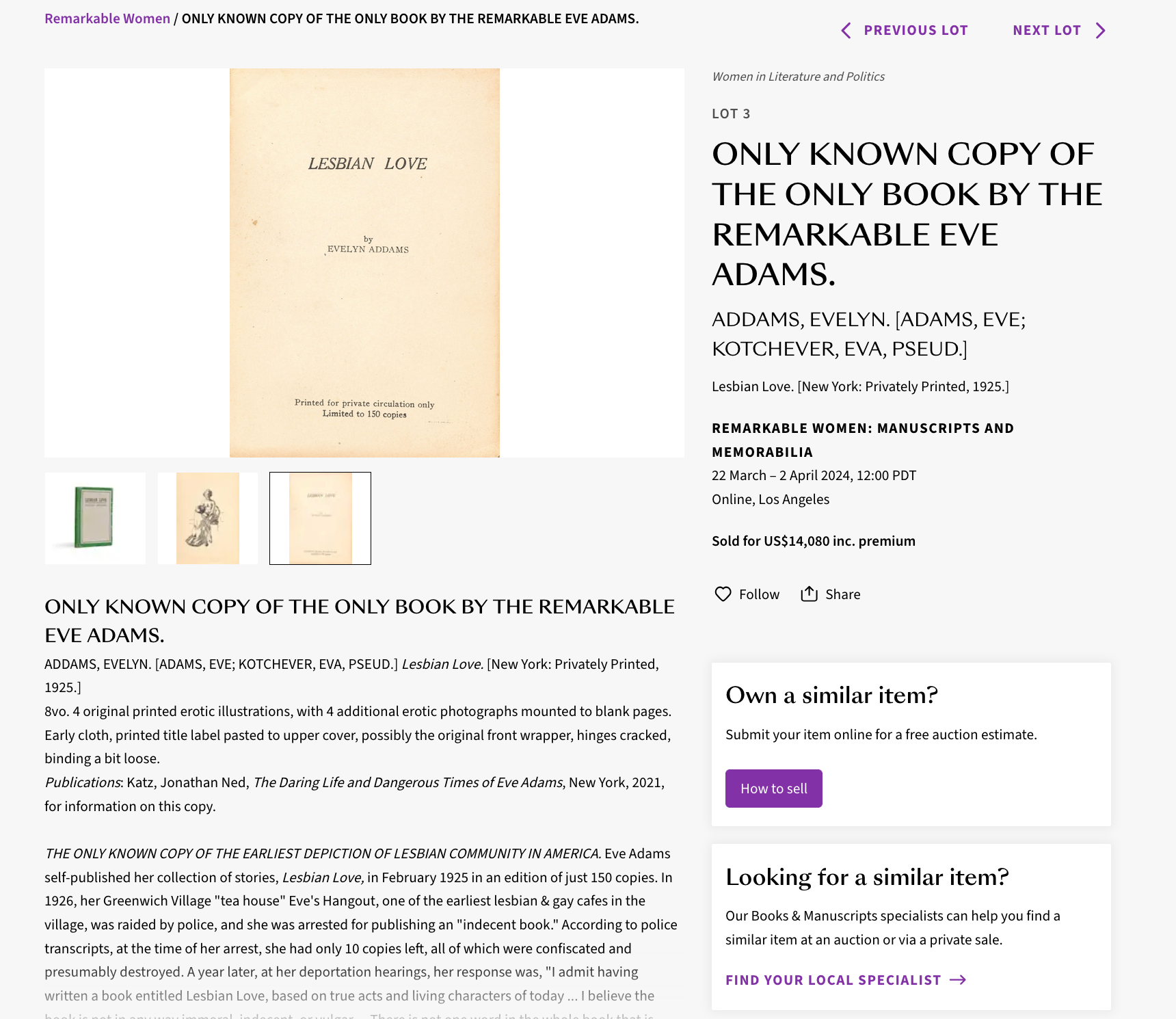
Images from the only remaining copy of Eve Adams' Lesbian Love and its auction which recently sold for $14,080USD.
And the book totally discusses bars and parties that are the focus of the first season of Our Dyke Histories! Here's Eve describing a tea room of her experience:
There was a scene in a little rendezvous tearoom, late after dinner hour, where six or seven girls had gathered. One lone man sat silent in a corner. Whispers and love sonatas could be heard among the group of girls—occasionally laughter. The atmosphere felt heavy— the man was intruding. . . . At closing hours he finally left.
They all, as one, threw up their hands: “Thank God, he has gone!”
May, the proprietress, known as Jim, suggested that Sara play the song she had composed for Ann. They all joined in the request.
With the windows shut tight, a dim candle light flickering, and, here goes the song:
“I love to have parties with you,
I know it’s not right, but I do!
Day and night, night and day, etc. etc.”
They all joined in the chorus—the song went on.
Jim smiled and the girls roared. She got a kick out of the song. It appealed to her greatly.
The song is full of passion and pictures before you, two nude girls, in ecstacy [sic] of love, fondling and kissing each others [sic] breasts, murmuring words of love.
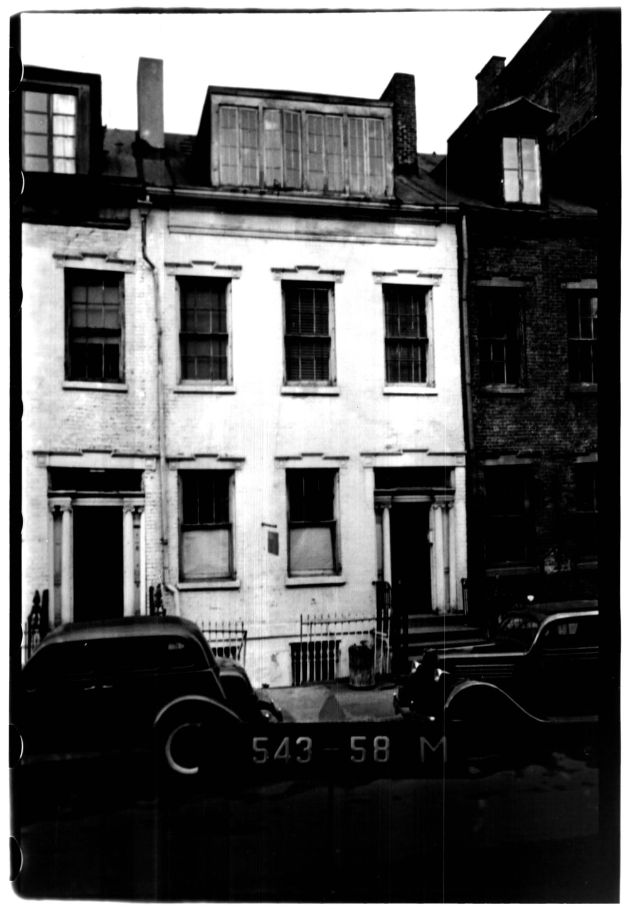
Beyond Eve's own words, Katz's book digs into her creation of a space that gathered artists, poets, theatergoers, and queer women. Eve’s Hangout a social space: a room where non-normative desires, Left politics, and gender variance could coexist. Because she offered a “setup” — the non-alcoholic elements you’d mix with the flask in your pocket–she even survived alcohol. Although, like today, you might have just gone in for the tea. Given the segregation at the time mixed with Eve’s radical politics, these were likely primarily white people, and working-class Leftists at that. There was also a plethora of theater folks as the next door - and still standing! - Provincetown playhouse was as gay then as it is now.
You can listen to two episodes of the faboo Katz chatting with me and Julie Enszer, Director of Sinister Wisdom, on Our Dyke Histories here:
- Tea, Anarchy, and the First Dyke Bar: Eve’s Hangout 1925 with Jonathan Ned Katz (Part 1 of 2 with Katz)
- Books, Bulldaggers, and the Birth of Lesbian Research with Jonathan Ned Katz & Julie Enszer (Part 2 of 2 with Katz)
To complement the launch of the Our Dyke Histories podcast, co-produced in collaboration with Sinister Wisdom, I put together a reading guide with my interns Michaela Hayes, Mel Whitesell, Paige LeMay, Syd Guntharp, and Sarah Parsons. A shorter version of this post was originally published with the Sinister Wisdom Blog, 3 Jan 2026. This post was expanded by the lead author.