"Tea, Anarchy, and the First Dyke Bar: Eve’s Hangout 1925"
Meet the wonder of Eve Adams. The lush transcript from S1E3 of Our Dyke Histories.

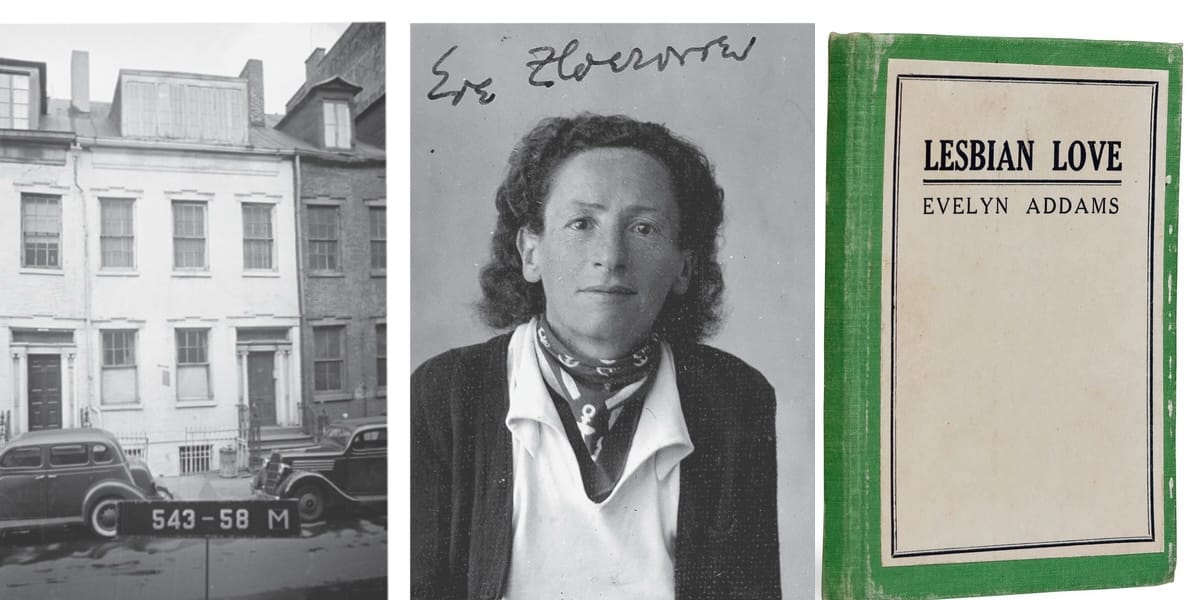
In this episode of Our Dyke Histories, we meet and follow the extraordinary life of Eve Adams. She was not just as a queer visionary and tea room-keeper, but as an author who wrote one of the most astonishing—and nearly lost—documents of early lesbian life: Lesbian Love (1925). Along with Sinister Wisdom Director Julie Enszer, I interview Jonathan Ned Katz to unravel the story behind this rare, self-published text that captured the voices, humor, desires, heartbreaks, and contradictions of the women Eve knew. We explore the political risks she took in writing it, the community that made the book possible, and the state forces that tried to erase it.
Introductions
Jack Gieseking: Okay, so recording with Jonathan Ned Katz and Julie Enszer here, And I'm Jack Gieseking. We want to talk to you today about Eve Adams, who I love.
Julie Enszer: I do too.
Jack Gieseking: And, whose story I love to tell everyone I talk to now. This person, Eve Adams, was really popular in the 1920s. She was, mythologized, as you say, multiple times throughout the book. We're especially interested in talking about Eve Adams because she opens this kind of bar, Eve's Hangout .
It's such a long, powerful, amazing life.
Jonathan Ned Katz: I too have a lot of feelings about Eve. She was such a character. That's what it's important to stress: her daringness.
Welcome to Our Dyke Histories. I'm your host, Jack Gieseking, historian, geographer, and environmental psychologist. We dive into the past and present of lez, bi, queer, trans, sapphic, nb communities, decade by decade in collaboration with multicultural, lesbian, literary and art journal, Sinister Wisdom. This season, we're all about dyke bars* with an asterisk: lesbian bars, queer parties, and trans hangouts-- the structures that made them necessary, the lives they made possible, and the worlds we made from them.
Our Dyke Histories come for the history, stay for the revolution, gossip and desire that built us.
Jack Gieseking - Narrator: "Daringness," indeed. In our opener, you heard me, Jonathan Ned Katz, and Julie Enszer. Katz is the grandpappy of LGBTQ history, one of them, and Julie is the director of Sinister Wisdom.
They're incredibly brilliant historians and scholars of LGBTQ lives, and we met in the summer of 2024 to talk about his book, The Daring Life and Dangerous Times of Eve Adams.
Eve was someone who personally knew Anias Nin, Emma Goldman, and Mae West. She was targeted by J. Edgar Hoover, himself. She lived from New York to LA and San Francisco, from Mława, Poland, to Paris. She made her living as a dirty and/ or radical book salesperson -- and a tea room owner.
And that tea room is what we might call the first proto lesbian bar in Greenwich Village in New York City, and even the entire United States. It's gonna help us understand why we think of Greenwich Village as such a hallmark of lezbiqueertrans-ness. Not just Stonewall guys.
And on top of it, Eve was a hunk. She was a Jewish immigrant who demanded a better world because she [00:02:00] believed in the idea of radical democracy.
It's the hundredth anniversary of Eve's Hangout here in 2025, and also the hundredth anniversary of her book, which was the first lesbian community study in the United States, if not the world.
As a heads up, this is part one of two. There was so much to say about the amazing life of Eva Adams that our chat cup runneth over.
So let's dive in.
Content Warning: we're gonna cover topics common to adult career life, including authoritarianism, fascism, deportation, and policing.
Finding Eve All Over Again
Jack Gieseking: How did you come to find Eve? You've been doing LGBTQ history research for so many years, and then why Eve?
Jonathan Ned Katz: I was reading a New York Times review of a book of women who had affected New York City history. It was in end of 2016 and there was a mention of Eve publishing her book and getting in trouble and I didn't remember a thing, reading anything about her. And I remember lots of stuff about this history that I've been studying since the early seventies.
I started to see what was available about Eve Adams and I discovered a playwright. Barbara Kahn had written a couple of plays. So I contacted her. Turned out she had done lots of research and had the help of a gay male archivist and librarian, and they had together found a lot of material, so that was fascinating to me. I had to convince Barbara that I was on the up and up, and I was gonna do justice to this person, Eve, who Barbara had come [00:04:00] to love too. That was the beginning of the research .
Jack Gieseking - Narrator: Barbara Kahn is a multi award-winning playwright, director, and actor. And two of the plays she wrote and produced are about Eve. That's why she was such an expert for Jonathan to find.
Next you're gonna hear Jonathan and I talking about the title of Eve's tea room because when we think about sources that don't exactly line up.
Was the team room called this or that? I'm sure you know of a party or a place. You can't exactly even remember the name, or your friend spells it differently, or swears it was on a totally different street or neighborhood.
So here we go.
One of the U.S. First Proto-Lesbian Bars
Jack Gieseking: We're especially interested in talking about Eve Adams because she opens this Eve's Hangout.
Do you personally call it Eve's Hangout? Eva Adams' place. What, what do you call her tea room?
Jonathan Ned Katz: E Eve's Hangout, I call it.
Jack Gieseking: You call E's Hangout.
Jonathan Ned Katz: That seems to be what she called it. I gather that's how she named it.
Jack Gieseking: How do you describe Eve Adams to people?
Jonathan Ned Katz: That she was an early lesbian activist. She was also associated with Emma Goldman And, was a leftist, of some kind. I think she picked up anarchist ideas, socialist ideas, and she made a living, selling radical periodicals and traveling around the country doing that.
Butch Anarchism
Jack Gieseking: As a hoboette?
Jonathan Ned Katz: Yes, a hoboette, that was one of the journalistic names that she was described as. It's the only time I say in the book that anybody categorized her as femme in particular.
Julie Enszer: Oh, she was butch?!
Jonathan Ned Katz: Yes, definitely. Have you seen,
Jack Gieseking: oh my god, she's such a hunk. Yes. Oh
Jonathan Ned Katz: Yeah, yeah. She's butch.
Jack Gieseking - Narrator: Whoa. I mean, I thought she was butch, but I didn't get that from the [00:06:00] book. This is a bit of hot gossip we're only dropping on this episode. If you take a peek at Eve's passport photo online, she is so freaking cute. She's got an ascot, this incredibly curly hair, piercing eyes. She's just gorgeous.
But you might not use the word butch in the 1920s. These are words that are still being formed or confused, maybe bulldagger is a word we would've heard more often. If you listen to our other '20s and'30s episode, we talk about the Bull Dyker Blues or the BD Blues that came out in that era. That kind of language was really popular in the songs of the blues and all sorts of codes about wearing masculine clothes, wearing slacks, having short hair. Among queer folks at the time, it was popular, particularly in blues songs from people like Ma Rainey, Gladys Bentley, and others.
So Jonathan also mentions Emma Goldman and Alexander Berkman coming up next. These are probably like the grandma and granddaddy of radical anarchist thinking. They were immigrants .In the United States, and Emma Goldman's by far the more famous of the two. While she never said the exact words, this famous quote is still associated with her: if I can't dance, I don't wanna be part of your revolution.
Jonathan Ned Katz: It's because of her connections with Emma Goldman and Alexander Berkman who put out this anarchist journal, the forerunner of the FBI gets on Eve's case. And it's an example of the state just coming on to anybody that was a social justice activist. She, that's what she was. I call her a democracy activist.
They watch her in different cities and report to each other that she's a friend of Emma Goldman's and they track [00:08:00] her, they interview her once, actually. And so she knows they're on her tale and she wants to do her own thing.
I think she loves the freedom that she is experiencing in the US so much that it doesn't seem possible that something terrible could happen, that they would really come after her and try to get rid of her. Although she saw Emma Goldman being thrown out of the country; um, alexander Burman was thrown out of the country. Batches of, they were called aliens, especially people who had immigrated and then not gotten citizenship so they didn't have citizenship rights. People she was friends with, you know, anarchists: why do we need our citizenship? That's government approval, right? So what do I need that for?
So I think there's that spirit of just, I'll do my own thing, right?
Jack Gieseking: Right.
Jonathan Ned Katz: Eve. I think of her that way.
Censoring Lesbian Love
Jack Gieseking: And then she writes a book, which you say is the first lesbian community study in history .
Jonathan Ned Katz: Yes. Her book, Lesbian Love she published in February 19 25. And it was groundbreaking. There's nothing like it. She was very, very daring.
I call it a community study. It's sort of based on her memories of various women so It's a collective portrait of different lesbians she encountered in her life.
Jack Gieseking - Narrator: If you read this tiny book, I mean it's just a few dozen pages, you will definitely think that Eve, quote unquote, encountered these women. Sometimes it reads like an L Word drama. [00:10:00] It's brief, but just juicy enough.
When we think of the 1920s and 1930s, we're often thinking of the fabulous jazz age, but the period was also filled with intense conservatism. To quote historian Mark Stein the police felt empowered to harass, abuse, and deprive basic protections to gay, lesbians, and others engaged in same- sex sex."
And the reason the 1920s are gonna change is not only because of medical reformers, leftist organizers including anarchists, libertarians founding things like the wonderful American Civil Liberties Union or ACL U, as well as commercial establishments standing up for the LGBTQ people who frequented them.
There's also the first queer magazines and books being published, often with a great deal of censorship, and there's tons of media about us being deviant, dark and diseased, depraved, blase, ignorant, and fearful.
But this means words like homosexual and lesbian, gay are in the news and someone can find out who they are. And with the spread of places and information, more people could recognize their desires and beings as queer. We had language, we had geographies of existence, even if it was often portrayed depressingly and violently in the mainstream cis-het press. We can see how this is still going on today.
Okay, back to it.
Jonathan Ned Katz: A couple of them sound very much like her. One of them, especially at the end, it's an autobiographical piece. Actually I thought the best written and most deeply felt pieces. . She doesn't identify herself as the author, but it's clearly a different kind of piece.
Jack Gieseking: Yeah, and she's this Jewish immigrant, butch dyke. She's claiming lesbian and she moves throughout the country quite a bit, and in New York she takes up with all these amazing people. And it's J. Edgar Hoover, who [00:12:00] actually deports her?
Jonathan Ned Katz: Yes, yes. The very, very young J. Edgar Hoover gets after her.
It's a whole government conspiracy against her. And not only her, but a whole batch of, uh, early social justice activists that happened to be immigrants and some who weren't immigrants who were jailed.
Jack Gieseking: It's the precursor to McCarthyism and how queerness and transness and gender nonconformity are wound up in that too.
Jonathan Ned Katz: Some were, all kinds of bad things happened to them. Debs was put in jail. SCO and TI were executed. And recent evidence shows they weren't associated in the murder they were supposedly executed for.
Jack Gieseking - Narrator: Ugh. J Edgar Hoover. What a bummer for queer history. He was a vicious targeter and jailer and deporter of all people deemed un-American in his eyes, which were largely people who weren't white, Christian, cisgender, heterosexual, and into some version of democracy that propelled the wealthy and the elite. Now while Hoover's transvestism is a total myth, the parallels today to social justice activists being jailed or immigrants being deported is absolutely true.
Surveillance Culture for All Eras
We're about to jump into Katz's parallel to the McCarthy era.
We talk about this a lot more in the '40s and '50s episode, but Joseph McCarthy created a fake list of people he said were communists in the government. And this grew to include communists and homosexuals.
Eugene Debs, who Katz names, was one of the founders of the Industrial Workers of the World, just the major labor movement and the Socialist Party of America. Sacco and Venzetto were two Italian immigrants falsely targeted and executed for armed robbery. We can definitely think of [00:14:00] parallels to our day even now.
Julie Enszer: i'm always curious to ask people who lived through the McCarthyism in the '50s and then Reaganism in the '80s, what's your kind of sense of the time that we're in as it compares to those times and the types of threats you experienced, particularly as a gay man?
Jonathan Ned Katz: Well, as I said, it's-- this is scarier than the McCarthy period. That's how I experience it.
My father was a communist. The FBI came to our house. I later wrote for my file, and here is an exact quote of what an informer said: Jonathan Katz leaves his house early every morning with what appeared to be school books. I was going to City College, so they really were school books. They weren't atomic bomb secrets for which I had no access.
It's both hilarious and totally scary that I was a victim of the surveillance state, which has only gotten more surveillance status.
This is scarier nowadays. It seems more threatening. 'Cause it's about a takeover of the whole government. It's not just one crazy right- wing person like McCarthy and a few others.
Jack Gieseking: Yeah. I-- There's a great interview with Chelsea Manning and she talked about having, an unplugged microwave and she had everyone put their phone into it. Because it creates a Faraday cage so the signal can't get out. So you can actually talk quietly. And it was really inspiring to me to think about for all this work about lesbian bars and queer parties and trans hangouts and bi shindigs. Like where can we actually meet? Before people organize or before people have an [00:16:00] event, they're being shut down and they're being targeted.
Jonathan Ned Katz: Yes, yes. This is more people. It's not an overstatement to worry about the fate of democracy in the U.S.
We're at this critical point, you know?
Julie Enszer: Mm-hmm.
Jonathan Ned Katz: Yeah.
Jack Gieseking: Absolutely.
Jonathan Ned Katz: Mm-hmm.
Julie Enszer: And so, but you didn't feel that way when Reagan was elected?
Jonathan Ned Katz: I was in the closet until, and I wasn't-- well, I was sexually active, but I was in the closet publicly until the winter of 1971. It was not clear in the early '80s that people in academia were gonna continue this research and so I made a decision not to get involved in ACT UP, and to go on and publish Gay Lesbian Almanac in '83. I mean, people died that I knew.
Also, i've been thinking about trans history and how my views have changed and how I evaluate the work now.
I had a very essentialist view really. to just start with that there were gays in the early American colonies and there were gays in Greenwinch Village in 1976. It just didn't capture the huge diversity over time and social context.
Jack Gieseking: It matters so much to hear someone who you read and who you admired and who you were taught in college to say, actually, I had to revise my thinking, I learned from this.
When Queer History Was First Written
Julie Enszer: But the moment of even suggesting that they were with-- even without thinking about that context, i'm always telling students how bold and transformative the assertion was. Like, we may have found out it wasn't fully accurate, but to [00:18:00] make that assertion in that moment was revolutionary.
Jack Gieseking: Yeah. And I found your book in the '80s. I was 10 when I found it, I was like, oh, we've been around forever. I was afraid to touch gay books, but that we existed? And it was a really big book and that mattered. There was a lot of us, right? Like the, the thickness of Gay American History.
It was like, oh wow.
Jack Gieseking - Narrator: When I say this book was thick, Jonathan's book, Gay American History, which came out in 1976, which was one of the first LGBTQ histories in the United States, was 1,036 pages. Guys, thick is thick.
Next we're about to mention Gay New York by George Chauncey, which inspired so much of my work that I named my book, A Queer New York Geographies of Lesbian, Dykes, and Queers. Now Gay New York focuses on the period from 1890 to 1930 on gay men's spaces and ways of hooking up and meeting one another, even making eye contact back in the day. So it syncs up with what's going on here.
And poignantly at that time, chauncey writes, in the beginning of his book, I really couldn't write about lesbians. There weren't the same amount of arrest records-- 'cause that's the materials he picked up. It was really groundbreaking!
Katz had looked at the laws that shaped our lives, recording every anti sodomy law as they created the United States: anti- indigenous, multi-gender, gender nonconforming laws, and so on.
But Chauncey took it to the next level by mapping arrest records. He could look at the patterns of who was arrested where, where there were cruising grounds, and, brilliantly, he also figured out how people created cruising patterns through that work.
It wasn't until we get to Hugh Ryan's brilliant work in Women's House of Detention and his other books, that we start to think about how to read these records to see how women and trans people are being regulated by the state. They're not being arrested in the same ways for cruising in public space. [00:20:00] Instead, they're being targeted for being gender non-conforming, for being Black, for being poor. And you can listen to the '40s to '60s episode with Hugh to hear all about that.
Jack Gieseking: I remember seeing Chauncey's book had just come out in '92, and so I was so afraid to go into the Baltimore LGBT center and buy it at the bookstore next door.
I'm 15 and I thought either two gay men in suits on the front with tuxes-- and I thought that we all had to be rich or play the piano for rich people. I thought that's what Chauncey first taught me. But they-- I was like, even these books existing, that our history existed.
Jonathan Ned Katz: There were a few friends: John D'Emilio was warned not to do a thesis about, the Mattachine Society, Lisa Duggan was warned that she'd ruined her career by a famously woman historian who was a teacher of hers.
I put into Gay American History everything that I had found, because I thought this may be the last chance to get the word out.
Jack Gieseking - Narrator: wow, this floored me. My jaw was actually on the floor and tears were in my eyes to hear that someone like Jonathan Ned Katz, who would go on to write multiple important and key books to LGBTQ history had once had the idea that he only might write one and had to shove everything into it. I honestly had the same feeling when I wrote A Queer New York and I wonder how many other LGBTQ historians feel that as well, You've just gotta write it down so it exists.
Tea for Two and Many More
Jack Gieseking: Let's go back to the fact that she opens a tea room. So how would you describe a tea room of the 1920s?
Jonathan Ned Katz: Well, you can go to 1 29 McDougall Street today and you can go in the basement, it's below street level.
Jack Gieseking: Did you go in?
Jonathan Ned Katz: Yes. Many, many times. We should go there actually. We should have had this session there, but it would [00:22:00] be noisy 'cause it's an Italian restaurant. You can go there and go downstairs and tell the, people in charge that you wanna look at the downstairs.
It's very atmospheric. You get a sense of what it was like. It's amazing.
There are changes probably, but there's a fireplace with and irons, and that's something that is described as there at the time. It's amazing to me that the same things are there in the fireplace.
I love to bring friends there to Eve's Place or Eve's Hangout. I go, let's go to Eve's.
Jack Gieseking: Oh, I love this.
Julie Enszer: And, and this was in the basement and she lived on the main floor, is that right?
Jonathan Ned Katz: No, she didn't live there. She lived about a block away. It's a building that's no longer there. It was a boarding house. She had one room in a boarding house.
Jack Gieseking - Narrator: Well, there is a parade of leztranses incoming at that Italian restaurant. I foresee it.
But what did Eve's look like? So we know some tables, some chairs, maybe like picnic tables, a piano, candles, a fireplace.
We know it was partially underground at a basement level. So if you were standing there about four foot high, you would have these windows that looked out. You could see people walking along the street, of MacDougal Street. There would be bars on the windows even then.
I've also done a little bit more research. It was just three doors down from the elevated train, so New York City still has a few of those up in Harlem and the Bronx, which means it was very loud and it was definitely stinking from exhaust, especially a hundred years ago. Not exactly a place that people wanna live, which is unsurprising for a proto- lesbian bar. In the other direction from the train, just one doorway, was the very queer and still standing, and still very queer, Pprovincetown Playhouse [00:24:00] Theater. A lot of people would leave the theater and come hang out at Eve's, which was also packed with poets and artists and all kinds of radical thinkers.
Another 200 feet north was the southwest corner of Washington Square Park, so we're in with today is the NYU Neighborhood. Washington Square Park was one of the key locations that gay men were already being arrested and pursued for cruising and public sex in the city.
Now, besides this glimpse of a description, we can perhaps imagine what Eve's looked like based on a previous tea room she owned. So the year before in Chicago, with a probable ex- lover, she opened The Cottage Room. I want you to brace for this description because it's, it's tragic. I'm, I can't say it any other way.
There was a poet. And also secretary for the International World Workers, and he and his wife, Mina, would go and hang out there. Now I'm gonna read the full quote from Katz's book and you're gonna say, wait, what did they do with the baby?
But I'm sure the baby was fine. I mean, it's the '20s. It's a very different way to raise children. So just brace for the whole thing guys:
When the first customer would come in the gate, we would all run around and pull down the strings (clotheslines), take down the baby's diapers, fold them up, put them in the folding bed. Fold the bed up, push it in the closet, and take the crib and push it, baby and all out beyond the pantry into what originally had been a coal bin. Then the place was open for business.
The windows had blue and white tied and dyed curtains, which Minna said looked like bedsheets from a Martian abortion. The tables and chairs were flimsy, secondhand dining nook furniture painted in bar mirror cubism. The place was always short of food and always running out of coffee.
It absolutely sounds like a hot mess .
Um, also you might be like, wait, blue and Martian? Yes. Back in the day people thought martians were blue. Just a fun addition from sci-fi [00:26:00] history
Jack Gieseking: She's selling what is known as a setup, which I had never heard about before.
Jonathan Ned Katz: It was during prohibition. So you brought your own liquor, and then the place would give you, soda water or whatever you wanted to mix with your liquor and have a drink.
Jack Gieseking: I love this 'cause it's a bar before a bar. It's a dyke bar before It's a dyke bar.
Jonathan Ned Katz: Yeah.
Reading Glimpses of Dyke Bars Long Gone
Jack Gieseking - Narrator: In Katz's book, he talks about all these women hanging out in the tea room / bar. It's part of Eve's book, Lesbian Love.
Here, let me read you how Eve described the scene. This is from her chapter "Glimpses".
There was a scene in a little rendezvous tea room late after dinner hour where six or seven girls gathered. One lone man sat silent in a corner. Whispers and love sonatas could be heard among the group of girls, occasionally laughter. The atmosphere felt heavy. The man was intruding at closing hours. He finally left. They all as one throw up their hands. "Thank God he is gone!"
May the proprietors known as Jim suggested that Sarah play the song she had composed for Anne. They all joined in the request with the windows shut tight, a dim, candlelight, flickering. And here goes the song.
"I love to have parties with you. I know it's not right, but I do day and night. Night and day, et cetera, et cetera."
They all joined in the chorus. The song went on.
Jim smiled and the girls roared. She got a kick out of the song. It appealed to her greatly.
The song is full of passion and pictures before you. Two new girls in ecstasy of love, fondling and kissing each other's breasts, murmuring words of love.
I have to tell you that when I first read this, I laughed aloud because I have been to that moment in a dyke bar before.
Also we really need to talk more about fondling. We, we don't talk enough about that, guys. [00:28:00] And finally, how cute and awesome is it that the bartender named themselves "Jim"?
And, while Katz doesn't write it in the book. I have a theory that this is actually nearby tea room owner, Eliza Jimmie Creswell, graduate of Bryn Mawr 1904, captain of the basketball team. They found The Mad Hatter Tea in the 19 10s. There's actually some really hunky photos of Jimmie as well.
One of my favorite facts from Gwen Stegal's thesis on the history of New York City lesbian bars is that there's a photo of Jimmie inside the tea room with this big fireplace sitting in front of it, kinda got this long white robe on and, and a, and a kind of puffy tie. There's a pot of tea sitting out. And then above them is a mural of the white rabbit and the caterpillar smoking on top of the mushroom. And Stegal says that this photo was misidentified as a young boy for years , and really it was Jimmie Creswell. How many butches out there have experienced these effects of butch youth?
Jack Gieseking: Did you get the sense that this was a precursor to a lesbian bar?
Jonathan Ned Katz: Yeah, sure. And it wasn't only a lesbian though, but that's a perfect description of a scene that i'm sure happened in Eve's. Place. I don't know if there was a piano there. There's no documentation of that.
I think it's important to realize it wasn't just a lesbian bar. Lots of men felt comfortable going there who weren't uptight, there's a description of, a poetry reading with lots of aggressive men talking, yelling, and carrying on. But, who knows?
Jack Gieseking - Narrator: Eve's Hangout Tea Room was not a lesbian bar per se. It wasn't primarily devoted to lesbians. It didn't technically serve alcohol, but clearly it did. But we take a step back. What the heck is a [00:30:00] lesbian bar?
How many places do you know or have you experienced that claim themselves to be a queer party, a lesbian bar, a trans hangout that aren't just lez, bi, queer, and trans? That that don't serve alcohol --shout out to sober spaces -- and are open somewhat randomly.
It's just as fuzzy to define what is or isn't a lesbian as it is to define what a lesbian bar is. Go figure. For example, when I was doing the research for A Queer New York, all of my participants would describe Clit Club-- one of the most famous les queer nightlife spots in the history of New York City, if not the most famous-- as being a bar.
In fact, it was a party that was only open on Fridays, and the location eventually started to move around. And people still think of it as a bar as well as a club, as well as a party, but it gets somehow imagined as a dyke bar. The geographical imagination of dyke bars is slippery because the concept of this place means so much to lezbiqueertranssapphic people . These are places we imagine we'll find one another in. These are places we call home.
Conclusion & Credits
Again, we are very excited about Eve's Hangout, and I call it this kind of proto- lesbian bar because it's the beginning of a record of our public possibilities. As I like to say, it's the 1920s. We are just dipping our dyke toes into publicness. Eventually, we'll get fully devoted public lesbian bars in the 1930s in San Francisco, LA, and Detroit.
Imagine that actually the first black lesbian bar opens in 1939 in Detroit.
In fact, we need to pause here and we'll cover the rest of Eve's incredible life and the huge impact she made on the world in the past, and our hearts and minds today. in our next episode. We'll keep discussing surveillance culture and all things about Lesbian Love.
In the meantime, we're gonna share tons of photos about Eve and her life on our Instagram at @ ourdykehistories
Check out the first two episodes [00:32:00] of season one with Lillian Faderman and Cookie Wallner about the large landscape of the 1920s and thirties. You two can travel from the rent parties of Harlem to the club scene of Berlin and back to the salons and bars of Paris, all from your earbuds or car speakers.
Thanks for tuning into Our Dyke Histories in collaboration with Sinister Wisdom.
Follow, support, and connect with me Jack Gieseking via my newsletter at ourdykehistories.com. And connect with us on Instagram and Facebook at @ourdykehistories. All this is where we pack everything we could fit into this podcast!
Our Dyke Histories is run by a queer, dykey, and mighty team.
ODH is hosted, edited, and produced by Jack Gieseking, co-produced and co-edited by Cade Waldo, co-edited by Mel Whitesell.
Our social media manager is Audrey Wilkinson, and our fabulous interns include Michaela Hayes, Sid Guntharp, Paige LeMay, Sophie McClain, and Sarah Parsons.
Our theme song “Like Honey,” was graciously gifted to us from Kit Orion who you can find at https://www.kitorion.com/.
We're forever grateful to Julie Enzer, director of Sinister Wisdom. Publishing since 1976, Sinister Wisdom recognizes the power of language to reflect diverse, multicultural lesbian experiences, and to enhance our ability to develop critical judgment as lesbians evaluating our community and our world/
We share Our Dyke Histories so we know more about who we are, how we were and yet could be, and who and what we fight to never forget.
Lez keep doing it, y'all.