"The Gender of Desire: Joan Nestle’s Last Interview"
Not long after we popped on our screens to record together, Joan Nestleannounced, "I'm 84. I'm very tired. This will be my last interview with you all today." I couldn't breathe.

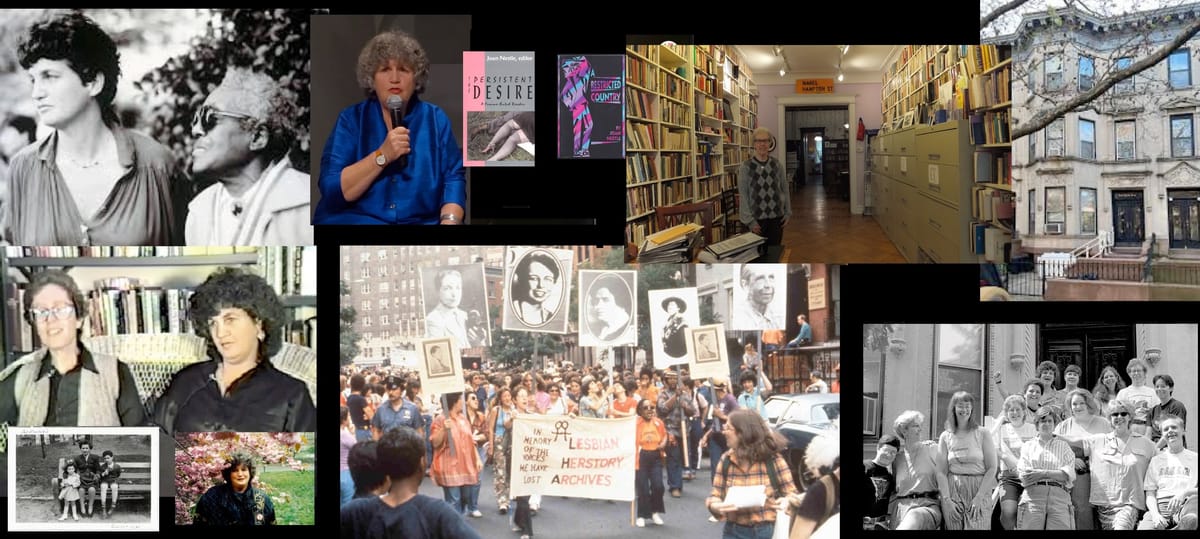
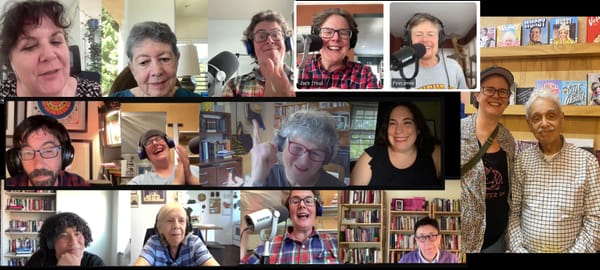
As part of her commitment to the radical mission Sinister Wisdom–our incredible Our Dyke Histories co-producer–Joan Nestle agreed to be interviewed for the podcast, in conversation with Hugh Ryan and Alix Genter. Not long after we popped on our screens to chat, Joan announced, "I'm 84. I'm very tired. This will be my last interview with you all today."
I couldn't breathe. But I had to breathe because I was leading this interview, so I inhaled and exhaled and we all jammed about queer New York City and beyond from the 1940s through the 1960s. And it was amazing.
As I mentioned in that first 1940s-1960s ODH epsiode, "Queer Pulp, Dark Bars & the Police State, 1940s-1960s," Alix, Hugh, and I were a bit mutually dazzled by Joan, and surely affected by her saying it was her last interview. Throughout our back and forth, she generously gifted us long, powerful, and amazing personal stories of her life, many of which she said she had never shared before. This all-Joan episode is likely one of the coolest things I've ever done in my life–which, to be fair, is how I feel after every podcast recording and editing, and with a woman I respectfully call a Queen. I hope you enjoy the magic of Joan too.
In this deeply moving and often electric episode, Our Dyke Histories sits with legendary writer, activist, and Lesbian Herstory Archives co-founder Joan Nestle in her last interview as she reflects on the queer worlds that shaped her life in the 1940s–1960s. Joan guides us through her Friday night walks from a condemned Lower East Side tenement to the Sea Colony bar; the dangers and solidarities of queer street life; the violent policing and erotic possibility inside lesbian bars; and the role of race, class, and labor in shaping queer women’s worlds. Along the way, she brings us into Harlem drag balls with Mabel Hampton, the lesbian feminist relationship to the Women’s House of Detention, the labor histories behind Massachusetts’ Moody Gang, and the erotic power of butch-femme desire. This is Joan Nestle at her usual: always generous, political, and brilliant—offering a vivid map of mid-century queer survival and community.
Introductions
Welcome to Our Dyke Histories. I'm your host, Jack Gieseking, historian, geographer, and environmental psychologist. We dive into the past and present of lez, bi, queer, trans, sapphic, nb communities, decade by decade in collaboration with multicultural, lesbian, literary and art journal, Sinister Wisdom. This season, we're all about dyke bars* with an asterisk: lesbian bars, queer parties, and trans hangouts– the structures that made them necessary, the lives they made possible, and the worlds we made from them.
Our Dyke Histories come for the history, stay for the revolution, gossip and desire that built us.
Welcome back to our second episode of the 1940s through the 1960s. This is Joan Nestle's last interview.
Co-founder of the Lesbian Herstory Archives, lifelong activist and writer and editor of all things butch-femme, desire, touch, sex, and resisting the state, Joan is very much alive and thriving down in Australia, but when we talked with Hugh Ryan and Alix Genter, which you can listen to last week, Joan mentioned that this would be her last interview. And because Hugh, Alix and I are– there's no other way to say this– we were deferring to the queen and letting her hold forth and tell these epically beautiful, powerful, profound, sometimes tragic, and always moving and brilliant stories about her life . I really wanted to give them their own episode.
In the event Joan is new to you, or even if you already love Joan, Often she makes references to different books that she wrote or interviews she gave, and i've gone back and gotten those readings so you can experience the full depth of her ideas as well. In this episode you'll hear me originally responding to Joan and also my additions. A few sentences may repeat the previous episode, but otherwise, brace yourself for pure Nestle.
One more wonderful share: I keep receiving requests for more about the twenties and thirties, so my band of awesome interns and I put together a reading guide for you. It goes live on Sinister Wisdom today, and I'll blog it on queergeographies.com as well.
Now we can turn our full attention to Joan Nestle.
Joan Nestle: Yes, thank you all asking me to be part of this. I found it a very emotional moment. I'm 84. I came out into these bars that are now the subject of historical examination, so I wanna dedicate this to communities first. I'm a writer. I'm [00:02:00] co-founder of the Lesbian History Archives. I have moved from the clandestine, dangerous, life-giving bars through the streets of the Women's House of Detention, or the "country club" as it was called. And I'm a survivor. I want to dedicate my time here to that community. It was my Sea Colony community, it was the working- class community of many genders-- and in the iron will of desire to be, where the touch you wanted was. I decided that we created a new gender, the gender of desire. How you put it into your historical narratives that I give over to you.
I also have to say that I'm speaking to you from the Wurundjeri lands of the Kulin Nation, their unceded lands, and pay respect to their elders, past, present, and emerging, and they inform all my history work.
Jack Gieseking - Narrator: As we opened our conversation about lesbian bars and queer parties of the forties to sixties, Joan immediately began talking about what it meant to walk to a bar and the bravery involved.
Joan Nestle: I just wanna lay the groundwork of flesh, of the lived body, before it becomes a textual page.
A Rich Darkness
So I'll set the scene. I'm living in a condemned tenement on the Lower East Side on Ninth Street in 1959. I'd already discovered the wonder of the Sea Colony. And so I was setting off on my Friday night walk from the safety of a condemned building. This is because I had very little money, and that's how we lived.
We could live for $30 a month, with the bathroom in the hall. I dressed [00:04:00] in my femme tight sweater and start walking into the lateness of the night. When I stepped down the steps of that stoop into the darkness. And started my trans- city journey. I was no longer a woman. I was no longer what were known genders.
I was a femme in the pursuit of touch.
And something happened to me that night as I was walking on streets where women were not supposed to be. That's where that territory gets left behind. This is New York but I'm crossing over from the east to the west, and all the streets were dark, but I was down a side street.
These are dangerous streets! Women were not supposed to be in the streets!
I see a huge man drunk, lying in the middle of this dark road. And I said, he's like me. He's a deviant. He's in some dangerous territory where he's been overtaken, by his desire to be drunk.
I stopped my walk. And this gender-less person that I was, bent down and I'm short, he was tall and huge. I dragged him out of that danger- ridden darkness onto the sidewalk.
And I was watching myself the whole time. I wasn't scared, I was strong. Where did this come from? Because I was on my way to this heavily judged, desperately needed place. And I wanna emphasize you do your work in light. I hesitate to say the word safety now because I don't think anybody is safe, but I want to emphasize for the audience who's listening: we moved in a darkness.
It was a rich darkness and– [00:06:00] we created, because of the power of desire. We focus so much on bars. And, yes, that's where became our public– we became the public face of our bodies. That's where our bodies entered public life.
Jack: The bars are attached to all these other spaces.
There's a great line in Finn Enke's Finding the Movement, saying that every time they interviewed a dyke, they would hear all these travel stories, they said, of going to and from the bar. But you never get that in the way people archive their materials. Just the story that Joan was telling, that's this huge part of the story. The dyke nod on the street, the ability to be in public and the nestling of these spaces around one another.
I interviewed people from the 1980s, 1990s, and '00s, cross generationally, and they all told me the same story. They're like, oh, I go to Henrietta's, then I went to Ruby Fruit, and then I had to get a piece of pizza. They would all tell me that they went to the same place.
Everybody went to Rizzoli Pizza Number Two, the most banal name of a pizza place you can imagine. Three decades of dykes are eating at the same pizza place! It's just this unrecognized beautiful space where you're getting your tipsy pizza at 2:00 AM, 4:00 AM-- and these kind of places matter just as much.
Where did you go to the movies before? Where did you come from work? What train did you take? So even though you're going to the bars, you're experiencing everything around you, which is incredible.
Harriet Lane at Amazon Limited
Jack Gieseking - Narrator: Next up, Joan shares a letter that she received at the Lesbian Herstory Archives.
The Lesbian Herstory Archives is still the largest lesbian archive in the world, which joan co-founded in the early 1970s out of her apartment with her then partner, Deb Edel Its collections, its meaning, its myth, mean everything to so many dykes.
Joan Nestle: I wanna read a letter, from a woman who I knew, Harriet Lane, her name was, I don't know if she's still alive. And this is a letter she sent [00:08:00] to me for the archives.
I lived at home in 1960. I was 19. So did my lover. Sometimes we went to cheap hotels in the Times Square area, but often even this was hard to arrange.
Somehow we heard of a woman on 14th Street who rented out rooms to lesbians by the hour or night.
I no longer remember-- and despite our terror of what we might find there-- we went. The downstairs buzzer, said Amazon Limited on it. We greeted at the door by a smiling woman who took us in the kitchen, made us some tea, and sat and talked with us for a while. Then she left us alone. The kitchen was at one end of a long hallway, off of which there were several rooms. I guess these were the rooms she rented out.
We could sometimes hear muffled sounds coming from them. I don't remember ever actually seeing anyone else there. We never rented a room. Still too afraid to acknowledge to someone else our erotic feelings. But we did go there frequently in that cold winter to sit and talk with her in the kitchen or by ourselves in the parlor room at the other end of the hallway.
The woman whose name I wonder if I ever knew, never asked for money or pressured us in any way. It was for us a safe space, and I now wonder about that woman and would certainly love to hear of anyone else who ever went there.
Jack Gieseking - Narrator: Now we don't know if Harriet did find others who went to Amazon Limited. What an extraordinary and special person to create a space like this. And we really do need to take back the naming of Amazons in all ways.
The Moody Gang of Lowell, Massachusetts
As a working class Jewish white woman and a devoted lifelong activist, Joan always brings us back to the role of political economy in our everyday lives, specifically what she learned and brought back in our everyday lives.
Joan Nestle: There's a bar community we discovered: the Moody Gang. A bar in Lowell, Massachusetts. I thought that would be turned into a motion [00:10:00] picture.
That became a lesbian bar grows out of the textile factories of Lowell, Massachusetts. It's at the turn of the century , in the 1900s there were women- only hostels set up there 'cause the textile factories needed the women workers. And out of that, it was a straight bar, but then the lesbians of Lowell, Massachusetts, in the 1940s and fifties, started going. And little by little , they were more of them than straight people.
But their roots are in those single hostels. They're in a labor market. So all these bars are embedded in the labor histories, the racial histories, the capitalist histories, and the subversive histories of a nation. And that's why I'm so grateful to all of you and my dear Jonathan Katz, because when I prepare for something, the first place I go is here.
And I was lucky enough to be in cohabitation, with these wonderful people with Alan Berubé .
All of us, we were grassroots' devotees of the unwanted.
Jack Gieseking - Narrator: Joan just mentioned Jonathan Ned Katz. Yes, that Jonathan Ned Katz of episodes three and four, discussing Eve Adams, as well as one of the late great queer scholars of all time. Alan Barbe. My favorite chapter of his is "How Gay Stays White and How White It Stays." He wrote length about the queer military, queer labor, queer racism. The man was extraordinary.
Also, I have to read you something fantastic that Joan wrote in the Lesbian Herstory Archives newsletter of 1981 about the old Moody Garden gang reunions, part of a lesbian community that dated back to the early fifties: Lynn and her friends had all hung out at a bar called Moody Garden in Lowell Mass. In 1979, they held their first reunion in the same town of Lowell, and over 175 lesbians came to celebrate their 30-year-old [00:12:00] lesbian herstory. She goes on to talk about how they wanted to work with the archives, and in their next reunion, 300 dykes showed up. How freaking awesome.
"Necessitated Wonders by the Horrors of the State"
Next up, Joan is gonna talk more about body and touch and how key bars are to her history. In doing so, she's always aware of the way the state works, the way public and private are structured. She's also, again, gonna mention HUAC, which is the House on American Activities Committee organized by Joseph McCarthy. They targeted so-called communists, homosexuals, and others against the state.
Joan Nestle: The body, when it is possessed by this knowledge that you had to take on really the whole society around you. We were creating spaces for desire to be enacted. The bars were one of those spaces.
Jack: I think that's part of what inspired all of this is I became obsessed with: why are we so obsessed with lesbian bars? And that's usually what we hear about lesbians, dykes, and queer people and a lot of trans spaces.
And so, what you said was where we became the public face of our, of our bodies-- was really potent to, to get to that. What, how, I think the other thing that I thought of when you were talking is I remember in the 2010s same-sex marriage was announced in the United States, reading George Chauncey's, Why Marriage?
And he said in the 1950s that decade was the worst decade for LGBQ people. I remember thinking a cis, white, gay man who lived through hiv aids, the beginning of the hiv aids pandemic has written this and how harrowing that must have been, and how we were led by our desire.
Joan Nestle: I would say it like much in life, it's more complex, yes. But that depends if you come from a working- class background. You've seen the police state in your own intimate life.
[00:14:00] There were wonders, necessitated wonders by the horrors of the state. Desire can create not only its own gender, but its own country, its own powers of resistance.
I talk about darkness because that's where we were regulated in a way.
Jack Gieseking - Narrator: At some point Lesbian Herstory archives organizers have put out a call for bar names. I would guess that Joan is part of this, as she wrote about it in the 1981 newsletter: bars have always been special institutions for lesbians. They were in the past both colonized territory and free space, and their patrons bore the brunt of police harassment. In the 1950s and 1960s, in my own experience, the bars were places of theater, sexual adventuring, community bonding freedoms and oppressions. They were escape and confrontation all at the same time.
Butch-Femme Desire at the Sea Colony and Beyond
The majority of Joan's work focuses on gender, sexuality, touch and desire, sex and the state. Published in 1992, Joan edited The Persistent Desire: A Femme-Butch Reader. It was a breakthrough piece and here's why . Joan writes in off our backs 1993. I'm really no longer interested in proving that butch women or fem women are feminist. I'm no longer interested in taking up the argument that butch femme relationships duplicate heterosexuality, and I'm no longer interested in arguing whether we have a right to love this way or to identify this way.
What I would like my work to stand for is the permission for and celebration of any lesbian woman, and I'm sure she would open up that description to find a way she surely he or they can express their love and desire in a world that destroys tenderness.
Wow. Damn, Joan! God, she's good.
In other words, what she's saying is people were attacking butch femme [00:16:00] well into the nineties. Lesbians straights gays alike. Some of would say that butch-femme was imitative of cis heterosexuality, masculinism patriarchy, that it was demeaning, it was unimaginative, but Joan and her reader showed truly otherwise.
Now back to Joan.
Joan Nestle: I wanna emphasize in these bars, there were passing women. We used different words, but many genders were represented and there were the breaking of genders, whatever gender you thought you came in with, something would happen. To take on the police. You had to be a different gender, to put your hand down someone's pants.
Even though we call it genderfluid in these times-- i'm not so sure our times are so gender fluid because we've been forced to have very concretized discussions.
But in that darkness and those prohibitions and in that clandestine-- none of this is to romanticize. In that Sea Colony, straights would urinate through the mail slot into the back room where we were romantically dancing.
So this, literally reducing us to body functions as a way to control us.
Jack Gieseking - Narrator: Wow.
What I know about the Sea Colony primarily comes from Joan herself. In her book, A Restricted Country, she wrote a well-known chapter called "The Bathroom Line," and I'm gonna read a longer excerpt because it's so powerful. It stayed with me my entire life.
She writes: we had rituals too. Back in the old days, rituals born out of our lesbian time and place. The geography of the fifties, the sea colony. A working class lesbian bar in New York City was a world of ritual display. Deep dances of lesbian want, lesbian adventuring, lesbian bonding. We who lived there knew the steps, but the most searing reminder of our colonized world was the bathroom line.
Now I know it stands for all the pain and glory of my time, and I carry that line. And the women who endured it deep within [00:18:00] me, 'cause we were labeled deviance, our bathroom habits had to be watched. Only one woman at a time was allowed into the toilet because we cannot be trusted. Thus, the toilet line was born, a twisting horizon of lesbian women waiting for permission to urinate to shit.
The line flowed past the far wall, past the bar, the front room tables, and reached into the back room. Guarding the entrance to the toilet was a short, square, handsome, butch woman. The same every night whose job it was to twist around her hand, our allotted amount of toilet paper. She was to us an obscenity doing the man's tricks so we could breathe.
The line awaited all of us every night, and we developed a line act. We joked, we cruised, we commented on the length of time one of us took. We made special appeals to allow hot and heavy lovers in together, knowing full well that our lady would not permit it. I stood a femme loving the women on either side of me, loving my comrades for their style, the power of their stance, the hair hitting the collar, the thrown out, hip the hand, and circling the beer cam.
Our eyes played the line. Subtle touches, gentle shyness, weaved under the blaring jokes, the music, the surveillance. We lived on that line, restricted and judged. We took deep breaths and played. But buried in our endurance was our fury. That line was practice and theory seared into one. We wove our freedoms, our culture around their obstacles of hatred, but we also paid our price.
Every time I took the fistful of toilet paper, I swore eventual liberation. It would be however, liberation with a memory.
Wow.
Women's House of D as Extension to the Bar
Joan Nestle: But I want to say on that walk from the bar, I passed the Women's House of D, as we called it, and it took me a long time to get the lesbian feminist movement to cast their eyes to that building.
You know what comes to [00:20:00] my head is, you either have to be a whore or a daddy. The daddy tanks, that the New York City Police Department had from the '30s on, where butch women were thrown into segregated holding tanks.
And remember Andrea Dworkin writing about the prison-- to make sure that it won't be forgotten again. And now there are new prisons.
And when women against Pornography took on the sex workers, I.
Was cooperating with the real estate. I wonder, there's just so many, all the battles, like with women against pornography that I was involved in, they grow out of some of these very old tensions. And feminism playing its role. There's good feminism and bad feminism in my head.
Boy, have I talked up so much.
Jack: No! I love you taking us into the porn sex wars.
Jack Gieseking - Narrator: And of course the Sea Colony was not very far from the Women's House of Detention, which I really recommend listening to the previous episode to hear so much more about that. All of these spaces are in Greenwich Village, the Stonewall Bar, the Women's House of Detention, where many dykes trans people, gender non-conforming people were pulled in and forced to do time.
Ah, Dworkin
And then there was Andrea Dworkin. People come down on different sides of the Dworkin. I am always moved by and impressed by the feminist work she did calling out the women of the Far Right. But as Joan has said, other times, she was also a bully. She was very mean and I'm less of a fan of her because she was kind of anti-sex.
She was a deep advocate against all pornography in any which way. In case you missed it. In the 1980s, there were some very powerful feminist debates called the porn / sex wars, and Andrea Dworkin came down hard on someone who would be understood as anti-sex.
She wanted to end pornography containing any images of women. She thought it was impossible that a woman could have her own agency [00:22:00] in being sexy and sexual in pornography, that any sexy images of women would immediately be for the patriarchy and male gaze. in these debates about pro-sex and anti-porn, some things even got anti-sex. Some lesbian feminists even arguing that penetration was evil and patriarchal and should be abandoned completely. On the other side, pro-sex advocates, people like the amazing Amber Hollibaugh and Joan Nestle said that there, of course there can be agency in women being sexual and sexy-- and we've very much landed on the pro-sex side of the porn/sex wars debate.
Thank the goddesses for pro-sex advocates.
Black Drag Ball & Queer Parties
Anyway, let's get back to the bars and the parties!
Joan has always been someone who is very conscious about how race works or doesn't work. She was thoughtful and she was critical about how bars were mostly white.
She was also thrilled to talk about the drag ball scene. That she got to be part of because of Mabel Hampton, a beloved black lesbian activist and performer whose rich archive now lives at the Lesbian Herstory Archives, much of it preserved in thanks to Joan.
And she helped raise Joan when she was small, a friend to her mother, knowing that Joan was quite queer as Mabel was. And when Mabel was older, Joan took her in, which was very radical for the time of the 1980s, a white woman tending to an elderly dying black woman. Of which Joan wrote openly, that she pretty much gave zero fucks what other white people felt about it.
I'll be sure to share all the links to the oral histories between a very baby Joan Nestle and Elder Mabel Hampton recorded in the early eighties on queergeographies.com . They're so moving, but here's Joan now on her memories of Mabel while we were chatting.
Joan Nestle: Because uptown there's a whole thriving, Black, lesbian, queer community that's been going on forever. Knowing Ms. Hampton and her partner, Ms. Foster, was a gift in so many ways. In [00:24:00] 1961, they invited myself and my then lover to go with them to a huge drag ball in Harlem. It was in a huge room. Two stories-- there was a balcony that ran all around.
And there were hundreds and hundreds of every gendered person. I think maybe there were three white people there. It was a wonderland in a way.
I remember, I was going up the steps and this very handsome woman stopped me and said to my girlfriend, Can I borrow your girl for a minute? She's really saying something. I have never in all these years forgotten: the gift, the gleam, the invitation of that voice.
So yes, hard times. But communities were creating all the time acts of resistance because of that iron will of desire-- for self presentation, cloaked in love, cloaked in valuing.
In Miss Hampton's papers, there's a flyer for a hotel in the Catskills owned by a black family that welcomed black lesbian, queer people. It's like the Green Guide. When you look in other places, you find what America really is made up of.
How did we come into being? How did this was made possible? There are these tendons, sinews of determination in impossible circumstances. They feed into those tendons of endurance.
And that's what I hope all of this will make possible in other [00:26:00] countries. We will learn from other countries as well, how they have survived and created queer joy and celebrated queer desire.
Jack Gieseking - Narrator: I'm inspired by Joan's notion of international queer desire and learning from one another. As much as we're always learning from the past and hoping for a better present and future
Poetry, Drama, Aesthetic, Punishment of "Bar Dykes"
Next up, she refers to three amazing bar dykes or bar women. This was short for lezbiqueertrans people who went to the working- class lesbian bars. of the forties, fifties, and sixties.
Joan Nestle: There are still people who come from those bar days: Meryl Mushroom, Cheryl Clark, my friend Paula Grant . But I have so many memories of those who didn't survive the alcoholism, the poverty, the hatred, and the loneliness. And so when I realize now I've made my whole writing life out of these memories, out of what we shared together, and I'm a surviving voice.
These are the surviving voices of those times.
Jack Gieseking - Narrator: If these are the bar dykes who survived, I can only imagine what worlds the rest of them would've built if cis hetero patriarchy had allowed them to live, love, and flourish.
Cheryl Clarke is a lesbian poet, essayist, educator and black feminist community activist. She's published countless books of poems and edited important publications ranging from Conditions to This Bridge Called My Back , from The Kenyon Review to Gay Community News. What a queen of queens.
Paula Grant is a lifelong activist for human and civil rights. She's been one of the co. She's been one of the coordinators, or also known as the Archivettes of the Lesbian Herstory Archives since 1979, soon after its founding. What an extraordinary gift of labor and care going on 46 years.
And [00:28:00] last but not least, especially for some dope news, I get to share right now: there's Merril Mushroom who defines herself as an old Ashkenazi Jewish rural feminist dyke, among other things. She grew up in the Miami Beach scene and she wrote an awesome play called Bar Dykes set in a 1950s Greenwich Village Bar. And the reason this play is so amazing is it feels like being there.
And what is even cooler, and I can barely contain myself, listeners, is that Merril Mushroom has personally given us permission to record it for you! So we'll be doing a table reading. I will gather the queer and trans theorists of my life, and we'll hang out and read this for you guys. Thank you, Merril! What a gift.
All of these places being infused by the labor and capital that make them possible.
Now, Bar Dykes or Bar Women, this shorthand for lesbians who went to the bars– What's interesting is this word is these words travel and how they're working similarly across such different spaces and geographies.
At this time, there is a thriving bar scene in Toronto for the lesbians who made community among hotel bars in the work of El Chenier.
And of course in Buffalo, Leslie Feinberg was part of 1950s bar dykes culture as well as ze identified somewhat then.
There's of course, a thriving bar scene in London. Perhaps the most well known of those bars being the Gateways Club. It was a members only club, which was a way to semi get around police harassment. It ran in a basement for decades.
For some reason, London has decades of lesbian bars in basements. If you all have data on that, please let me know.
And it probably is the most well known because of a documentary sponsored by none of than Sandy Toksvig, that wonderful nugget comedian from the British Bake Off.
Joan Nestle: There was poetry, there was drama, there was aesthetic, there was punishment, there was fear. There was retributions, there was loss.
And all the [00:30:00] time, I wanna emphasize we were working women, working people. We had jobs, and those jobs were shaped by how we were living in our bodies. So butch women or passing women, were taxi drivers, stock boys.
And then sometime after 10 o'clock at night, it's almost -- I'm riffing now, but it's almost like a version of, Somewhere over the Rainbow because it's like you open the door. And that dreary life in the office where you couldn't use the right pronoun for your woman or lover becomes full of color.
In the midst of darkness, there's a shining light, and that light is, I'm going to get to the sea colony! I'm gonna transverse this city! I'm gonna go from a bathroom in the hall in a condemned building to another where urine came through a mail slot. But I'm gonna to get there taking all my hopes for life.
I was 19 years old and there were others who were younger.
Bar Dykes in Print and Archives
The writers who still survive, their works.
Jack: Yes. I wanna give a shout out to Under the Mink.
Joan Nestle: Yes. Lisa Davis! Absolutely.
Jack: If you wanna experience what it was like to go to the bar and there's the mafia, and oops, they killed somebody. Whoa. That opener just floors you.
And then if you need a little lighter entry, but still so powerful you can feel in your body: Malinda Lo's Last Night at the Telegraph Club, which won the National Book Award for young adult fiction. It's so incredibly powerful about this young, Chinese-American woman in San Francisco going out to her first bar. And what is this, this risk? You can just feel it in your body the whole time you read these books. They're so powerful.
Joan Nestle: Okay. I just have to, I have to mention all the pioneering lesbian and queer [00:32:00] archiving groups.
Jack Gieseking: Yes!
Joan Nestle: The gay history groups of San Francisco, Liz Kennedy and Maline Davis .
Jack: I have had a Google News alert for anything lesbian for decades, and the number one news item that we get covered for is lesbian bars. The second highest is cele- lesbians of any variation. The third is a lesbian murdered someone. The fourth is a lesbian was murdered, and the fifth was something political with a lesbian. She lost her kids, she got her kids , some sort of policy or law enactment.
This is a consistent narrative and narrow idea: all of our history is in lesbian bars. Sometimes I feel it's just a hook to get you to hear about lezbiqueertrans life is, we're gonna talk about dyke bars!. And also this why Dyke bars matter and this idea of them.
That's such a feeling that transcends space and time. 'cause you're entering this space: what's it gonna be like? Will you be accepted? Who will be here? Who am I? Gets put upon this space.
And especially these ideas of what happened in the '40s, '50s, '60s, we hear a lot about the bars.
Jack Gieseking - Narrator: Of course, I will put all of these cool notes and more and great images on queergeographies.com [you're here reading, how lovely! and thanks!] if you'd like to read about it there. And our social media guru, Audrey will have everything up on Instagram as a well. There'll be scoops on all the dyke bars I'm mentioning. I will never leave you without sources.
And since somehow we missed talking about lez, gay, and queer Pulp of the 1950s in this episode, I did wanna say that if you're looking to get your stocking stuffed perhaps the book, The New Lesbian Pulp, just out from the Feminist Press, containing contributions from none other than Sarah Schulman and Trish Bendix who are on this podcast in season two will delight you.
"This Iron Will of Desire"
As Joan teaches us, we have to keep talking and acting on that iron will of desire.
Joan Nestle: We were all in this because our bodies had been touched by this movement, this iron will of desire. The bars were also a place where we [00:34:00] compared our wounds physically and psychologically, where we gave each other important information of how to survive this calamity. Or when the landlord decided to throw you out or where we shared resources.
They were community centers under stress.
I remember, one night when this woman came through-- she was one of us. And her nose was smashed, because she needed to make a call and she'd stopped earlier in the street into a straight bar-- 'cause they had a phone, this is in late '50s. And one of the men, seeing -- she must have been a butch woman, how she was dressed-- took the phone and smashed it into her face.
The first thing she did was come to Bruno. He let her in, gave her wads of paper towel and come to the back room at the Sea Colony.
There were all these other places. But once you had a bar, that was your bar, because that was your bar family, you knew from Friday to Sunday nights.
Jack Gieseking - Narrator: The gender and sexuality studies historian Marie Cartier wrote Baby You Are My Religion, where she talks about how so many of the women, trans and gender nonconforming folks of the forties through sixties found a religion in going to lesbian bars. These were their homes, these were their families. Cartier calls it, quote, the only place end quote for lesbians for many lesbians in the time.
Near the end of our conversation, Joan mentioned how much the bars changed in the 1970s and eighties, and increasingly formalized party scenes started to grow.
The Very Different Bars & Parties of the 1970s
In the discussion below, Joan will also mention CR groups and how important they are. That stands for consciousness raising. This is people sitting around and just having chats about the most private parts of their lives, but also telling people things they had never told one another. My mother, whose in her [00:36:00] seventies, told me she never talked to anybody about menopause. My mind's blown. I'm talking to all my friends about menopause.
Joan Nestle: Then came the new generation of bars where there was spaghetti, free spaghetti at the Bonnie and Clyde's. That was a whole different world.
I just wanna say one other thing: always be aware when new things are offered you, new bars, new gathering places, new freedoms-- who you are leaving at the border.
Because, yes, Bonnie and Clyde's and the new world of lesbian feminists, lesbian feminist CR groups-- we're talking now the 1970s, and then we go to Bonnie and Clyde's. But so much of that was a judgment of the bar women who had come before and they were not welcome into those places.
Again, you'll have this in your lives: you'll get some modicum of security, you'll get some modicum of power. How you use it at the border, how you keep in your kin, the new freaks, the new unwanted ones. That's what really you will look at the end of your life.
Audre Lorde 4ever
Jack Gieseking - Narrator: Now we're gonna talk about one of the great record keepers of the 1950s bars and her own writing about them, Audre Lorde and her book Zami, A Mythobiography.
Jack: You mentioned the Bagutelle, another bar, and there happened to be a young woman named Audre Lorde hanging out there. If you haven't read Zami, her mythobiography. Just stop listening to this. Go read that, it's just gonna make your life better.
And, In Zami, she talks about hanging out at the Bagutelle being the only black woman or one of a few black women in that space. Which sounds different than the Sea Colony, Joan. Because Bagutelle people were showing up with their Corvettes, their very fancy cars. And, there was a [00:38:00] lot of wearing crisp shorts. The description of this place is, it sounds a little preppy?
Joan Nestle: Butches wore very sharp creases in their pants. There's a lot written about gay men's style and the aesthetics , but boy, the butch femme community-- style! The way the collar was raised, the haircut you've talked about. These bars had their own communities form around them.
Yeah, you could be poor, but you could iron your pants.
Just to give a shout out to a new biography of Audre Lorde, Survival is a Promise by Alexis Gumbs. And that I think could be the theme of all our work: survival is a promise, . And the new book of poetry by Cheryl Clarke and her poem, " Althea and Flaxie," which is her poetic history of a butch-femme Black couple from the 1920s. I was reading that poem and knowing Cheryl and knowing that was at the heart of Persistent Desire. Because I thought, am I crazy? Am I the only one who sees this ? And then I thought, no, I wasn't. Those of us who lived it saw it.
Jack Gieseking - Narrator: When Joan is saying to herself, am I crazy? No, we lived it together. What she means is, what she means is we made sanity. We made witness in being in real life community together. Because you start to wonder if you're crazy when you queer, don't you? When the world is out to get you, when the world doesn't support you, when the world doesn't see you, recognize you, support you.
I wanted to go back into Zami and reread it after we chatted about it . I was a little absurdly white hopeful about how intermixing lesbian bars are. And here's Audre Lorder herself. Being women together was not enough. We were different. Being gay girls together, being gay girls together was not enough. We were [00:40:00] different. Being black together was not enough. We were different. Being black women together was not enough. We were different.
The scholar, Katie King wrote an excellent article about Audre Lorde's experiences in the bars in Zami. She writes, for Lorde the Gay bar stands for the contradictions of identity, and solitary soarness over and over. Lorde has to recreate the possibilities of being both gay and black. This is in a bar culture that is dominated by white women in which black women have powerful reasons for making connections sexual and strategic with white women, not with other black women in the bar.
Thank you, Audre Lorde always for the wisdom or the gracious wisdom that you have gifted us all.
"The bars were filled with all the things America was filled with."
Joan Nestle: To your point: yes. The bars were filled with all the things America was filled with.
This is not a story I think I've ever told, but, my old lover Carol, had just gotten a new apartment in the village. She died in 1964, so this would've been 1962.
She was with her new lover. She had a party, a house party, and she invited some of the women we've known in the bars. At this party, I'll never forget this, she was playing Nina Simone. She put Nina Simone-- it was old fashioned turntable. And one of the bar women, we were, came over to her and said, I don't wanna hear that-- and she used the N word. I don't wanna hear that music. It was such hatred in her voice.
And Carol said, this is my house. We'll listen to the music I wanna listen to.
But I-- yes, there were all the race-- the uglinessed were there as well.
There's an incredible, archive of oral histories being done by two, young, Black women. That they've been doing it for years now, interviewing Black [00:42:00] elders. The resources are there. You just have to find them. Sinister Wisdom, if you go on their sites, Julie has created and brought in wonderful communities of women doing this work.
When we started the archives, a lot of it is our own biases. So when we talk about, go to the prison records, go to the jail, this was distasteful. This is not where people wanted to find their histories. You start out by examining your own prejudices, your own places that make you uncomfortable.
You can't do good work unless you're aware and challenge your own discomforts.
This ties in also with not romanticizing things, but when I would speak to middle class lesbians later in life and they'd say, I couldn't get through the door. There was so much violence.
Maybe it's my own background 'cause there was violence, there were fights, there was violence answering violence. The police were violent when they came in for their payoffs.
So yeah, you had to be tough. And that's another, this is the wonder I think, of a femme self. When I say it's beyond gender, that desire you became tough.
These bars contained us well. Walter Winchell, who wrote New York Confidential, he'd say, we know where to find them. So yes, we were on the map of the state.
Jack Gieseking - Narrator: Walter Winchell's venomous gossip columns mapped our bars for both the state and ourselves. It is staggering to take in how queer people became legible to one another with both the same tabloid and supposedly respected presses that tried to and did demonize us. You can think today of the New York Times as a great example of a newspaper that intentionally demonizes and works against trans people and other populations. And at the same time, in the 1950s, those targeted public attacks and policies that made us visible to the state as so-called deviance, also curated proof of life [00:44:00] for LGBTQ plus people who had never even heard those words before.
1960s Social Movements & Changing Bar Politics
Let's return to Joan and the movements that changed us all.
Joan Nestle: I saw a fist thrown. Yeah, it wasn't always pleasant.
It was tough and violent in a tough and violent time. So you gotta put it all together. And again, that's why I give gratitude for surviving. My own tough childhood allowed me to survive. So there was prejudice, but there was also the recognition.
There were many lesbians who could not walk through that door, but! They found other doors they created the firehouse on Worcester Street, GAA. So if you get repelled by one scene, you're still driven.
We haven't even talked about the liberation movements around us. The Civil Rights movement filtered into the bar. Some of us were marching in the streets with Civil Rights and going to these bars at night and they fuse all those histories, feed who we become in life. And I was just lucky enough to have a lot of streams of hope.
Jack Gieseking - Narrator: Everything we just talked about reminds me of this utterly beautiful quote from Joan Nestle Here it goes.
Surely the struggle between our public expression and societal control has not gone away yet. I think there's something deeper calling out from these places. It was here that women transform themselves right under the fist of the state. It was here on continually shifting grounds that we created the semblance of communal permanence. It was here that we found a way to be real in places that were never our own, by deed or laws of property.
Wow.
And while bars are often seen as the epicenter of lezbiqueertrans, gay, sic, [00:46:00] asexual, non-binary, you name it, history, it's important to recognize that they didn't exist in isolation, house parties, street gathering, secret clubs, as well as beaches, waterfronts, Sidelong glances on subways, certain walks down certain streets.
These are all part of a much broader, interconnected network of queer life and memory. These are constellations of queerness over the ages.
With and Beyond Stonewall
We often talk about mid- 20th century queer history because that's when we have a visible queer public. We're quite fixated on Stonewall and what it's done for us today, or what it means to us too, as a myth and a monument to carry on, to do something grand and important today. And so thinking about the 1940s to the sixties helps us understand how we even got to Stonewall.
It is a more complicated history. The feminist movement, the Black Power Movement, the American Indian Movement, the disability rights movement, we could go on and on and we should. The story of LGBTQ plus liberation is never just Stonewall, it's richer It's more layered.
What empowers the people of Stonewall in 1969 comes in part from what happens in Dewey and also what happens at Compton's Cafeteria.
The tactics of both Dewey's and Compton's fit the moment. Dewey's relies on the civil rights sit-in, and Compton's on the ability to fight back like the Black Panthers and Young Lords.
So Compton's cafeteria would frequently call police on trans customers thinking that they, claiming that they were loitering and the police would come in and frequently arrest people for the crime of quote female impersonation.
So when the cops showed up and tried to arrest a trans woman, the cafeteria, according to Susan Stryker, in her amazing documentary about this, erupted.
Patrons threw sugar shakers, tables, dinnerware at the police. The windows were shattered. A trans woman threw coffee at an arresting police officer, and drag queens and trans women, gay [00:48:00] men poured into the street, fighting back with their high heels and purses. The police retreated into the street. The protesters damaged a police car, burned down a sidewalk restaurant, and the police kept fighting back, but more protestors arrived.
The police arrested as many protesters as they could and took them away.
But the next day, more trans folks, hustlers, Tenderloin, street people, and other queers showed up to pick at Compton's cafeteria and would not let people enter the restaurant.
And of course, the revolution of the 1960s, especially as it's attached to Greenwich Village, we all harken back to Stonewall, but we also have to know what comes before it and what took place alongside and in solidarity with it.
Lez Talk about Sex, Babies
Now it's time to turn to the last and most essential focus of Joan and her work. For those of you who are long time Joan Nestle fans, you know that we haven't talked about wonderful Joan's favorite things to discuss, and that is sex. She absolutely brought it up. And of course I jumped in.
One heads up, Joan will mention Abingdon Square as a place no one wanted to go, so so that it became a queer space on the margins. I had to even figure out where this was, this little triangle of a park between Hudson and Eighth Avenue in the village. In 2025, the average apartment lists there for $1.2 million or $4,000 a month in rent. Where the Clit Club used to be, the Meatpacking District costs run about the same.
We can think about so many of the places where queer sex has flourished, now real estate and capital rule, WTF. Regardless, queer sex keeps proliferating and hotdog for it.
Joan and I got talking about sex when I went to list the lezbiqueertrans bars of the Village from the forties to sixties, as recorded in Alix Genter's writing:
Jack: While we're doing this, I want to jump in and do a little roll call, with the Bagutelle, the page three, the Howdy Club. The Bonsoir Club. The Moroccan Village [00:50:00] Club 82 Club. 180 1 ELLs Bar, McDougall. . 17 Barrow Street, the laurels.
Joan Nestle: Charlie's up in Harlem. You gotta go uptown. You gotta go uptown and out to the boroughs.
Jack: This was a village map. Alix has more, and blind Charlie's. And we're just talking about New York City. So to think about how many spaces and places there are multiplying and they don't have to be, a permanent bar too. There's a lot of confusion. Even when I talk to people now, they'll say, oh, I went to this bar and it was a party.
It was every Friday night, at a bar, like Clit Club, which comes up a lot. People are like, oh, it was such a great bar. I'm like, it was a party. We were only there one night a week. The boys had it on Friday for meet MEAT and we had it on Saturdays for Clit Club. People were like, oh no, it was a great bar.
I was like, it wasn't, actually trying to reconceptualize why a permanent space matters, but how these spaces were quite permanent. I think also gets caught in the modern imagination as something more.
Joan Nestle: I just wanna throw out one other thank you to the Lesbian Sex Mafia in New York for the lesbian sex clubs that I had the joy and privilege of participating in. They were rare and they were wonderful. Within a judged community, this, there are communities that are even more judged .
But just one last thing. All these things are made possible. Those places you all named because of real estate, nobody wanted to go to Abingdon Square on a dark night back in 1949, but now these places are in prime real estate.
Jack: Yep.
That's hot. And the Lesbian Sex Mafia, founded in 1981 by none other than Dorothy Allison, and an amazing other group of folks, the Submit Party is still running in New York. There are many parties running everywhere. As somebody who is constantly looking at what kind of lezbiqueertrans spaces are being created, sex parties are on the rise. The consent politics are just lovely, just delightful, thoughtful and sexy and [00:52:00] great. I love all of
them.
Joan Nestle: In Australia, yes. Kink parties and kink is the new community of words. So language is ongoing histories.
Jack: Yeah. I love the pandemic brought out that I'm gonna go after what I want on a new level. So yeah. Let's bring out the kink.
Thank You for Not Hiding Your Desires
Jack Gieseking - Narrator: The literary scholar, Claire Watling, says that Joan was accused of, among other things, quote, unequal patriarchal power sex end quote in her work. This is because she participated in butch fem sex. Oy those weren't all lesbian feminists, but that's how we began to think of them, right?
Anyway, Joan goes on: I was testing my boundaries and I think she was too.
For those of you who are driving and can't listen to any kind of sexy talk, or if it's just not your thing, you might wanna stop now .
Some of these pieces are clearly, I read them as erotica in the stories of A Restricted Country, one of which is called "Esther's Story". Joan meets this, what was known as a passing woman-- language uses to describe this time. Some of these folks today may call themselves stealth.
Here is Joan writing an Esther's story: we both had power in our hands. She could turn for me and leave me with my wetness, leave me with my wetness, my need, a vulnerability and a burden I could close up, turn away from her caring and her expertise. Usually I was in control from the first with Esther, I knew it would be different. I was 20 and she was 45. I was out only two years, and she had already lived lifetimes as a freak-- and this is a word that Joan struggled with because she was told this by a doctor. Her, Esther's sexuality, was a world of developed caring, and she had paid a dear price for daring to be as clearly defined as she was.
Then in Joan's chapter, "the Gift of Taking." She writes about a woman, surely a butch, she calls Margaret: when she is on her back, her body's fullness begs for touch when she's above me. Her muscle back, her wide shoulders, her powerful forearms present a different kind of woman. She goes on, [00:54:00] usually I was in control from the first.
I'll end with her chapter, "A Change of Life," she writes, after forty, fems turn butch. This is, is this what happened to my girlfriend? She looks so cute and flannels. And then Joan writes, let me butch for you. I have been a femme for so long. I know I'm trying to feel something other than a woman. And writing of finally enjoying a dildo, she says: no need to hide the word anymore. No need to hide my desires.
Thank you, Joan, for not hiding your desires.
Joan Nestle: Thank you for listening. You are all beautiful. Yes, yes, yes,
Credits & Conclusion
Jack Gieseking - Narrator: Joan has continued writing . She remains so important to so many of us.
Thank you all for listening to a little bit of the magic of Joan Nestle, if she's new to you lucky you. If she's not new to you, lucky you too.
Take care. See you next week.
Joan Nestle is a Lambda Award-winning writer and editor, as well as founder of the Lesbian Archives. She's edited nine books, written three, most famously A Restricted Country, and most recently, from our own Sinister Wisdom, A Sturdy Yes of a People.
Thanks for tuning into Our Dyke Histories in collaboration with Sinister Wisdom.
Follow, support, and connect with me Jack Gieseking via my newsletter at ourdykehistories.com. And connect with us on Instagram and Facebook at @ourdykehistories. All this is where we pack everything we could fit into this podcast!
Our Dyke Histories is run by a queer, dykey, and mighty team.
ODH is hosted, edited, and produced by Jack Gieseking, co-produced and co-edited by Cade Waldo, co-edited by Mel Whitesell.
Our social media manager is Audrey Wilkinson, and our fabulous interns include Michaela Hayes, Sid Guntharp, Paige LeMay, Sophie McClain, and Sarah Parsons.
Our theme song “Like Honey,” was graciously gifted to us from Kit Orion who you can find at https://www.kitorion.com/.
We're forever grateful to Julie Enzer, director of Sinister Wisdom. Publishing since 1976, Sinister Wisdom recognizes the power of language to reflect diverse, multicultural lesbian experiences, and to enhance our ability to develop critical judgment as lesbians evaluating our community and our world/
We share Our Dyke Histories so we know more about who we are, how we were and yet could be, and who and what we fight to never forget.
Lez keep doing it, y'all.
**
Join Our Community
Want to be part of our community? We'd love to have you. 😏 Come comment, connect, and get your gayme on!
- Newsletter to your inbox: Jack's Queer Geographies newsletter with detailed takes on each episode, & more about lezbiqueertrans spaces across time
- Instagram for more dyke visuals and stories @ourdykehistories
- Read and follow our co-producer and collaborator, Sinister Wisdom
- Email us questions and comments at ourdykehistories AT gmail DOT com