"When Paris and Berlin Were Dyke Bars*"
Enjoy the detailed transcript of the second episode of my Our Dyke Histories podcast.

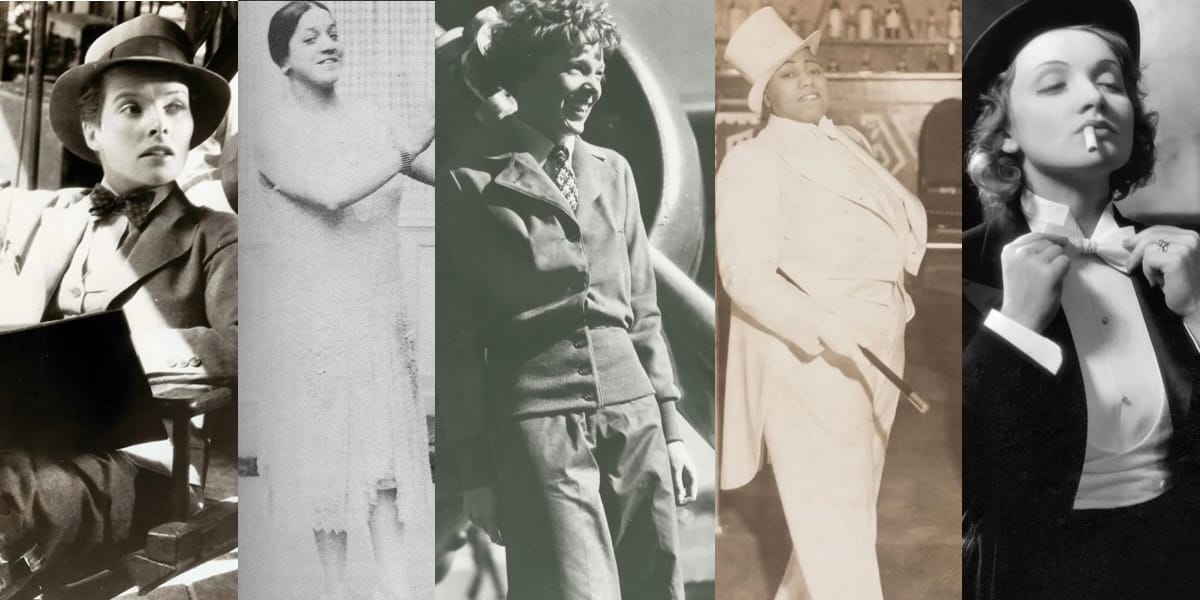
What if Paris and Berlin were the first great dyke bars*? In Our Dyke Histories, I continue to talk with "the mother of lesbian history," Lillian Faderman, and the brilliant historian of 1920s Black queer women's lives, Cookie Woolner. We follow the trail of queer women, trans patrons, and gender rebels from Harlem across the U.S. as well into the theaters and hotel parties of Black artists and performers in the U.S. We then head across the Atlantic to trace queer modernisms into the salons and show of Paris and cabarets and clubs of Berlin.
This episode is brimming with Radclyffe Hall’s The Well of Loneliness, Natalie Barney’s infamous salon, and the urban legend behind Ma Rainey writing "Prove It on Me Blues" after getting bailed out of jail for lesbian pursuits. The 1920s to 1930s shimmer with both liberation and backlash. From Black vaudeville circuits and Bessie Smith’s private train car parties to the queer glamour of Paris’ Le Monocle, the episode captures the dazzling creativity—and the precarity—of queer life between the wars.
I'm dropping the transcript below.
Here's a link for every podcast app. Enjoy!
Intros
Welcome to Our Dyke Histories. I'm your host, Jack Gieseking, historian, geographer, and environmental psychologist. We dive into the past and present of lez, bi, queer, trans, sapphic, nb communities, decade by decade in collaboration with multicultural, lesbian, literary and art journal, Sinister Wisdom. This season, we're all about dyke bars* with an asterisk: lesbian bars, queer parties, and trans hangouts-- the structures that made them necessary, the lives they made possible, and the worlds we made from them.
Our Dyke Histories come for the history, stay for the revolution, gossip and desire that built us.
Jack Gieseking - Narrator: [00:00:00] We hear about rent parties when it comes to Black queer women, but it's clear we need to be much more expansive in how we imagine, absorb, and retell our lez, bi, queer, trans, sapphic history-- in the ways we found each other, found a place, a people to belong with, to socialize with share information-- whether it be from what to wear, to what to listen to, how to pick someone up, to how to fuck.
But bars as we imagine them-- to remind you, we're here in the 1920s -- do not exist yet, even though I call Eve's Hangout Tea Room , the first documented proto lesbian bar in my my special interview with Jonathan Ned Katz, coming out next week. And the first publicly identified lesbian bars won't emerge until the 1930s.
So what is a lesbian bar?
There's not any official definition to be honest, since so many dykes call places lesbian bars that may not call themselves that. You do need to know that it targets lesbian clientele often serves alcohol. It's open seven days a week, maybe five, unlike a party which moves locations-- might be weekly, monthly, or infrequent.
And what's undergirding ideas about a bar being so important to dykes is we want fixity, we want constancy, ownership. A place to go. A place to call our own. But we also have to think about our relationship to land,, the United States, these are also white, colonial , patriarchal imperialist ideas .
So then how do we understand the range and depth and breadth of these parties that made way for bars? What happens when we leave our shores, because the nascent possibility of a lesbian bar is happening elsewhere just a little bit sooner -- with many public parties and salons. Lez go.
Please note that this episode reads like adult queer life. It contains discussions of sex, as well as some discussions of violence that some people may find disturbing, including police brutality, fascism abuse, lynching, murder, the worst parts of World War II and Jim Crow, and all the isms and [00:02:00] phobias.
As a reminder, this is Part 2 of 2 of our return to the 1920s and thirties. But you can jump in here as well.
We still have two incredible guests with us this week.
First up, one of the queens of L-G-B-T-Q in particularly lesbian history. Of her many books, Odd Girls and Twilight Lovers: A History of Lesbian Life in 20th Century America was named one of the Top 10 books of Radical History.
Lillian Faderman: I am Lillian Faderman and I've been writing, first lesbian history and more recently LGBTQ+ history, since the mid- 1970s. In 1981, I did Surpassing the Love of Men, and I've been writing ever since.
Jack Gieseking - Narrator: Our other esteemed guest is a cultural historian of race, gender, and sexuality in the modern us.
Cookie Woolner: Hello everybody. I'm Cookie Woolner. I published The Famous Lady Lovers Black Women and Queer Desire Before Stonewall, which focuses on the twenties and thirties. So I'm very excited to be in conversation with you both.
How Queerness Kept Traveling
My book generally focuses on New York and Chicago, but it's also a national story and it's also really a story about kind of movement and mobility because so many of the women I write about were performers in the Black popular entertainment world, and so they're constantly touring. The theater is a really important space for them to meet one another. For Black women, having this opportunity to work in the entertainment world is really one of the only alternatives they have to escaping domestic work at this time.
In the early 20th century, it's still rare for Black women to be able to work in department stores, as secretaries-- positions that are opening up for, white, middle and lower -middle class women.
So being able to be involved in the entertainment industry, some of them get to travel like not only across the country, but to Europe, is really phenomenal.
But there are, of course, a lot of the women I write about do come from the South and do come from the rural South.
Jack Gieseking - Narrator: If you don't know about The Great Migration: between 1910 and 1970, mostly in the [00:04:00] twenties and thirties, 6 million two thirds of the entire US Black population move from the US South to the North.
While I open with describing this era as part of the Great Depression, many black people in the era, including Mabel Hampton, never described it as such because they were in an eternal struggle-- of anti-blackness, racism, sexism, and homophobia.
Now back to Cookie.
Cookie Woolner: The book actually starts with a short story that comes out of a Chicago newspaper about two women who lived together in Chicago. And one of 'em is basically leaving her husband for another woman, which the journalist has never heard of before. But he specifically knows that the two women originally knew each other from Paducah, Kentucky. So they were from a smaller town in the South and they reconnected when they both moved to Chicago.
The Great Migration really holds a lot of stories like that. A lot of stories of Black queer women from the South, from smaller towns who go to larger cities and either reconnect with women they knew from their hometowns, or just have that freedom to experiment with the anonymity of city life.
Jack Gieseking: Your book reminded me too, of what Sadiya Hartman did in writing Wayward Lives, Beautiful Experiments: the histories of black women who are left in the fragments of archives, where we have a photo of them, but we don't know anything about them, or we have a fragment of a story, know nothing else.
Tell us a little bit about where people went and what did these theaters look like? Where did they stay? How did queerness travel?
Cookie Woolner: So, queerness traveled in so many ways. One of my favorite ways it traveled is: the most successful of the classic blues women as--- such as Bessie Smith and Gertrude Ma Rainey and Alberta Hunter, who were able to actually buy their own train car.
This allowed them to have privacy when they traveled and to avoid the indignities of traveling on a Jim Crow train car. Often the car they would have to travel on, soot would get all over your clothes and it would just be a horrible experience.
They were able to create these spaces for [00:06:00] queer intimacy on their train car . There's an amazing story where Bessie Smith is traveling with, you know, 12 chorus girls and she's seeing one of them she doesn't wanna, kiss her in public. So she basically gives her an ultimatum and tells her that, she better do it because she could really be with any of the girls on her show, right? Well obviously there's power dynamics there between the star and chorus girls. Who has more power in this scenario here?
So they're traveling via train car. They often stay in boarding houses that are specifically for Black entertainers, where often the folks who own them are familiar with, sometimes, the queer shenanigans that would happen. Especially if they came back from visiting a buffet flat, like the one that Bessie Smith loved to go to in Detroit that was known for having some very kind of sexy acts on the stage.
Jack Gieseking - Narrator: Yes. The consent politics we have now are radically different from the past. Thank the goddesses.
We're gonna take a sharp turn here because, well, don't you think that we don't really get enough stories about vaginas? And one of my favorite tales is about the glorious blues singer Bessie Smith, as told by her niece, Ruby Walker. Wait for it! It is such a nugget of history.
I am quoting from Cookie's book, The Famous Lady Lovers:
"While Smith tried not to participate in scandalous behavior out in the open because of her fame, she nonetheless enjoyed watching risque performances when she visited these spaces. One feature at an infamous Detroit buffet flat, particularly captivated Smith. A plump woman performed, quote, ' An amazing trick with a lighted cigarette, then repeated it in the old fashioned way with a Coca-Cola bottle.' Walker recalled that quote, 'She could do all them things with her pussy, a real educated pussy.' While rent parties only occasionally feature commercial sex, buffet flats usually did."
Now, with that said, who doesn't enjoy meeting an educated pussy? Wowsers.
And next [00:08:00] up we're actually gonna talk about Ethel Walker and Ethel Waters, who Cookie refers to as the Two Ethels.
Cookie Woolner: Another successful singer, Ethel Waters met her partner for a while in the twenties, who was a dancer named Ethel Williams. She met her when she saw her performing and they went on tour together. Which was very scandalous because she was actually on Black Swan Records, which is one of the few, short-lived black owned record companies, which, you know, strove to be very, very respectable.
So much so that they created this big press release that Ethel Waters was single, but she was not allowed to get married even though she was the apple of every man in the audience's eyes. So they really went overboard to present her as incredibly like straight and desirous even though, or because specifically she was very queer and literally traveling with her queer partner.
On Tour with TOBA
Jack Gieseking: That's amazing! One thing that I, I love Kentucky being in here and you're talking about Detroit-- are they going through the South? Like where are these tours? The people who are not in New York City, San Francisco, and L.A. are like, thank God you mentioned us.
So where are they going?
Cookie Woolner: Yes. There's a Black vaudeville circuit. It's known as TOBA circuit which technically stands for like the Theater Owners Booking Association, but was nicknamed, um tough on Black asses. Because Black performers were often treated horribly, had to perform in kind of shoddy circumstances, were paid poorly, et cetera.
And black queer women would also have to deal with traveling through the Jim Crow South, with the indignities and the potential racial violence of it. There was actually one tour that Ethel Waters went on where they were supposed to go South, and most of her band quit the tour. They were so uncomfortable with going through the South.
Navigating Violence in the U.S. South
And of course, this was something they were not imagining. One time they actually performed in a theater in a small town in Georgia, and a body of a young man who was lynched was actually thrown into the theater, [00:10:00] basically to serve as a threat to her coming through with her, you know, with her band as Black performers coming through the South.
And she was actually one of the few women I read about who was actually from the North. She grew up in Pennsylvania so this wasn't even something that she was familiar with from her, from her childhood.
Jack Gieseking - Narrator: This is horrifying. There were 4,467 victims of lynching between 1883 and 1941 in the United States. But those are only the ones we recorded.
This kind of targeted violence went on for centuries. It's a long history of racism, colonialism, sexism, imperialism, anti-transness, ableism, patriarchy, anti queerness, and anti-immigrant and anti-immigration. In fact, the Hate Crimes Act we have today is based on the more recent lynching of a black man, James Byrd, and the brutal beating and murder of a white gay man, Matt Shephard in 1998.
The KKK, who you might not hear about as much today , was a white-based supremacist Christian paramilitary group. When we think about the fascism in our face today, they're one of the core predecessors of the modern day movement. They targeted not just Black people, but also brown people, including indigenous people, Syrian people. They targeted Jews, immigrants, LGBTQ people, and leftists. Sound familiar?
These are norms we get socialized into, and we need to know our history so we don't repeat them.
Cookie Woolner: And then of course, there's an amazing story where the KKK showed up to a Bessie Smith show, when she was performing under a large canvas tent. As they would often do in the rural South, when they didn't have a theater large enough to hold the audience.
But she basically, you know, told them to get out of town and was not afraid to stand up to them. There's a lot of stories about Bessie Smith that have never really been verified-- including of course, the amazing, um, story that she once had to bail Ma Rainey out of jail after she had an orgy with some of her chorus girls in Chicago as well--
Jack Gieseking: Whoa!
Lez All Sing the Blues
Cookie Woolner: Which some people say is what led Ma Rainey to write the song, " Prove It on [00:12:00] Me Blues."
Jack Gieseking: Wow!
Jack Gieseking - Narrator: Before reading Cookies book, I didn't know how much I love the blues, and I thank her for that. And talk about some delightful dirty songs!
I have got to read you some lyrics from "Prove It on Me Blues ":
"it's true. I wear a collar and a tie
makes the wind blow all the while.
Don't you say I do it. Ain't nobody caught me.
You sure gotta prove it on me.
Say I do it, ain't nobody caught me. Sure gotta prove it on me.
I went out last night with a crowd of my friends.
It must have been women, ' cause I don't like men."
This is amazing. This is a famous song that people are listening to all the time and, and it gets better. It gets better, guys. ' Cause there's the "Bulldyker Blues." This is real. This is incredible. It's really fun to listen to these songs, and you too can make a queer party everywhere you go.
Dykes Do Paris
Jack Gieseking: I wanna bring in some things from across the ocean and see how you think they compare to the US.
Paris has this reputation for being super sexy, super free, really easy. Is that how you see it too? 'Cause I would love to talk about Le Monocle there and other kind of spaces.
Lillian Faderman: Even in the late 19th and early 20th century, American women who saw themselves as lesbian went to Paris if they could afford to, to be free. That's when Natalie Barney went. Renée Vivien, who was British and, uh, American, went to Paris. They were lovers for a while.
Natalie Barney had these wonderful salons, which were exclusively lesbian and attracted uh, lesbian artists, writers, poets, graphic artists, musicians. I can only dream of the fact that one might come as an expatriate to Paris. I sometimes project myself there in the early 20th [00:14:00] century and be part of those salons.
They were very bold. They weren't censored. Renée Vivien wrote poetry that was clearly lesbian poetry. Natalie Barney, who wasn't a very good writer, uh, wrote about herself as a lesbian.
Djuana Barnes in 1928 wrote The Ladies Almanac, which was a wonderful satirical collection of-- they're very poetic stories about various lesbians. Some of them privately published, some of them by mainstream publishers.
Jack Gieseking - Narrator: Djuana Barnes also wrote the book, Nightwood, the first modernist novel with overt lesbianism. Huzzah.
Now, Paris at the time, was home to a really raging lezbiqueertrans party scene.
And you know, The reason there was a really raging lezbiqueertrans party scene was because there were a lot of young, white, really wealthy, women who decided to move there so they could be free in their gender and sexuality. Refuting patriarchy in all ways that they could, and creating their own worlds.
you might think of Gertrude Stein and Alice B. Toklas hosting a salon. I don't know what you've heard about Stein, but I was on the fence about her. I've read she sometimes didn't let women into her salon so she could sit quote with the other men, end quote. But it seems women were often there too.
Actually, Stein's feminism is hard for us to understand a hundred years later. She lived in a much more binary world, and she even wrote a piece called "Patriarchal Poetry." We have to remember that as much as queerness changed, feminism had to change with the times too.
Natalie Barney, who Lillian just mentioned, is quite an incredible character. Barney hosted a absolutely delicious and delightful salon at her house for over 60 years. There's a lot of like thick red wallpaper, red hangings, beautiful art, mostly [00:16:00] modernists from the time.
And who visited Natalie Barney's salon? Besides them being really ragey dyke parties, there was of course Gertrude Stein and Toklas, but also Colette, F. Scott Fitzgerald made it over, T.S. Elliot, Ezra Pound, Djuana Barnes, Radclyffe Hall, James Joyce, Isadora Duncan, as well as Rodin and Romaine Brooks. It was an incredible place.
It's a key point that Lillian says, afford to be free because it's so pricey to have these sorts of spaces. Now, who financed all these people? I know that a lot of them are really wealthy, but the most wealthy among them, is a person I didn't know about and I got excited about. I really recommend looking at Breyer, B-R-Y-H-E-R, who is a trans-ish human millionaire who got many Jews and psychoanalysts out of Nazi occupied territory, including Freud himself.
Jack Gieseking: So in 1928, this book gets written and published called The Well of Loneliness by Radclyffe Hall.
In the mid eighties, Lesbian Herstory Archives does a survey about The Well of Loneliness, and everyone's like, I've read it.
Jack Gieseking - Narrator: I went back and found that Lesbian Herstory Archives newsletter survey, and someone who read it at age 23 in 1980, said, I'd love to have access to Stephen Gordon's wardrobe. Now, that is a wonderful insight into The Well of Loneliness.
In fact, Radcliffe Hall and Una Vincenzo, Lady Trubridge, her partner, are one of the long-term relationship of the period. While those who came out after the aughts have The L Word as a common lesbian vernacular-- AKA, we might say another night out? You're being such a shame, or, oh, please don't be a Tina-- those who came out since the eighties have Bechdel's Dykes to Watch Out For: Are you a Mo, a Lois, a Ginger, Sparrow, Tony? If you haven't read it yet, get these cartoons immediately.
But before the 1980s, the point of the Lesbian Herstory Archives survey that I've mentioned here, is that all English speaking dykes had one common [00:18:00] text for 60 freaking years, and The Well of Loneliness was pretty damn depressing.
Not that The L Word's Jenny did anything but make us wanna claw most of our collective faces off. But hey, in retrospect, across all of our texts, we're always well dressed.
Lillian Faderman: But it was so much freer in in Paris than it would've been, certainly in England where The Well of Loneliness was censored. You couldn't get a copy of it. It came to the States in 1929, and there was an attempt to censor it here as well, but it didn't succeed. You had to go to Paris to get a copy of The Well of Loneliness.
Censorship at Home & Abroad, but Mostly @ Home
Cookie Woolner: I also always think about the censorship of The Well of Loneliness in tandem with the Broadway play, The Captive, which premieres in New York in 1926, which is seen as one of the first representations of lesbian life on the stage.
Although there's an earlier one: God of Vengeance that comes right a little bit earlier. But, The Captive also appears and is censored.
When we talk about kind of the progressiveness and the conservativeness of this period, we're seeing like these cultural productions of queerness for the first time.
And then there's this immediate clamp down.
Lillian Faderman: Yes, God a Vengeance was, it was an early play from 1906, but it didn't hit Broadway until 1923. And when it did, it was raided, as was the the production of The Captive. The actors were marched off to jail and it was shut down.
So it's the roaring twenties, all right. But it wasn't entirely free, at least as far as gay people and lesbians were concerned.
Cookie Woolner: Yes. And then of course, Mae West, in her work, she's she's putting on plays on Broadway about, drag and about sex work, literally called Drag and Sex, right? And also experiencing the same form of [00:20:00] censorship.
Jack Gieseking - Narrator: Mae West, famous for the movie line: Come up and see me sometime, big boy, was put in jail briefly on obscenity charges for a play she was in at the time.
The more you hear about Paris and Berlin, they feel somewhat antithetical to the crackdowns of New York City. Reading the work of Tamara Chaplin, who did really detailed research about lesbian Paris , she footnotes a British couple who went on vacation to Paris to be freer in their sexuality.
Lez Code: Monocles
Jack Gieseking: Wow. Um, and so one more mind blowing thing about Paris.
In Paris, the bar La Monocle opens, and, it's this deeply bohemian space, a word that will get used as well for Greenwich Village.
And please correct me if I'm saying, 'cause you, I think you pronounced it differently, Lillian: Le Monocle Is that how you said it?
Lillian Faderman: Oh yes. My French accent is not wonderful, but it means the monocle, which is what gentlemen wore in one eye instead of glasses and, uh, women in drag, as the term was then, would wear monocles as well. There's a wonderful picture, for instance of Dame Trubridge, Radlcyffe Hall's lover painted by Romaine Brooks, in which she's wearing a monocle.
It was very big for lesbians.
Jack Gieseking - Narrator: The liberalization of gender norms in the 1920s are changing so many things that make way for the bars of the 1930s, and those places in Paris will open up as sapphic cabarets.
Nowadays, primarily because of photos that get reshared around Instagram, TikTok, et cetera-- we have a wonderful set of them on our @ourdykehistories Instagram-- one of the most well-known dyke spaces of the 1930s was the bar Le Monocle in the Montparnasse district of Paris.
At Le Monocle and other spaces, there's already lesbian fashion. This is so cool!
First of all, besides very dapper people carrying walking sticks and trying to look like Radclyffe Hall, et cetera, you [00:22:00] also have people wearing monocles, the one on glass and one eye. And this is a symbol of dykedom.
Their haircut is called the Eton crop. It's incredibly short and slicked over to one side with a deep side part. This is really radical for women to have short hair and especially to copy the young wealthy boys of Britain.
And the well shared photos of Le Monocle? Please search now if it is safe to do so. Not only because of road safety, but also because wow, your mind will be delighted.
Taken by Georges Brassai in 1932-- this not queer man that we know about-- staged these epic photos of dykes and trans people with the owner and staff of the club all in their tuxedos.
Rarely known fact: if you zoom in, you'll see they're actually wearing skirts because it is illegal, for decades still in France, for women to wear pants. Oy vey.
The Queer Who Breaks Our Hearts
Jack Gieseking: And one of the most famous photos includes Violette Morris. Who is the super thick, hunky butch, you'll see sitting at a table.
Do you know about the history of Violette Morris? 'cause I get really deep in her life.
Lillian Faderman: I know the book and I know the photograph, but I don't know much about her history.
Jack Gieseking: Get this! She won two gold and one silver medal at the Women's World Games. She was a French athlete, a professional weightlifter. She also drove ambulances for the French during World War I. She got herself a double mastectomy so she could drive racing cars more easily. This is a really kind of DIY trans practice.
But because she was so masculine, she was banned by France for violating moral standards. And then Adolf Hitler personally invited her to compete in the Olympics for Germany.
She then conspired with the Nazis and the Vichy France regime. She was recruited into the kind of German SS Secret Service, and, and gave away very key information, on the Maginot Line and [00:24:00] was eventually killed at the end of the war.
Jack Gieseking - Narrator: In this time of ever rising authoritarianism and fascism, I think it's important to highlight her story. 'Cause she's one of those people who thinks the hyena will not eat her face, but they always do. They would've come for her eventually.
I didn't say it at the time, but I found the story heartbreaking. I've loved this photo of Violette. When I found it and I thought this butch person was the kind of role model I needed, and she was up to a certain part of her life.
And because she was marked as special by the Nazi regime, she wasn't marked as "deviant", sent to the camps like other queer and GNC people, Jewish people, Roma people, intellectuals, and political resistance.
We often heroicize lesbian, bi, queer, trans, gay, intersex, asexual history. But when we dig in, sometimes we're complicated people. We all need to wrestle with that.
Butch Ambulance Drivers
Lillian Faderman: I, I, I should say too, speaking of World War I, of course, England was in the war for five years. America was in the war for less than two years. Women in England often joined the military as ambulance drivers. And Radclyffe Hall, the author of The Well of Loneliness, wrote extensively about how it was mostly lesbians who joined as ambulance drivers.
She wrote a short story that preceded The Well, called "Ms. Ogilvy Finds Herself." Ms. Ogilvy finds herself as an ambulance driver being able to do masculine things and making contacts with other women who were lesbians. Of course, now we would say some of these people were trans, but they saw themselves as lesbians. And in The Well of Loneliness as well, Stephen Gordon the main character, we would probably call Stephen trans now. Called a sexual invert by Radcliffe Hall, but a lesbian by reviewers and by probably many readers. Stephen [00:26:00] Gordon is also an ambulance driver.
So World War I was very liberating for lesbians, certainly in places like England and France. In the States, for two years, when we finally joined the war, there was a women's division of the military, but it was much smaller. And it hasn't really been well researched yet . And I'm sure there's a lot of meat there for lesbian historians to look at American women who joined up for World War I.
A 1928 Lesbian Bar Guide for All Time
Jack Gieseking: Whoever's gonna write that book, we can't wait to read it.
We should also talk about Berlin. Over at the Spinnboden Lesbenarchiv , that's the second largest lesbian archive in the world after the Lesbian Herstory Archives in Brooklyn, New York.
And while I was there-- once I said what I was working on about bars and parties-- one of the organizers of the space brought out to me the 1928 1928 lesbian bar guide.
And this really blew my mind that some place in the world had enough places to put a bar guide together.
Jack Gieseking - Narrator: I need to clarify something. It's actually not called the lesbian bar guide. There was no lesbian bar guide until... ever. Anyway, so let's get back to this-- is there really no, les-- I really think, yeah. I don't think there's ever been a lesbian bar guide, listeners. Holy cow. I just figured it out while I'm editing this!
And I mean an exclusively lesbian bar guide, listeners. We've had many a dyke tour guide, but that would include hotels, beaches, et cetera. Anyway! Forgive me. So. Berlin's Lesbian Women is the title-- in Deutsch the Lesbinische frauns Berlin. Ruth Margarete Roellig wrote this book in 1928 and published it herself, uh, and it highlighted a dozen venues. These are cafes, clubs.
The introduction is from the famous Magnus Hirschfeld, the sexologist [00:28:00] who founded the Institute for Sexualwissenschaft, or the Institute for Sexual Study. He was a huge advocate and proponent of positive understandings of LGBQ people and their lives.
But I called this a lesbian bar guide because there were so many spaces that people are talking about, spaces that are beautiful, spaces that are passé, spaces that are hip or cool or old women hang out at, I don't wanna go there anymore, it's not as cool as it used to be. Now these spaces, they're usually one night a week, maybe one night a month. But people are in public and they have public spaces.
They're located all over the city, primarily in Schöneberg. Schöneberg would become the gay men's neighborhood from the 1950s onward. It reminds me of the lesbian neighborhood Andersonville in Chicago becoming the gay Mandersonville, as they now call it. Again, Oy vey.
There's no record of those travel stories to and from the bars that are so important to our history. So we don't know if people wore their Eton crop and their monocle out in public, but I suspect they might have. And that creates another kind of publicness onto the street.
Lillian Faderman: Yes. And, also had lesbian newspapers. There was Liebende Frauen, and there was, another newspaper, the name.
Oh.
Jack Gieseking: Die Freundin.
Lillian Faderman: Yes.
Thank you. Die Fruendin. There was enough of a readership for those newspapers to keep going for a few years in Berlin.
Transvestites for Freedom
There are fascinating stories about uh, Marlena Dietrich when she was still in Berlin. She had a mentor, a woman by the name of Claire Waldoff, who was also a singer who was clearly a lesbian. and Dietrich apparently had a relationship, a a love relationship with Claire Waldorf for several years.
I think there was a real romance about, what would've been called a [00:30:00] transvestite, in those days would've been called a transvestite appearance. But Claire Waldoff dressed in men's clothes when she entertained. Of course Dietrich learned too as well. And there's the wonderful image when she came to the States in 1930, appeared in Morocco. Fabulous image of images of her in tuxedos and that image, who can forget it, of her kissing this beautiful woman when she entertains and giving her a rose.
Jack Gieseking: Rather than Gary Cooper, I mean, choosing this woman, over Gary Cooper.
Lillian Faderman: Of course, in the end she follows Gary Cooper through the Sahara, takes off her shoes to run after him. But nevertheless, lesbians cherish that wonderful image of her kissing a woman in a cocktail lounge. Dietrich wearing a tuxedo, and the woman wearing a gown and giving the woman a rose. And it's, it's an iconic image for lesbians.
Jack Gieseking - Narrator: Like Claire Waldoff, Lotte Hah m also dressed in men's clothes when she performed. Hahm was also a lesbian organizer and devoted to improving lesbian lives. She co-ran the largest lesbian club of the 1920s with up to 2,000 members and 500 participants, as well as other various bars. She was also in 1929, a founder of the Transvestite Association, Deon, one of the world's first organization of transgender people. She did all of this in her twenties, including founding Damenklub Violet ta, which Lillian mentions, which was associated with the Deutscher Freundschaftsverband , one of the major homosexual organizations at the time.
Yes, what I'm saying is there are homosexual organizations happening in Weimar Germany, between the end of World War I and Hitler's rise to power, especially in Berlin.
That's when queers flourished. They are making these spaces-- and people are traveling there, and they're [00:32:00] carrying the ideas home that, wow, we can be in public.
It's an incredible moment.
Cookie Woolner: It's random because the history of queer Weimar Berlin was actually kind of my gateway into being interested in queer history. Yeah, it was just a thing where, you know, I was a young queer person who really just didn't know anything about queer history.
I saw the documentary Paragraph 175, about the experiences of queer men and women during the Holocaust. That was the first time I saw images of Weimar Berlin and all the queer spaces. It just blew my mind. I knew nothing about that history.
And then I got this incredible book by Mel Gordon called Voluptuous Panic, which is a coffee table book. It's just like these incredible pictures of Weimar Berlin and it has a chapter on the queer clubs, a chapter on the gay men's clubs, a chapter on drag clubs, on nudity clubs, on BDSM clubs. It just went on and on and on.
And I lived in San Francisco at the time and I was blown away that there was so many more queer spaces in 1920s Berlin than there were in 2000 s San Francisco.
Bringing Queer Berlin to Life
Jack Gieseking: I wanted to just give you some quotes from the 1928 1928 Lesbian Guide. 'Cause it's so amazing. And two spaces that I think are worth describing. So, one is the Hoehenzoelle Plunk, and it's described as
An old tribe is still there. Meets in the evening. Drinks its mocha dances a little. But the mysterious great attraction of the past has disappeared. Despite everything, a lukewarm mood prevails. The reputation of the cafe, as it is now called, is in the past.
So this idea of a dyke bar that's already not cool anymore is around in 1928 Berlin. That's what I took away from it. Like it's, you know, we don't just don't go anywhere anymore. It's just not as fabulous as it used to be. I'm I'm like, it's 1928!
You could validate that you've heard that as [00:34:00] well.
And the other one is Café Dorian Gray.
So this one blew my mind because the description sounds like a bar that exists today. And I wonder if you see another bar in this too.
This place doesn't have a specific audience. It's constantly changing. You just have to be there from time to time without getting stuck. The rooms could look very interesting. It is intentionally ensured that visitors who come from the gray of everyday life enter an almost exuberant, colorful world.
All the luminous flames are softly dimmed in an almost artistic tone by colorful hangings or Chinese umbrellas, fluttering tissue paper garnishes hang from the ceiling, slightly moved by the wind created by the whirlwind of dance.
Couples sit on high stools at the bar or watch the dance room, listen to music, which is nowhere as good an atmospheric as here.
And it feels so contemporary!
Jack Gieseking - Narrator: Of course, it feels contemporary because it's decorated exactly like the famed Cubbyhole Bar of New York City. It reminds me exactly of the feeling and description when you walk into Cubby Hole. There's, it seems like a thousand rainbows scraps of paper and kites and other dangly things hanging from the ceiling.
If you'd like to read more about Café Dorian Gray, I wrote at length about it in my own newsletter, queergeographies.com.
It leads me to wonder: do we just have the same dyke fashion for a century? And as much as I was shocked that we seemed to decorate the same way, this next line brings us right back to 1928 .
Jack Gieseking: And then she says, the violinist knows his subject perfectly. He sometimes goes from table to table. You have to hear him sing this melancholy song of the Volga, et cetera.
I found it really, moving. As you read this guide, you'll dip back and forth between something that seems so intimate and something hasn't changed, which is actually heart wrenching and beautiful. And then you'll be ripped apart through time and the violinist is walking through.
Lillian Reminisces, Sigh
Lillian Faderman: My [00:36:00] favorite lesbian bar in Los Angeles, which I used to go to as a teenager in 1957 when it first opened up, was the Club Laurel. And it really harked back to other times, and I think it's because the uh, singer, the entertainer there was Beverly Shaw who had also entertained on the Sunset Strip um, , not as early as the thirties, but the 1940s. And entertained in San Francisco at Mona's.
But where she entertained on the Sunset Strip had a certain kind of, for want of a better word, I'll say, elegance. And the Club Laurel was elegant. It was a piano bar. Beverly Shaw would sit on the piano on the the, not the keys, obviously there was a pianist, but she'd sit on the piano, hold a microphone in her hand, throw the wire over her shoulder, and sort of caress the microphone as she sang.
She would always pick one woman in the audience to sing a set to. And of course, all of us in the audience would think, Choose me. Choose me. 'cause she was just so glamorous and really glamorous in a way that harked back to the 1920s.
I think she was purposely emulating Marlena Dietrich. Beverly Shaw would wear a skirt and high heels. But she would wear a men's, men's tailored jacket and a bow tie. And there was just such an, a feeling of, of style and elegance and mysteriousness about the place. It was, unfortunately open to tourists and as the bars on the Sunset Strip often were and I think they came to see the quote "lezzies." [00:38:00] But we put up with it because Beverly Shaw was just so beautiful and so seductive.
And, and the bar itself was just such a fantasy like place. There was a lot of pink and a lot of darkness and little lights at every table and-- just what I imagine bars in the 1920s must have looked like. And speakeasies in the twenties and bars in the 1930s that catered to lesbians and perhaps gay men too.
Jack Gieseking - Narrator: I imagine too that these bars looked a bit magical. I feel this way and I bet I'm projecting it onto them, 'cause it was so extraordinary that they began to exist at all. Again, we don't have a lot of images in these spaces.
Jack Gieseking: We haven't touched on one major thing that's gonna start in the 1930s, which is World War II. This is gonna close all of our spaces in Berlin. It's going to wreak havoc and lead to genocide.
Lillian Faderman: What I would like to add is not, from the 1930s, but the 1940s and the fact that so many women served in the military in the States as well as abroad. And so many women were alone because millions of men went off to fight the war, to Europe.
Jobs were open to women as they hadn't been before. It made it possible at the end of the '40s and the 1950s for this huge proliferation in big cities in the United States of lesbian bars. In Los Angeles alone, uh, when I came out into the subculture as a teenager with a phony id, I have to say--
Jack Gieseking: Me too.
Lillian Faderman: In 1956, I'm sure you didn't come out
Jack Gieseking: It? No, 1991 [00:40:00] it was. It was just a little bit later. Just a touch.
Lillian Faderman: But in, in 1956, I would've had a choice of maybe a a dozen lesbian bars, exclusively lesbian bars in Los Angeles alone. The first bar I came out into was, uh, the Open Door, which was right across the street from the, uh, If Club, which was more famous. The If Club had started about 1947, shortly after the war, and it could start because suddenly women had more money than they had before.
Many of them were urged back to the home, but lesbians didn't go back to the home. They found jobs. They were fired from the defense industry, but they had skills that permitted them to find other jobs. They had more money and there was more employment of women than there had been in the 1920s .
But in any case the Open Door, I was taken there by a gay man. He got me a phony id. He was only three years older than I was. His name was Eddie. He first said, you wanna see where I hang out? And he took me to a couple of men's bars and then he said, and you know, there are bars uh, for girls like this too. And I said, oh, really? I had had a tremendous crush on a woman from the time I was 11 years old. And I walked into the Open Door, which was very much a butch femme bar. And immediately I knew I'd found my home. Very much a working class kind of bar. Very much in danger of being raided. I think that the the owners paid the police off.
There was no mafia in Los Angeles, but police were certainly corrupt enough to say, I'll keep this bar safe if you give me whatever. And I think the owners did. But it, it was a, an absolutely flourishing bar, and there were like a [00:42:00] dozen like it around Los Angeles in the mid 1950s.
Jack Gieseking: Lillian, I love that unfolds that you're like the West Coast Beebo. That was amazing.
Jack Gieseking - Narrator: If you don't know Beebo Brinker, it was a six- part lesbian pulp series from the late fifties, early sixties. Those super sexy dime store novels of the mid- 20th century where queers usually die. But what was cool about Beebo, she didn't. Chased out of her conservative Midwestern hometown at 18 for cross-dressing at a fair, she winds up becoming the hottest butch in the city.
But heads up and unsurprising, Beebo is also a hot mess .
Lillian Faderman: I should say too that the Open Door and the If Club and a number of other places, lesbian bars in the 1950s were very much working class bars and they could not have existed in earlier eras. That working class women who were unmarried had a little more wherewithal to support bars--
Jack Gieseking: Yeah.
Lillian Faderman: -- than they would have in the '30s and in the '20s.
Dyke Labor Geographies
Jack Gieseking: I've spent a lot of time in the Gale Archives of Sexuality and where you really get most of the lesbian newsletters in the seventies is the rust belt. 'Cause here are butches with union jobs. And here are femme people who can also get a job related to that, Or they're in sex work or they're doing something else, but they have an economy.
Jack Gieseking - Narrator: And the reason that people in the '40s, '50s, '60s, '70s have the possibility to have an economy to be able to possibly own a house or at least live independently-- as dykes to not have to rely on men for income-- is because what is now the Rust Belt afforded so many jobs dependent on gender shifts of labor. But we don't yet have that possibility before World War II. In the twenties and thirties, there's just not a way for dykes to be able to afford it.
Jack Gieseking: Also when you talked about working class bars, that stood out to me in the Berlin guide as well, that there are, as they describe it, tough [00:44:00] working class bars, always this kind of tough language too. Different gender dynamics, different expectations. There's poetry readings. There's a lecture series. It's very popular to have a lecture series in a Berlin lesbian bar. And I was like, oh, I know many of dykes who would really love for that to come back.
Lillian Faderman: And the working class bars in Los Angeles, like the Open Door and the If Club were very much butch- femme bars. That is the population was clear. Who was the butch and who was the femme? In a place like the Club Laurel that I mentioned earlier where Beverly Shaw was the entertainer, it's not that couples didn't have butch- femme dynamics between them. But it wasn't that apparent in the dress and the presentation and the mannerisms as it was at the Open Door, the If Club.
Jack Gieseking: Gender identities are always being constructed, and they're not recognizable to everyone, everywhere.
One thing I did wanna say , at a moment where we're facing ever increasing rise of authoritarianism and fascism, it's important to think about what happens to these spaces coming into World War II and what they're a marker of and what kind of liberation they offer, whether they're in-house parties or they're public spaces.
Lillian Faderman: I think that's a very important point, Jack, that there are periods when things seem so free and so liberated, and it seems to us that this is forever. And we learned that it's not forever. And I think that's what happened in the 1920s as opposed to the later 1930s, particularly in Europe, in Germany, and then all over Europe because of fascism.
It's a lesson that we have to remember, things from my perspective seem so free and so liberated now compared to when I came out in the 1950s. But we have to be constantly vigilant and there [00:46:00] are people out there who want to reverse all the gains that we've made.
Jack Gieseking: Yeah.
Lillian Faderman: Yeah.
Cookie Woolner: Yeah. I'm actually coming to you right now from the state of Tennessee where, you know, abortion is not legal. They I think they just again, said that it's illegal to perform in drag. Although there's a small local queer theater group in Memphis and they're the main group who were taking this on like for the entire state because it's literally their livelihoods, they put on performances in drag like every weekend. That is the art that they make and there's a queer community here for it.
We're literally seeing our rights being rolled back. But then you turn on the TV and there's like 20 different queer shows !
Jack Gieseking: Yep. It's dissonance. The tensions, and we have to take action to keep our spaces and our livelihoods and our lives. Woo. All the anti-trans laws about us everywhere.
Jack Gieseking - Narrator: In fact, it those anti-trans laws that structure a white national society, white nationalism, doesn't thrive without maintaining gender norms that structure all women's and GNC's lives, especially women and GNC of color and to tight fitting limited boxes.
We Must Keep Dreaming
But we need to end on some dreaming because dreaming is needed to fight fascism too.
Jack Gieseking: So I think, cookie, if you could go back in time, what bar or party would you go to?
Cookie Woolner: I guess the question is, would I go back like ten years? Would I go back a hundred years? There's so many, there's so many places to think about.
As someone who came up in my own queer life in San Francisco, I live five blocks from the Lexington Club in the Mission District when I spent my twenties there, and I went there a lot. And that was a space I really loved. Long gone.
I lived in San Francisco for several years before I learned about the core history of North Beach. I was really blown away. And when I learned about that, I, I had known nothing about that.
And So learning about a space like Mona's was really intriguing to me. There's amazing ephemera from it. There's an ashtray that says Mona's that, probably at the San Francisco Historical Society, that you can see online, just like there's little tidbits of it. Gladys Bentley performed there.
There's a podcast about lesbian bars and [00:48:00] I just listened to an episode about Mona's, Mona's--
Jack Gieseking: Cruising Pod! Yes. Let's give a shout out to Crusiing! I love those guys. They're fantastic.
Cookie Woolner: Amazing. So I, I would love to be able to go to a, a drag show at Mona's.
Jack Gieseking: Ooh, yes.
Conclusion & Credits
Thank you both so much.
Cookie Woolner: Also, I would be thrilled if you don't have a copy of my book. I would be thrilled to send you one, Lillian.
Jack Gieseking: I'll send you one too. You just get free books from all the queer historians.
Lillian Faderman: Thank you.
Jack Gieseking: Um, Okay. We will, we will, we will.
Thank you. You're both so awesome.
Thanks for tuning in to Our Dyke Histories, in collaboration with Sinister Wisdom
Cookie Woolner is an associate professor of history at the University of Memphis. Her first book, The Famous Lady Lovers: Black Women and Queer Desire before Stonewall was nominated for Publishing Triangle’s Judy Grahn Award for lesbian non-fiction. Prior to becoming a historian, she was a musician and performer in San Francisco.
Lillian Faderman is Professor Emerita and a pioneering LGBTQ historian who's been writing about lesbian and LGBTQ history since the 1970s. The Guardian dubbed her the mother of lesbian history. Her award-winning books include Surpassing the Love of Men, Odd Girls and Twilight Lovers, The Gay Revolution, and Harvey Milk: His Lives and Death.
Thanks for tuning into Our Dyke Histories in collaboration with Sinister Wisdom.
Follow, support, and connect with me Jack Gieseking via my newsletter at ourdykehistories.com. And connect with us on Instagram and Facebook at @ourdykehistories. All this is where we pack everything we could fit into this podcast!
Our Dyke Histories is run by a queer, dykey, and mighty team.
ODH is hosted, edited, and produced by Jack Gieseking, co-produced and co-edited by Cade Waldo, co-edited by Mel Whitesell.
Our social media manager is Audrey Wilkinson, and our fabulous interns include Michaela Hayes, Sid Guntharp, Paige LeMay, Sophie McClain, and Sarah Parsons.
Our theme song “Like Honey,” was graciously gifted to us from Kit Orion who you can find at https://www.kitorion.com/.
We're forever grateful to Julie Enzer, director of Sinister Wisdom. Publishing since 1976, Sinister Wisdom recognizes the power of language to reflect diverse, multicultural lesbian experiences, and to enhance our ability to develop critical judgment as lesbians evaluating our community and our world/
We share Our Dyke Histories so we know more about who we are, how we were and yet could be, and who and what we fight to never forget.
Lez keep doing it, y'all.