Why Did U.S. Lesbian Bars Start in the 1930s?
On dykes and the mafia: a tale of the Prohibition sex tourism, racialized racist tourism, policing, graft, and desire.

As a lezbiqueertrans geographer, I'm the kind of person who lies in bed and thinks:
- Why did gayborhoods become so idealized?
- Where did lesbian bars come from?
- Why do we make Uhaul jokes?
- Gosh, there were "suddenly" five lesbian bars in the 1930s, including Los Angeles' Jane Jones Little Club and Tess' Cafe Internationale, San Francisco's Mona's and Finnochio's, and Detroit's Sweetheart Bar? Why did lesbian bars happen then?
So today I'm wondering:
- Why did U.S. lesbian bars start when they did?
- What are the most significant forces that led five bars to emerge then, and so many more to proliferate thereafter?
- And, as a queer historian of New York City, why the hell weren't there any on record in the same way? Because that's just weird.
Sure, some will say U.S. dykes were inspired to go public by the lezbiqueertrans club scene of Berlin or the bars and salons of Paris. Indeed, the 1920s was a time of outright and somewhat pro-LGBTQ medical reformers, leftist activists, a few supportive commercial establishments, and even one of the first gay organizations in the U.S., the Society for Human Rights. But it was a much more radical political economic shift that made lesbian bars, as well as gay bars and eventually gayborhoods, possible.
Maybe it really isn't a very happy slice of queer history or one of political resistance. But it is one that allowed LGBTQ+ people to find one another–and that was all we needed to build a revolution. Yep, it's time to discuss the mafia, police abuse, and dykes*.
In certain East Coast and Midwest cities, it was the time of Prohibition and the mafia, anti-queer lawmakers, and crooked law enforcement who profit from it that brought all us queers together into bars and even neighborhoods. Without them, goddesses know if we ever would have the queer worlds we have today.
Please do not think I am grateful to the mafia who overcharged, disrespected, and were often violent to our ancestors in the bars they sold to us, or the law enforcement who abused, harassed, raped, molested, and incarcerated us based on anti-queer laws, policies, zoning restrictions, and more. I also didn't care much for U.S. Prohibition, which spurred even more corruption and required the black market to form clear and solid infrastructure.
But it's absolutely the case that the mafia built a world of LGBTQ+ public spaces in their bars in certain East Coast and Midwest cities where they had their operations. They had made a massive profit off of their Prohibition speakeasies, and created an ordered operation from and around them. When the repeal of Prohibition was announced in 1933, the speakeasies needed to look like legitimate businesses and the mafia hold on cities like New York City restricted who else could open bars, cafés, restaurants, and other sorts of businesses for decades, especially in specific neighborhoods. And the mafia had a captive audience in lesbians, gays, trans people, and other queers, and they kept profiting from them.
Since the 1890s, the mafia hosted "a few hospitable establishments in [Greenwich] Village"–what is now the home of the Stonewall Bar, Riot, and Monument–and by the 1950s there owned and ran dozens and dozens of these places. By the 1950s, the alcohol, and even the cigarettes and cigarette machines, jukeboxes, and pool tables in the bars, was all run through the mafia. In fact, the stories of the 1950s running gay bars and widely common, but we often fail to discuss the time before that.
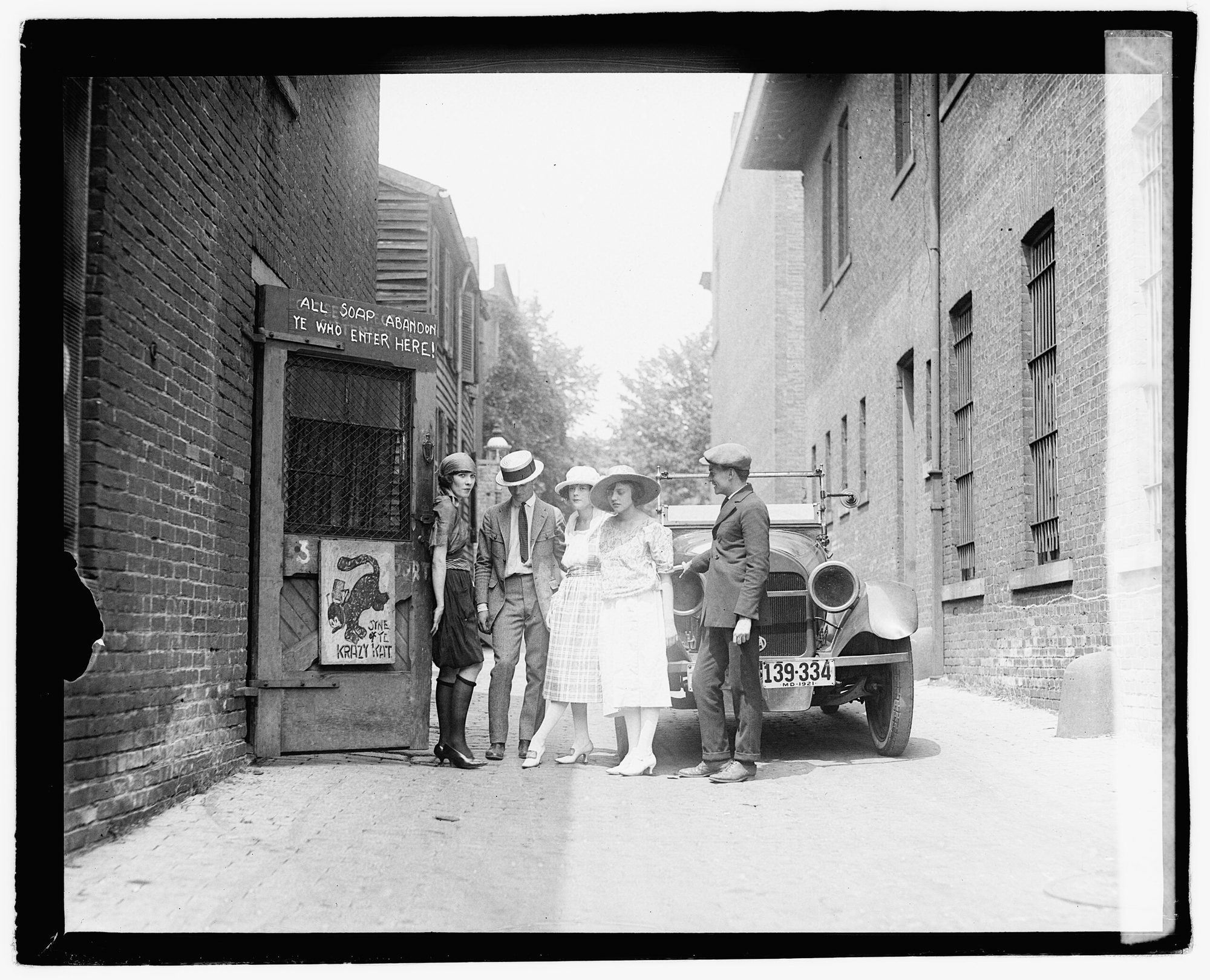
If we take a beat, and think on the time between Prohibition and the 1950s lez pulp sagas, the worldbuilding becomes clear. Remarkably, I could find so very little on actual gay and lesbian speakeasies, but multiple sources allude to them, as historians Lillian Faderman and Cookie Woolner both did on opening episodes of Our Dyke Histories. A speakeasy independent of the mafia – and perhaps why it only lasted a few years before being actually recorded in history – the Krazy Kat Klub, which hosted raging jazz parties and was dubbed a "a hidden haunt where one might find in comradeship those divine, congenial devils, art inspired and mad, no doubt" by The Washington Times. Evidently in it's brief 1919-1922 existence, it was delightfully queer.
At different moments in the 1930s, there were restrictions on women drinking in public without as escort. Which brings us to the Howdy Club. Ye olde and often deeply reliable Lost Womyn's Blogspot entry on the HC quotes antiracist, labor and queer historian (who I wish I could have met and known) Allan Berubé:
Cities clamped down on women's public heterosexual activity. ... Partly because of such restrictions, lesbian GIs rarely found a predominantly female bar in any city, although "men only" bars were common. Instead, together with lesbian civilians, they carved out their own social territories in corners of bars frequented by gay men, such as the Black Cat in San Francisco or the Howdy Club in New York City, and often went out in the company of their gay male friends.
There are few lesbian-ish bars/speakeasies/whatever they may be in New York City in the 1930s, a.k.a. public spaces that were more than private parties that were known to draw dykes. Often lezbiqueetrans public spaces were luncheonettes and restaurants where dykes gathered. One stand out is Greenwich Village's Howdy Club, as noted by Lisa Davis:
The Howdy Club is the earliest club I know about that hired lesbians as entertainers–strippers, singers like Blackie Dennis, and chorus boys who might serve the first round of drinks, then join the floorshow. They were paid a token $10/night, but made a small fortune in tips. The Howdy dates back to the late 1930s, when many midtown operations that featured strippers and other risqué acts moved downtown to the Village, fleeing from Mayor Fiorello LaGuardia's attempts to clean up the troublesome Times Square area–target of many subsequent cleanups.
Of course, the Howdy Club was also a scene for drama and violence.
The details are in the geography. Go figure. 😏 As a reminder, I am speaking primarily of the East Coast and Midwest.
Another time we can discuss the West Coast, where the mafia never took hold. San Francisco mostly stayed a "wet town," which meant they didn't fully regulate Prohibition, and instead the police profited from charging bar and club owners. Places like SF's Finnocchio's and other L.A. bars and clubs made their money off of racialized racist and sexual tourism. Gender impersonators were the main draw. And around these performers, queer audiences also gathered and thrived.
For all references to the Howdy Club, I draw heavily on and am grateful to the HC entry on ye olde Lost Womyn's Blogspot for the Berubé and Davis quotes, and piecing together those ideas I build on here. I cite this material knowing that the ifnal entries of the LWB became quite anti-TERFy, but recognizing the thoughtful and careful research that existed otherwise, and which still feeds our understanding of lez, bi, queer and trans spaces. Also, thank the goddesses LWB recorded the quote from Davis, which is no longer online or archived.