"Softball, Separatism, and the Shescape Seven, 1970s"

We're back at it sharing the transcripts from Part 1 of Our Dyke Histories podcast decade-by-decade coverage on dyke bars* around the world. We spent four profound episodes in the 1970s because there's you just gotta, friends. They did so much, those lesbian feminists and those lesbians who were and weren't feminists but were surely not lesbian feminists. This groundbreaking era built entire dyke ecosystems, worlds we can only imagine because these lezbiqueertrans folks went public – and they never ever let go of their bars. In fact, they fought for them.
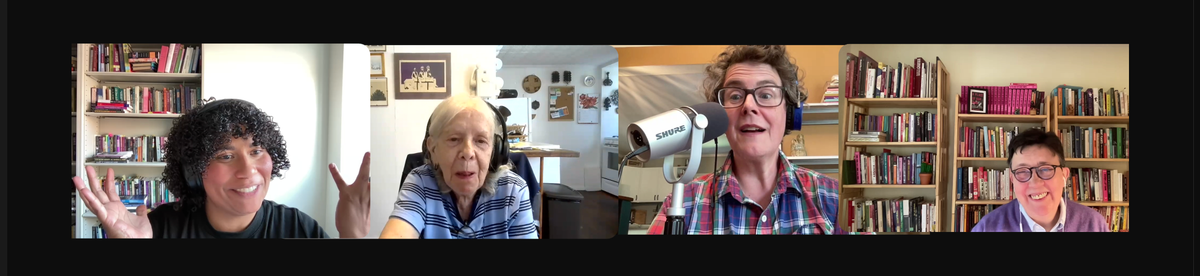
A quick sum? Our fabulous conversations in Episode 7 of Our Dyke Histories breaks open the messy, brilliant contradictions of 1970s lesbian life. Join host Jack Jen Gieseking in conversation with lifelong activist Maxine Wolfe, historian and podcaster June Thomas, and literary scholar and historian SaraEllen Strongman. Together, they trace a decade shaped by separatism, softball leagues, racist bar door policies, the rise of the Christian Right, and the fierce groundwork of lesbian feminism. From Anita Bryant’s Save Our Children crusade to the Shescape Seven’s battle against racial discrimination, the episode reveals how queers built dyke infrastructures — publishers, collectives, consciousness-raising groups, bookstores, and bars — while fighting right-wing fearmongering that still echoes today. This is the decade where lesbian potentiality explodes.
Jack Gieseking - Narrator: [00:00:00] Buckle up buttercups, because we're going back to the '70s. If you think you hate lesbian feminism, get ready to find some magic in this decade and embrace lezbiqueertrans complexity. These dyke ecosystems create an infrastructure of spaces that mean we don't have to hang out only in those dark, back alleys.
Bars and parties, they're no longer the quintessential space that dikes need for survival. But at the same time, the bars and the parties will stay our primary—I guess maybe we could even think about this as a poly relationship. Lezbiqueertrans bars and parties were the publics to see and be seen in. They were the places to share fashion information, to learn what was going on, to learn how to date and who to date just as much as they are in still so many ways today.
I did it again. This chat was so on fire, y'all, that this is a two-parter. Enjoy part one of two.
We have three amazing guests this week. Let me introduce them and some of the knowledge they'll drop to help you rethink queer history and your crush on, despising of, and or indifference to dyke bars.
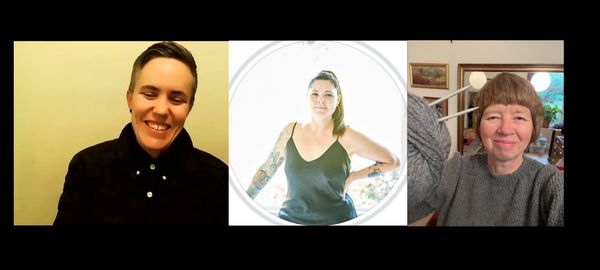
First here comes SaraEllen.
SaraEllen Strongman: Hi, I'm SaraEllen Strongman. I am writing a book on black feminist sociality and literary culture in the 1970s and eighties.
Jack Gieseking - Narrator: Her book in progress is titled The Sisterhood: Black Women, Black Feminism, and the Women's Liberation Movement. We'll particularly talk about women of color, are starting to call out the bars don't always work for them.
SaraEllen Strongman: One of the major figures in my book is Pat Parker, a black lesbian feminist poet who spends a lot of her life in the Bay Area and is very active in the social and literary scene in the bars. A lot of the places that I encounter in my research – bars are those places that are not as welcoming, to women of color.
One of my favorite Parker poems.
Jack Gieseking - Narrator: I also wanted to bring in a journalist, researcher, and professional podcaster, and her accent is awesome.
June Thomas: I'm June Thomas. I am a journalist, a podcaster, and [00:02:00] I'm the author of A Place of Our Own: Six Spaces That Shaped Queer Women’s Culture. I'm in Edinburgh, Scotland.
Jack Gieseking - Narrator: June will especially help us think through the dyke constellations of places that remain interwoven and interdependent with bars and parties:
June Thomas: I personally am a very indoor person, but I do see the appeal of-- if our choices are, and of course they are not the bar or the softball field, both have much to offer-- but it does feel like the softball field is probably better for us overall, even though clearly in the great war the bar has won.
Jack Gieseking - Narrator: Now here's Maxine Wolfe. Last, but the opposite of least as someone who co-founded the Lesbian Avengers and played a wildly significant role in ACT UP, along with a multitude of other activist groups.
Maxine Wolfe: I am in Brooklyn, New York, where I am born and bred. I'm a lesbian activist. I was on the faculty of the Graduate Center at City University of New York. I wrote a about the history of the social production of lesbian bars. I'm still one of the coordinators of the Lesbian Herstory Archives.
Jack Gieseking: And how many years has that been?
Maxine Wolfe: Many, let's see, I started in 1984.
June Thomas: 40 years.
Maxine Wolfe: That's right.
Jack Gieseking: That's amazing. Max.
Jack Gieseking - Narrator: Content warning: we will use different language for different identities that change over time. And you might not always agree with these thoughts on lesbian feminism, but they're definitely gonna make you think.
Jack Gieseking: As we're talking about lesbian bars, queer parties, other forms of sociality that had some sort of beverage attached to them, when you about the landscape of the seventies, what do those spaces look like?
Maxine Wolfe: Well, the ones that I went, I mean, they were very diverse. I couldn't tell you what they individually looked like.
In the early part of the seventies, a lot of them were still run, in New York, by, the [00:04:00] mafia. But by the mid seventies, that was no longer true.
And there were more, more bars opening that were being opened by individual owners. There were also alternative spaces that people had created. There was the women's Coffee house, restaurants, I'm trying to remember the name of
June Thomas: the courage.
Maxine Wolfe: Mother Courage. Right. So there were plenty of other, and there was the women's building, which had been taken over by a group of women, in I guess 1973, and it kept going until well into the early nineties actually.
June Thomas: You know, I do think it's super important to talk about those other places. I remember when I was working on a story about gay bar, so gay and lesbian.
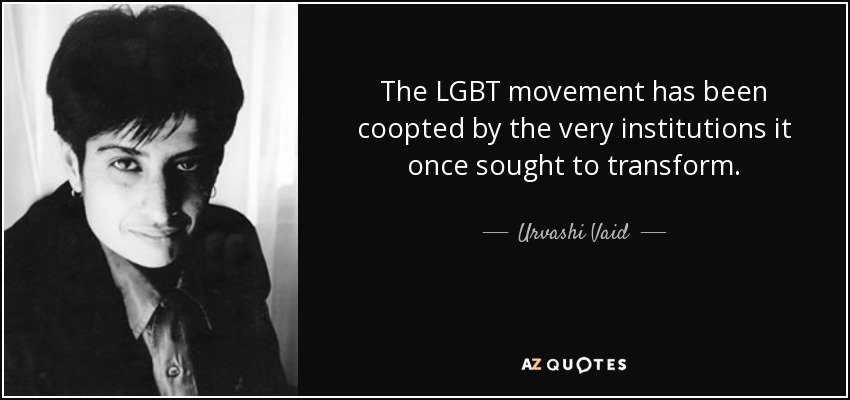
I spoke with Urvashi Vaid and, and she said, it's kind of one of the failures of the queer movement that there are so many people who go to bars every weekend, a tiny fraction of those people has ever been involved in queer politics.
And I think that maybe changed in the fight for marriage equality. I think that was maybe a cause that kind of more people could attach themselves to, maybe bars themselves became more politically engaged.
But there's an aspect of queer sociability that, like we're—especially some of the people on this call, or been amazing political activists, and yet we spend so much time talking about bars, which for a long time were the antithesis of political action.
Maxine Wolfe: I would also say that in New York, the bar owners did not want anybody doing any activism. If I would come with a leaflet, I couldn't get inside. I'd have to be outside. Um, and that went for a march. For a meeting, for anything. They wanted the people who came [00:06:00] in there to drink, not to do politics.
I remember the first place that really welcomed political people in New York was a bar called Crazy Nanny’s. They not only invited people in, they actually held fundraisers. And that was mostly, they started by doing it for the Irish lesbian and gay organization.
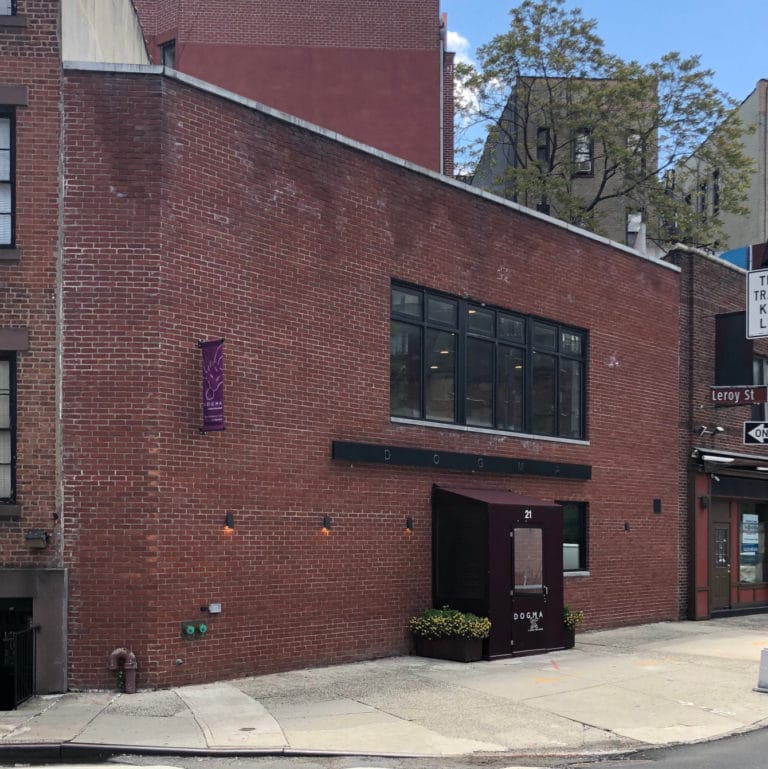
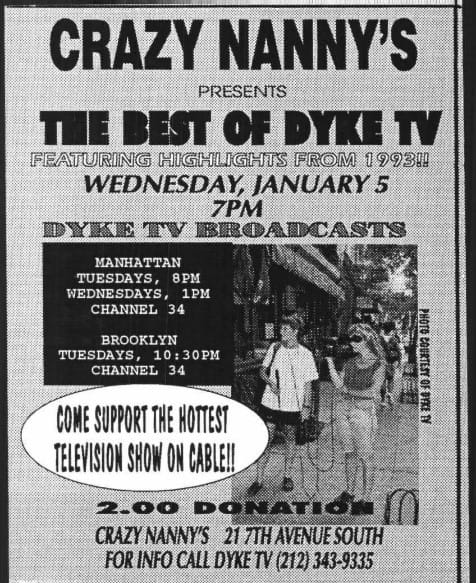
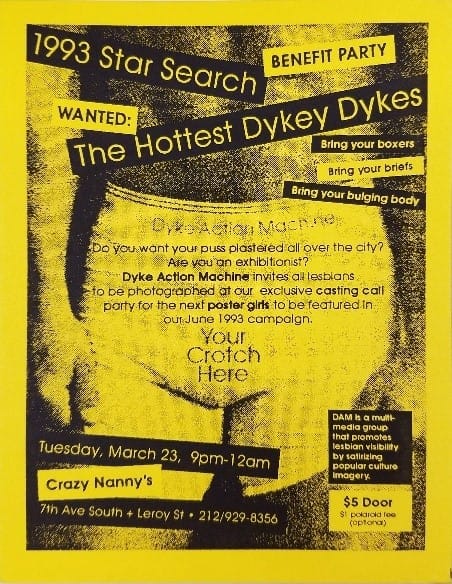
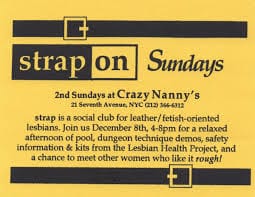
Crazy Nanny's bar front at 21 &th Ave South, and flyers from the bar. Check out NYC LGBT Sites Project for more.
June Thomas: Crazy Nanny’s was owned by Elaine Romagnoli, who was somebody that I spoke with Long after, she had left being a lesbian bar owner. She was still involved in bars in a very frustrated way working with straight men who just drove her crazy because they didn't appreciate her expertise until there was some problem when suddenly they wanted to know what she would do.
That was her activism.
And I've heard that from other people who run bars, that bars are the place where most people go as their first, you know, oh, I think I might be queer, i'll go to a bar and find my people.
And they see it, just having a bar, having a place for people to go as activism. She did talk a lot to me about, that she saw it as a place to organize, as a place to raise funds.
Jack Gieseking: When we think of the lesbian feminist 1970s, we definitely imagine a political time, but bars couldn't be less political.
What a radical change in dyke bar culture in the second half of the 20th century. When we think back to the 1950s, I wonder how much the bar being apolitical was to make any shared public space that didn't have to deal with the cruel reality of state oppression and violence.
June Thomas: What you were saying about bars just being very opposed to having, any kind of organizing happen in them. I read about a bar in Portland, Oregon, that was run by lesbians in 1977. So it was in that time when bars were changing and they wanted the people who went there to be fair to them because the women who went to the bar [00:08:00] expected much more from a bar that was owned by lesbians.
They wanted: well, why can't we organize? Why can't we, play women's music? Why can't we have political discussions? The women said, well, you can kind of, could do that anywhere, but people who come into the bar, wanting to have a drink, they don't really want you to buttonhole them about politics. You can't really play women's music. People don't wanna dance to that. The bar that's owned by guys down the street that you patronize, they don't do those things either. This is a place where people come to relax and get away from politics and problems.
Even lesbian operated bars that were potentially open to politics had a resistance. There's a lot of that around the whole country.
Jack Gieseking - Narrator: In the 1970s, you need to understand that most bars were very working- class spaces. They were deeply butch, femme in their identities. But lesbian feminism would bring massive shifts about what gender was and what it could look like. The queen herself, Joan Nestle, says that they created their own genders in the forties to the sixties.
I'm sure she's right, but by the 1970s there's a bit of at times and us versus them fight going on, which is a bummer.
You can't have gender and you can't have class without what you guessed at: sisters, brothers and them stars: race.
We also just heard about Elaine Romagnoli. I'll remind you who she is as we go on, but Elaine is a major character in New York City Dyke life. She also happens to be the only lesbian bar owner that I know of who had a New York Times obituary. Well done, Elaine.
According to many sources. Elaine Romagnoli was also the kind of lesbian bar owner we all want to frequent. She was pro-black, protrans, anti-racist, and evidently a wildly good time. But most bars and parties were not Elaine's parties, and surely she fell short often too.
These spaces were heavily racialized in a way that didn't [00:10:00] allow people to be who they are. When I said these spaces were historically butch, femme, they were actually historically butch, femme, and very white.
Parker takes on topics ranging from growing up in poverty and dealing with her sexual assault to the murder of her sister.
She came out as a lesbian, and she said that she was liberated and quote, she knew no limits when it came to expressing the inner most parts of herself.
And thank the goddess, she did.
Jack Gieseking: You brought up Crazy Nanny’s, the first black lesbian bar in Greenwich Village. And to my knowledge, the only one still, ever. Bonnie and Clyde was predominantly African American in 1972, but it didn't bill itself as that. In the 1970s spaces are even more segregated. Elaine ran Bonnie and Clyde, then Cubby Hole, then crazy nineties.
These are three of the most storied bars in the history of New York City.
June Thomas: And Bonnie and Clyde had Bonnie's upstairs, which was the restaurant that apparently had a white crowd.
Maxine Wolfe: That's what it was a restaurant upstairs, which actually turned out to be a very she she restaurant, which was always really funny because downstairs was pool playing bar. It was definitely a working- class, mixed, bar, all women were welcome and it was really, amazing for that.
I think she started that restaurant because she might not have been making as much money. There was a bar for black lesbians that I've been searching for the name of it, but it existed for a very short time. It was right before, the crackdown on bars in Greenwich Village when they wanted to sell off all the property and stuff.
SaraEllen Strongman: One of the major figures in my book is Pat Parker, a black lesbian feminist poet who spends a lot of her life in the Bay Area and is very active in the social and literary scene in the bars. A lot of the places that I encounter in my research -- bars is those places that are not as welcoming, to women of color. [00:12:00] Parker has sort of funny relationships with bars and certain club spaces as a poet.
This tour, she takes, in 1974 to 1975, she and her girlfriend at the time, get in a car and drive across the country. Bars are places sometimes where she's performing with musicians, and musicians want a higher cut of the door, and she gets really upset about that. Actually, in DC there's a moment where this happens, but one of the women who is in attendance says, why don't you do another reading?
And so Sharon Gomillion invites all these people to her house, all of these black lesbians, and Parker does a reading there. She has all this booze and takes money at the door. And Parker talks about that as being such a more enjoyable experience to be surrounded by these people.
And She wrote a bunch of letters that are really funny. She complains at various points on the tour when they're staying with people that like all the white lesbians are vegetarians and she can't. And she's from Texas originally and she wants to eat good food and like, these are all her people. So these bars are also a space where some of these different social tensions emerge.
And that's not to say that Parker doesn't frequent bars. She goes to and performs at Ollie's. She's, a regular at mod. She, is also a regular patron at, and it's not a bar, it's a cafe, the Brick Hut, also called a Dyke Diner.
Listen to Mary Watkins sing about the Brick Hut / Dyke Diner!
Um, There's a song that Mary Watkins records on her first album with Olivia Records in 78. The cover of that album is a shot from inside the Brick Hut. And Parker pens the lyrics for the song Brick Hut being a fun community place, they've got everything from drinks to scrambled eggs.
So there are, in the Bay Area, all of these other things that are next to bookstores, close to, coffee hu that aren't bars, but are still very much a part of that same social meu..
Jack Gieseking: It feels like, in the beginning of the 1970s you're entering with this very extreme butch femme working class expectation in most bars. [00:14:00] And by the end of the 1970s, feminism and lesbian feminism has reinvented all of these places.
As has softball.
Jack Gieseking - Narrator: Ha! You think I jest. But the reason that we make all those jokes about softballs is, softball is a major paradigm shift. We laugh about softball is one of those core dyke tropes, -- and I had no idea about this until I talked with June, Max, and SaraEllen-- but it might've even saved some of our lives.
Whoa.
As we start to see: the way race, class, and gender structured dyke life didn't just stay in the bars, and bars don't end at a physical doorstop because how they operate shapes the entire dike world in the 1970s -- and in the same way I would say today.
Softball is this huge economy of people coming in un masse, and everyone who wants to flirt with them and date them are going to these bars.
SaraEllen Strongman: Actually, one of the ways that bars show up in Parker's life is through some of these other lesbian spaces.
Jack Gieseking: Ooh, most excellent. Say more.
SaraEllen Strongman: So It's through Rec Sports League, specifically softball, in 73, 74. In the Bay Area, there's basketball leagues, softball leagues. One season a bunch of women of color– so black women, Asian American women, Latino women, indigenous women, – are playing in this league, but on different teams. And they're having uneven experiences. So a bunch of 'em get together and decide for the next softball season, they're gonna form their own team called Gente, which is Spanish for people or folk.
That year in the Bay Area Women's Softball League, there are 10 teams. Nine of them are bar teams. So they have bars as like home places or sponsors. And Heta is the one team in this league, the 10th team, that doesn't have one. And part of this is because there's sort of a tension for them between the bars being places they can congregate.
And actually Lesbian Tide does this like cover story on them where they interview the whole team. It's really cool. So they say, like : one of us goes in, we're invisible. But the whole team shows up and it really changes the space. We're seen as threatening, violence might happen. One [00:16:00] of the women in this interview says, I don't think third world women need to be in the bars. The bars are for white women. We can create other spaces where we can have this socialization.
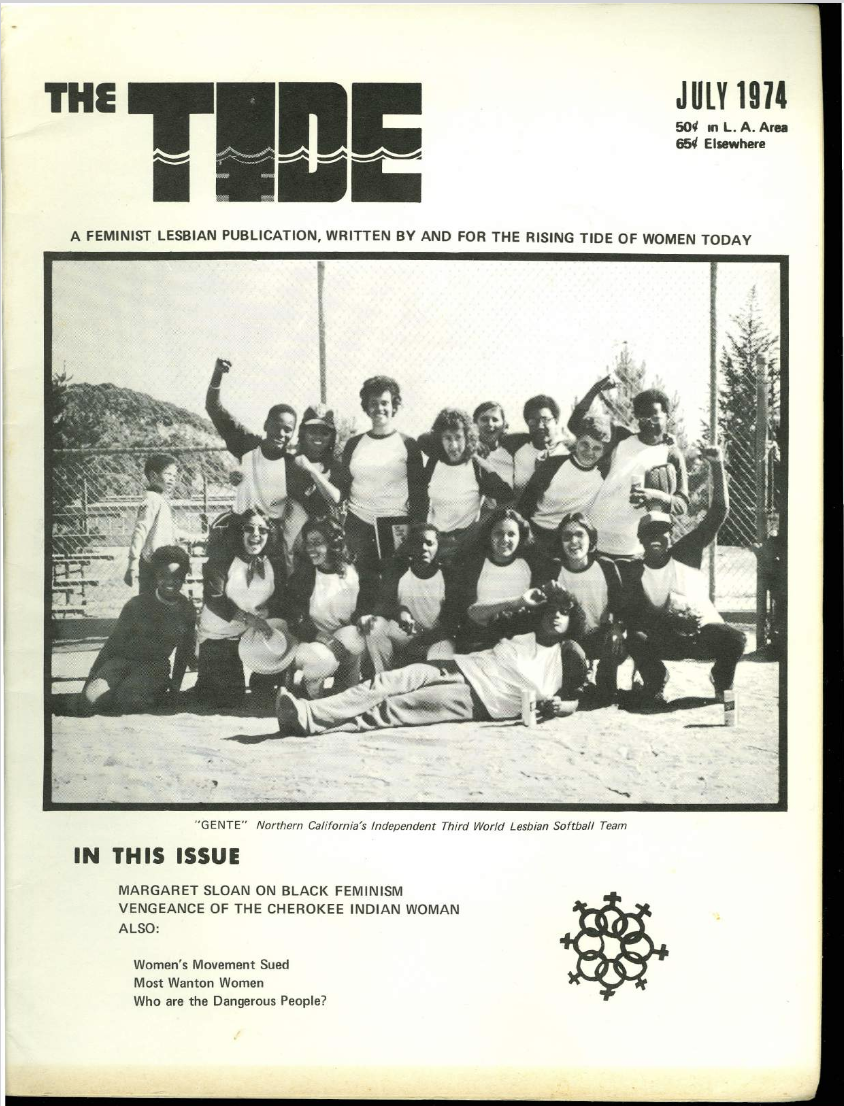
It doesn't work out quite that cleanly because as part of the like sports league thing, you like go out to the bars afterwards and they don't have a home bar. So they go up to the other team's bars -- and then there's this expectation you're buying rounds of drinks, which also creates some class tension.
But the softball team is the space that, for Parker at least, is one of Intraracial, or at least third World Women's Solidarity.
Jack Gieseking - Narrator: I am just gonna jump in quickly in case you bristled at the idea of quote, "Third World Women," end quote. But before we have the term women of color, we have third world women. And this concept starts as solidarity, not only among women of color in the United States, but women of color around the world. This concept comes out of the late sixties and is carried through the 1980s, which is probably why we don't hear about it very much. And now back to softball and Pat Parker.
SaraEllen Strongman: She's a poem named after the team called Gente. And In, the collection, that it's published in, there's a photo of the team of course that's printed, as well. She talks about as being a space where she can understand other people understanding her experience, not questioning her experience, and it being a safe space.
In that poem, there's a line: it feels good to hear we're gonna have a party and know it's really going to be a party. The next stanza. It feels good to be able to say, my sisters and not have any reservations.
In some ways the bars, are failed, attempts at creating community. These things that are proximate to the bars become successful sites.
June Thomas: SaraEllen, it's really interesting that in that collection of letters that,, sort of side project of Sinister Wisdom published between Parker and Audra Lorde, she has letters about how she's trying to stop drinking and she's trying to get in shape more and she is playing softball and then has an [00:18:00] injury and also talks about having to go to bars and, it is a real tension.
Obviously it's wrong to, suggest that bars and softball are in opposition because as you said, like nine of the 10 bars in the Bay Area softball were sponsored by bars at that point.
Jack Gieseking: I think what you're getting at here, June, is how lesbians now in the seventies finally have places, primary places in their dike lives that aren't foremost defined by alcohol. And poignantly. The first L-G-B-T-Q AA meeting is going to launch in the seventies.
June Thomas: Yeah, they're another component of potential lesbian socializing that might be more healthy, that might be more, sort of a, a cleaner socialization. you know, you're not out at night actually to play softball. You're outdoors.
I personally am a very indoor person, but I do see the appeal of-- if our choices are, and of course they are not the bar or the softball field, both have much to offer-- but it does feel like the softball field is probably better for us overall, even though clearly in the great war the bar has won.
Jack Gieseking: An equal number of breakups and drama. On the softball field,
June Thomas: Totally. Totally.
Jack Gieseking - Narrator: Quick side story because it's one of my favorite Les by Queer Transa places of all times: St. Mark's Women's Health Collective founded in 1974 on St. Mark's place.
If you've ever been to St. Mark's, it's like this hip street that NYU first years go to hang out on. They think it's like the coolest thing. There's a cheap vegan restaurant and probably like a skateboard place and some vintage stuff, if any of that's even still there in gentrified New But back in 1974 it was pretty abandoned. So it was a cheap place for women as they self-identified at the time to build their own health collective. Get this, you could go in and pull out your own health file! You had access to all of your health information at any time! And if you were nervous, they would [00:20:00] play you acoustic folk rock as you waited for your gynecological appointment and made ut. How cool is that?
June Thomas: I do think that, again, softball is another potential political organization. For the most part it isn't. But, in my book I talk about, ALFA, the Atlanta Lesbian Feminist Alliance.
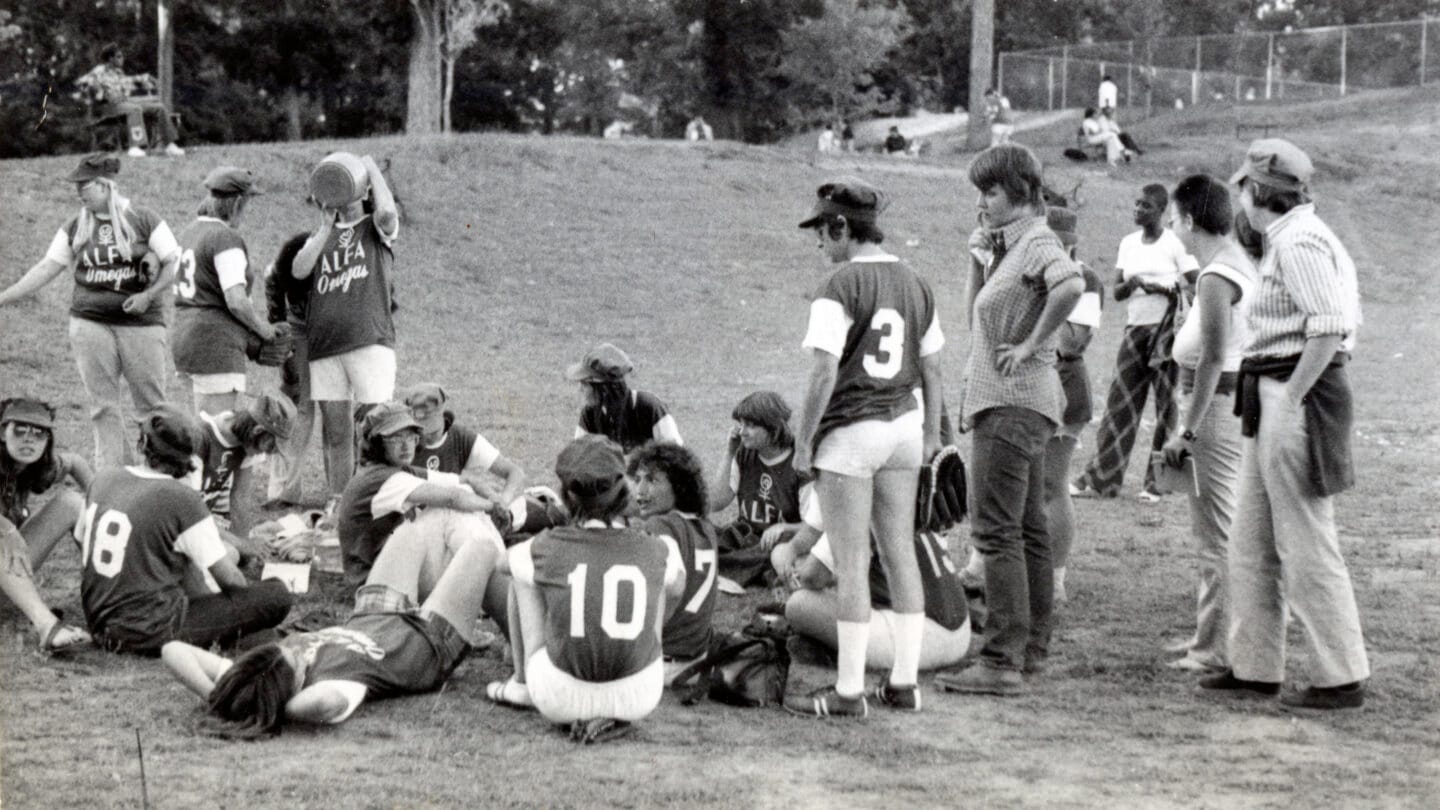
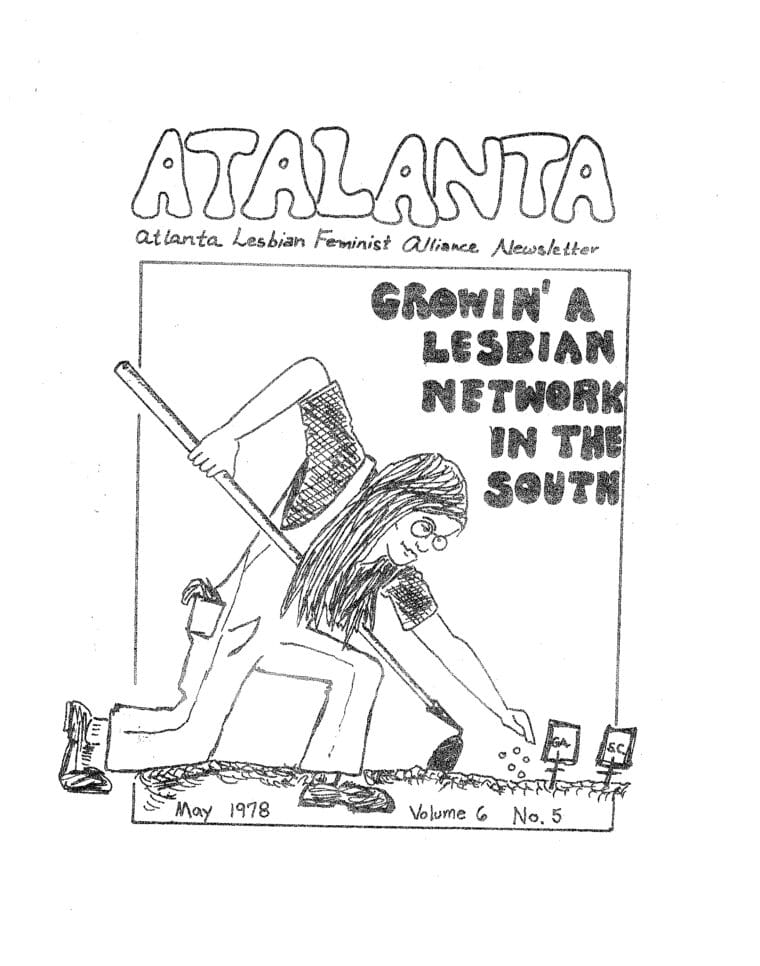
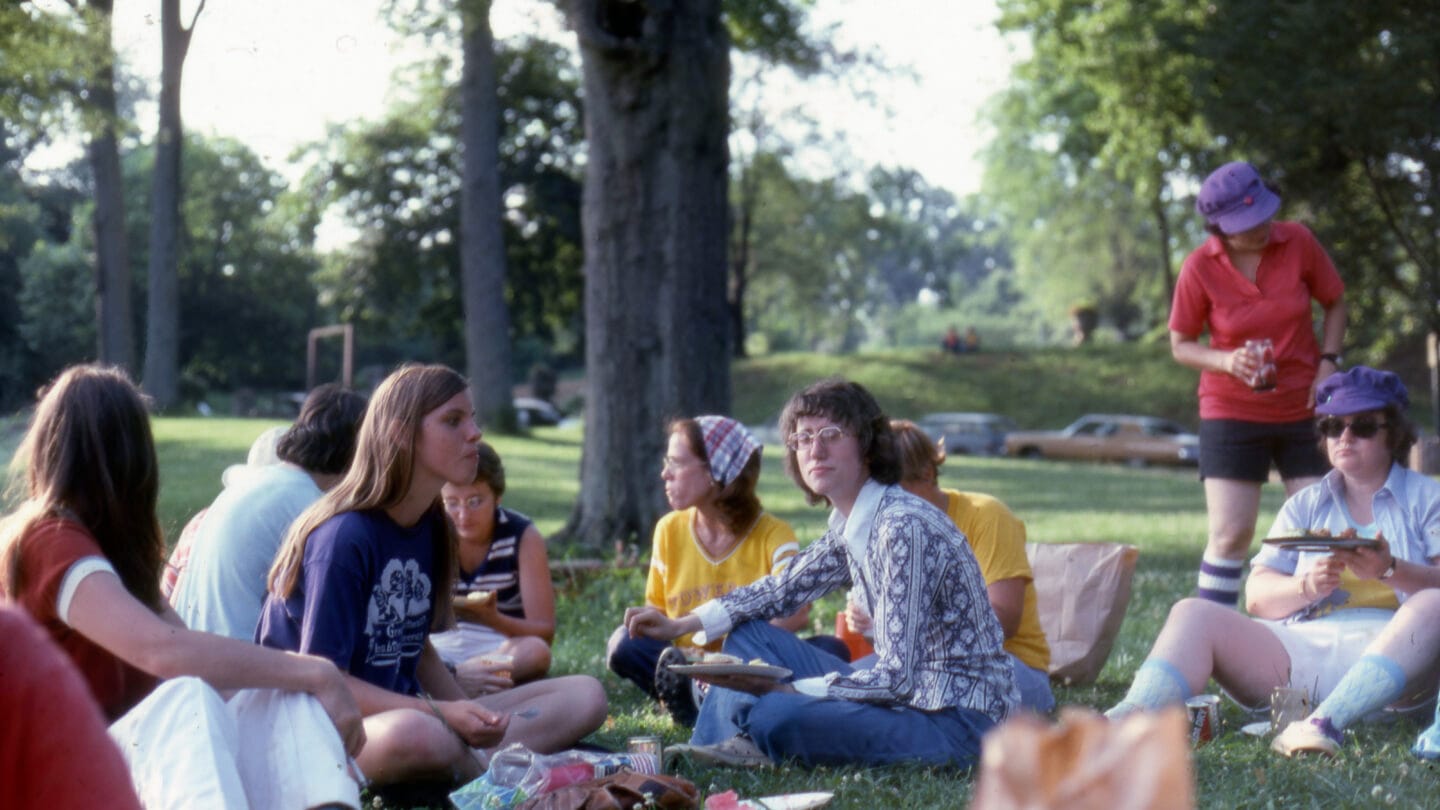
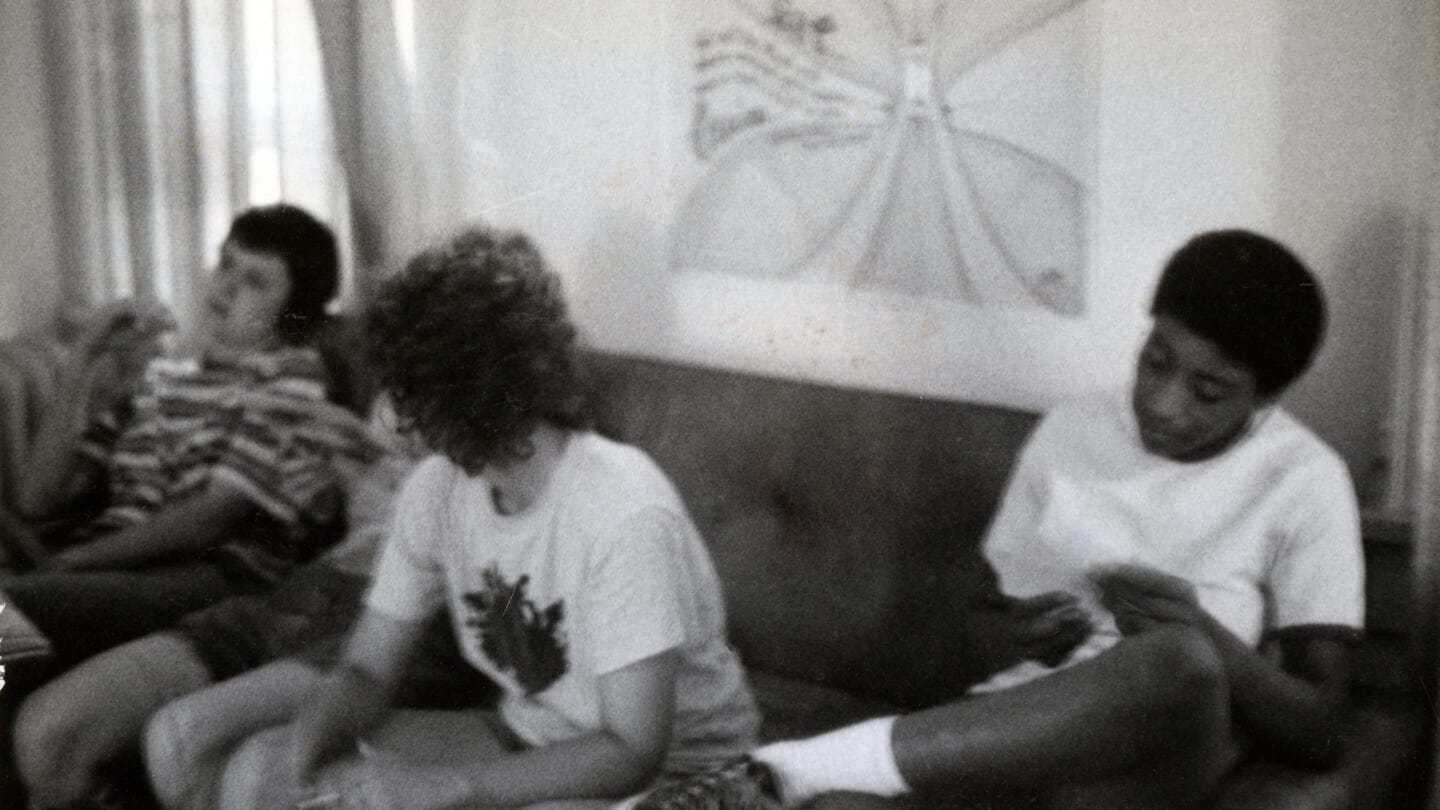
Images of the The Atlanta Lesbian Feminist Alliance from the Atlanta History Center coverage.
They were a very political, lesbian feminist organization and they knew they needed to recruit more women. 'cause they'd kind of maxed out, from their network. They said, where are the thus far apolitical women? They knew it was the softball field. During that process of starting teams and teams playing in the rec league, several of them got in touch with their inner jock.
At that point there was no Title ix. They hadn't ever had any training. So many of those early softball teams, the feminist ones, we're really about helping women to Get some training to learn what it would be like to use your body in a athletic or athletic adjacent way. That it can be a both a fun thing that it genuinely is, but also can be something that helps organize.
When Alpha started its first team, they went from having 35 members to a hundred. Also it changed the group completely because that 65 women who weren't necessarily as political.
So it changes things, but it expands things too.
Jack Gieseking - Narrator: At this point, if there's one thing you take away from this podcast, besides our love of softball and why, is that lesbian feminism contains multitudes. It contains multitudes in the ways it's going to shape and rework dyke bars and parties, and also in the fact that we can really have multiple voices in the same space, even if they're ca kaus. Political activism started to work and look differently over time.
Also, as a heads up, Maxine Wolf is actually about to disagree with herself and everyone else in the pod. That's what a longtime activist is great at. Thank The Goddess,
Maxine Wolfe: The image of bars that's [00:22:00] coming out doesn't sit with me. Because they were mostly working class places. Interestingly I took group of dykes to a bar that was in my neighborhood that I grew up, which at that point, was an Orthodox Jewish neighborhood. The edge of Borough Park. But this one was interesting because I felt like I was walking into the past because everyone in it was Butch Femme. This was 1982. It was not in the seventies.
June Thomas: Mm-hmm.
Jack Gieseking - Narrator: While we spent a lot of time talking about bars in Manhattan or across New York City, most bars in the 1970s didn't list their address or publicize themselves for safety. Or they lasted so briefly, they didn't have a chance to do so. Or they didn't even have a newspaper to publish their address in.
Maxine Wolfe: Okay. Also that Deb Edel and Joan Nessel, they organized in bars. That's how they got the Lesbian Herstory archive started. They went into bars, they had shopping bags, they had things that were theirs or Mabel's or somebody else's. Okay. And they did show and tell
Jack Gieseking: Wow.
Maxine Wolfe: to start giving them their papers.
Jack Gieseking: I've never heard that.
June Thomas: neither. Me neither,
Jack Gieseking: God. Wow.
Jack Gieseking - Narrator: I know you've heard about her in other episodes-- and really, we shouldn't have an episode without Mabel Hampton because so much of our history wouldn't be possible without her. Hampton lived from 1902 to 1989. She was a dancer during the Harlem Renaissance. She's a well known black lesbian activist and her materials are in some ways the basis of the Lesbian Herstory archives, ranging from oral histories to cards she gave out at a rent party for the 1930s with her partner Lillian Foster. She marched in the first national march on Washington for lesbian and gay rights, and she spoke at the New York City Gay and Lesbian Pride Parade. She was even named Pride Marshall in 1985. She was also wildly [00:24:00] adorable. Check out her photos online.
Maxine Wolfe: :They went to any place that there were lesbians and that was a major place for lesbians in 19 73, 74. Even though Joan belonged to the gay academic Union, she comes from a working class background, as I do. And that's where she thought to go: to the bars, which is where she came out.
I think it's one of the reasons that our collection is so broad and has every kind of lesbian you can imagine, because we never had the image that any place that you go to that has, lesbians or dikes, in it, is necessarily unpolitical just because that's where they are.
It could be that that's the only place there is.
June Thomas: Yeah.
Jack Gieseking: Yeah.
Maxine Wolfe: so that was one thing that I definitely wanted to make clear, that's the place for people to go to.
June Thomas: Yeah, yeah.
Jack Gieseking: When I was looking at the Gale Archives of Sexuality, which is a huge gender and sexuality online archive, if you haven't come across it, one thing that really stuck out to me, I, I am a geographer, was the number of materials I kept seeing from the rust belt.
I was just really struck by that because we wind up hearing a lot of stories about coastal cities like New York, dc, San Francisco, la, but most of the newsletters I was seeing were actually from places like Milwaukee or Buffalo, Detroit. And the first researched lesbian history was, Elizabeth Kennedy and Madeline Davis's, boots of leather, slippers of gold, which takes place in Buffalo. They really look at the period from the thirties to the sixties, focus a lot on dyke bars.
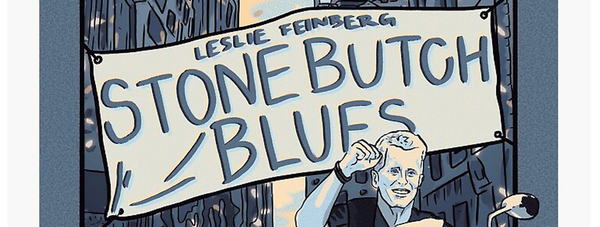
Then of course, stone Butch Blues by Leslie Feinberg, the sixties to seventies and eighties, which. Takes place in Buffalo, in New York City. And I remember laughing to myself, looking at these materials, thinking, oh my gosh, are are all lesbians from Buffalo? But then I said, [00:26:00] actually, it's labor, right?!
Where can people where can gender nonconforming people, where can butch people get jobs? They can get union jobs? That is a stable job that they can get. Where can fems get jobs? They're often forced to work as sex workers or work in jobs where they deeply have to hide who they are. And when you finally have an income, maybe even two incomes for working class people, you can solidly rent a home together. You can even, perhaps purchase a home. I mean, if they stay together, with all the pressures.
So working class sexualities start to flourish even more, particularly white working class sexualities because who's gonna get union jobs, right? They're happening especially in these areas and places where there's strong labor is another way of being political.
Like Leslie Feinberg was never not political.
And also at this moment, some lesbian feminists are gonna show up and say particularly about gender nonconforming people, butch people, and those that love them in the 1970s, that they're not doing lesbianism right. Am I right? Yeah. And, and I'm being polite.
They think: they're being anachronistic and patriarchal, they're mimicking men. They're mimicking the worst part of ci straight relationships.
There's a lot of agony and antagonism. It often falls out across class lines, just like in the 1950s when Daughters of Bilitis talk about quote bar dykes end quote, that these are these horrible people. You don't wanna hang out with them. We're gonna meet and be civilized and middle class, mostly white women.
Jack Gieseking - Narrator: Okay, so I had always heard that the daughters of Beis or Daughters ability us, we debate this as queer historians came outta the Madison Society meetings when the gay boys. Told them they could only be their secretary.
With more digging, I found out they were founded in 1955 by Rosalie Rose Bamberger, a Filipino woman who was working in a brush manufacturing shop who just wanted a place to hold parties and dance with her [00:28:00] girlfriend.
While Daughters of Titis did create the first national lesbian newsletter, for which we are deeply grateful, it did become a very solidly white middle class organization. I've heard very little of their partying culture.
June Thomas: Time is so relevant here, which is what you're getting at. I'm solidly working class, and when I moved to America, it was 1982, and there was a rejection of butch fem, there was a rejection of working class identity really. And bars were becoming more, don't know, I can't think of a posh word for it. When I was going to bars, like they weren't political, and that helped me latch onto that idea that though the bars were rejecting politics.
So I'm very glad that you pushed back against that Maxine because Yeah. Clearly that, that's such a great story about Deb and Joan.
SaraEllen Strongman: What you made me think of was even beyond bars as sites of politics, politics around bars.
So the first time I went to Lesbian Hearst Archives in Brooklyn, I was a grad student and I was looking for some stuff, and Deb Ed actually pushed me towards some things.
There are some places that I had never heard about that I first learned of the Lesbian Hers Day archives and one of them is DARE, Dykes Against Racism Everywhere. Of which Maxine was a founding member. Her and Joan Gibbs did such incredible work. Sort of part of what comes out of this lesbian anti-racism is also organizing around imperialism, but definitely domestically around police violence.
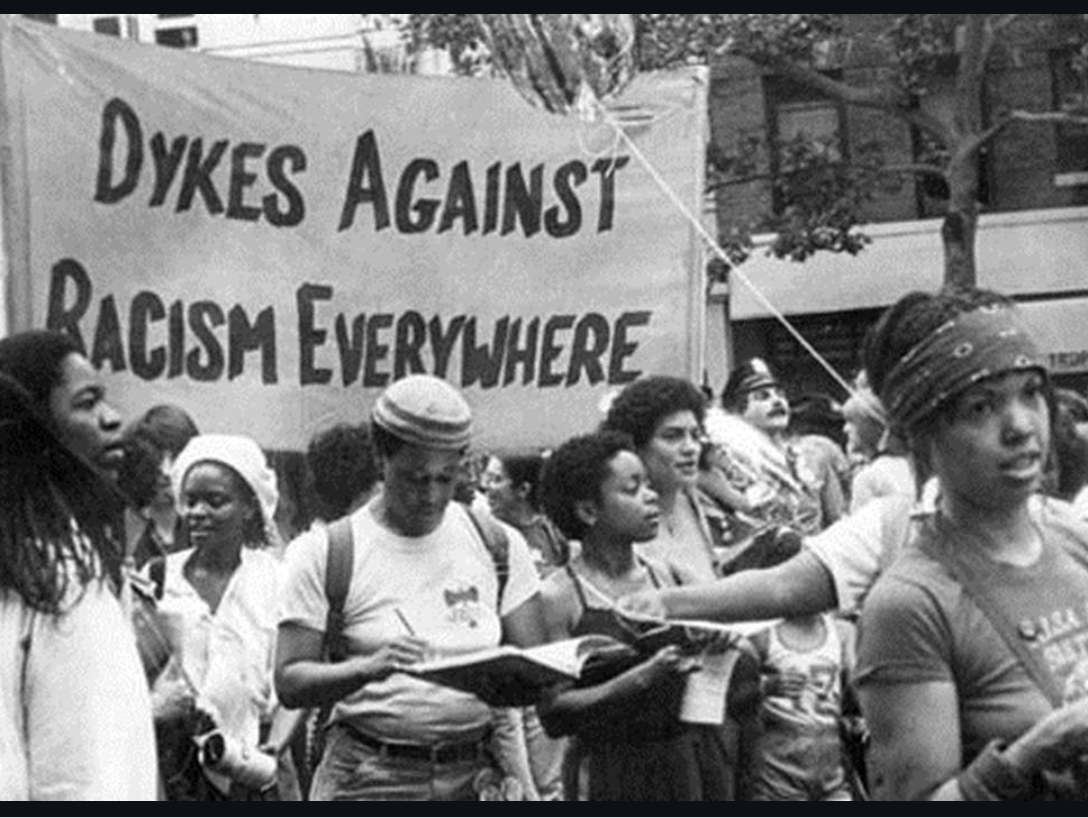
So this is also, I think, 1982 Maxine with Blues. There's a police raid of a bar in midtown,
Maxine Wolfe: --Times Square.
SaraEllen Strongman: Yeah. The police actually, I don't think they arrested anyone, but they brutalize a lot of people and DARE and then the New York chapter of black and white men together organize consciousness raising, but also activism around the police violence and the targeting of queer communities.
Jack Gieseking - Narrator: Okay. We're gonna dip very quickly into my book A Queer New York: Dykes Against Racism Everywhere or DARE– SaraEllen is right. It's a great name– co-organized to protest racial discrimination at the Village lesbian [00:30:00] Barber calls in 1991, around matters of quote unquote dress code. This is what else I wrote about this in a queer New York : Owners issued a statement regretting quote, that any woman of the gay community feels they have been discriminated against. This statement shifted the blame onto women and trans and gender non-conforming people of color, focusing on patrons feelings rather than their own discriminatory behavior. Clearly the bar is in position of a so-called dress code invoked, a range of racist stereotypes.
Okay, now back to our chat.
Jack Gieseking: I very much appreciate these glimpses into the eighties because they so clearly show us where the seventies are gonna lead us. Please keep going SaraEllen.
SaraEllen Strongman: That the bar is a site where that stuff happens. But also is a site of, of activism and anti-racism. Also in the eighties, a little bit later, 84, 85 in Boston, there's another great acronym for a group committee of outraged lesbians, COOL. And on their flyer, it's the two interlocked, women's symbols for lesbian, which is organized in response to, women of color getting kicked out of bars.
June Thomas: Or not getting into bars.
SaraEllen Strongman: Yes! We're gonna organize around the access to these social spaces and racism: what does it mean politically to have access to these spaces where people are socializing and finding community? And then how do we sort of organize around the ways in which that shows up within the community?
So we see both. Action about outsiders, about oppression from the state and even within, like how do we navigate those things?
It's always really interesting to me when people talk about, the more recent baggage that, lesbian feminism have around TERFs.
Where actually like lesbian feminist anti-racism in the 1970s and 1980s, these are the people on the forefront, you know, including Maxine of being like, no, we're not gonna do that. Actually our politics needs to be something very different. And bars are a place where that's also happening.
Maxine Wolfe: Yeah, I just wanted to correct you, I didn't start,
I didn't start there at all.
Jack Gieseking: To know that's one of the--
SaraEllen Strongman: Yep.
Maxine Wolfe: [00:32:00] No, and you are right. One of the biggest things that people did was to picket bars that were carding black lesbians. That they were the only people being asked for ID.
Jack Gieseking - Narrator: The Shescape Seven. First of all, you're likely wondering what the hell's a she scape. It was one of the most popular parties in New York City for at least a decade. It traveled from place to place, and in order to find out where it was on a given week or month, you'd have to call a phone number. I kid you not that when I did my research interviewing Dykes who came out from 1983 to 2008, I had more than one participant call out the phone number from the top of their head, even though they hadn't used it in over a decade.
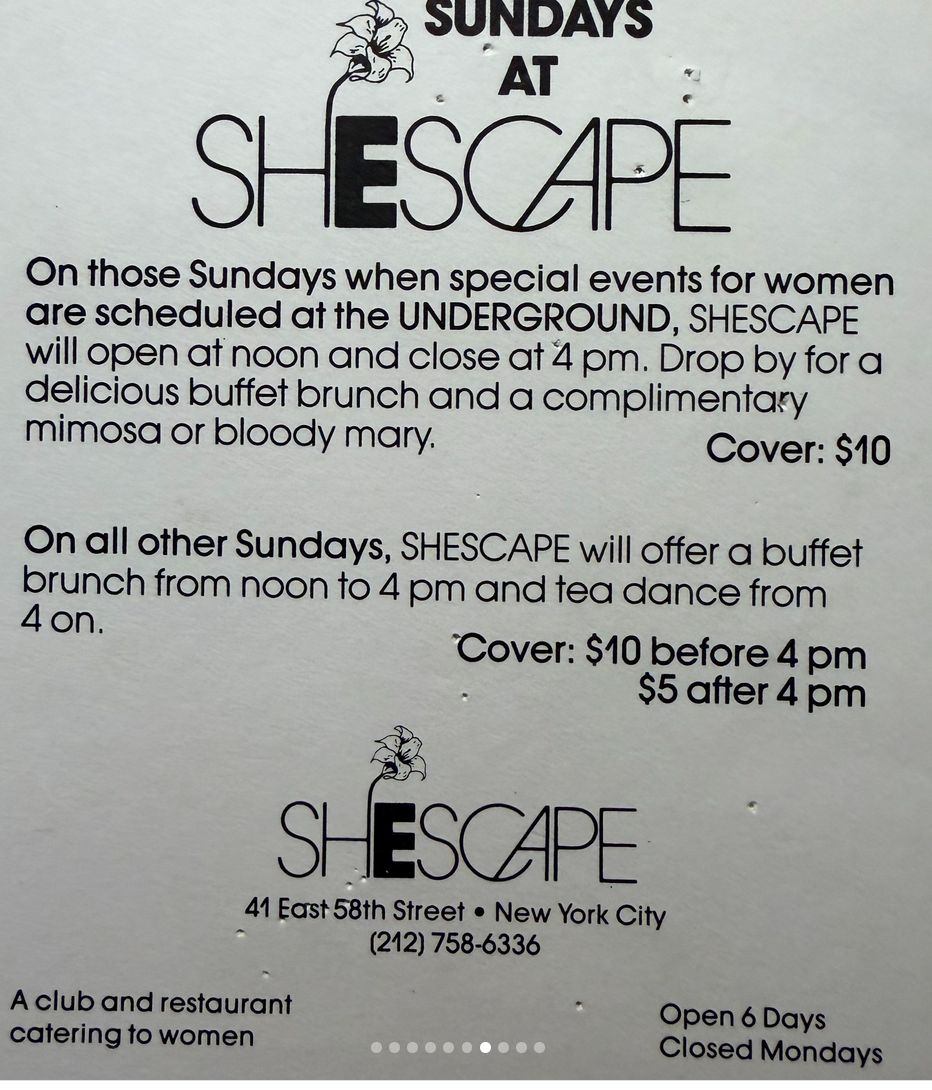
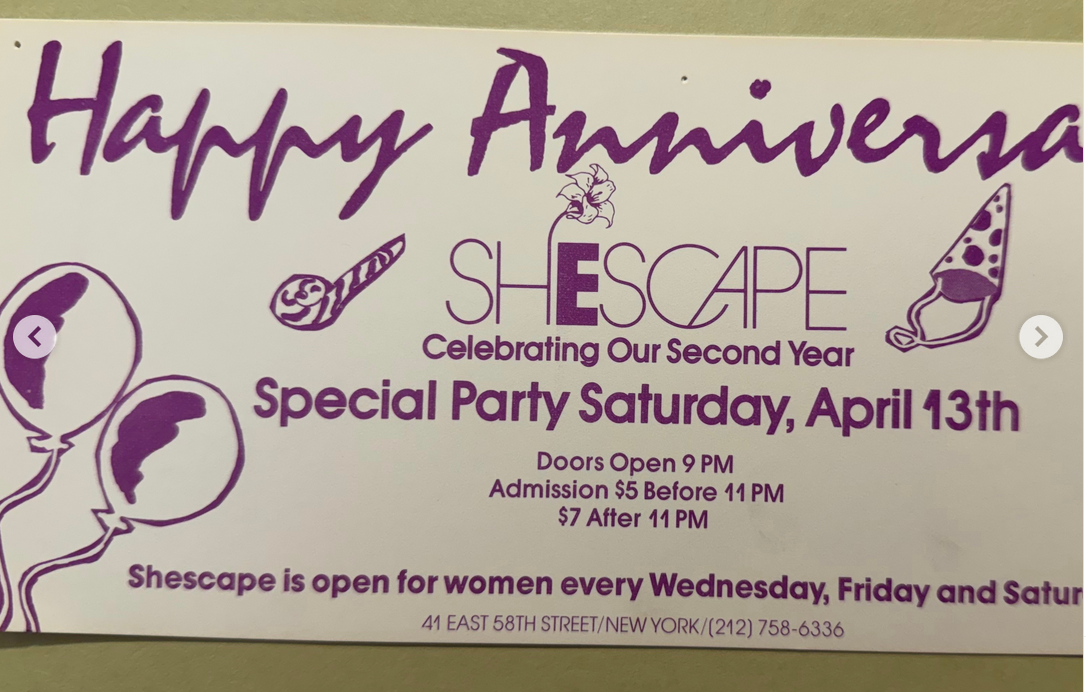
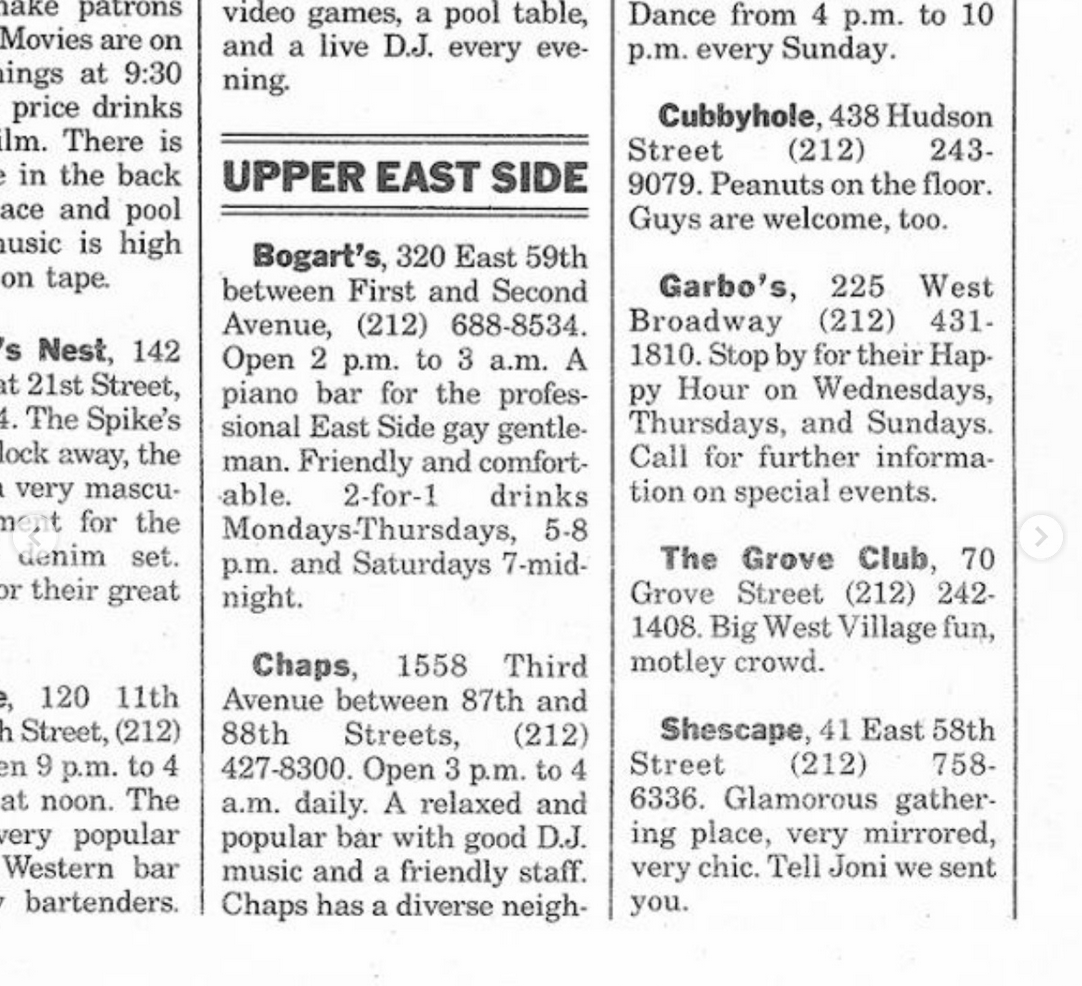
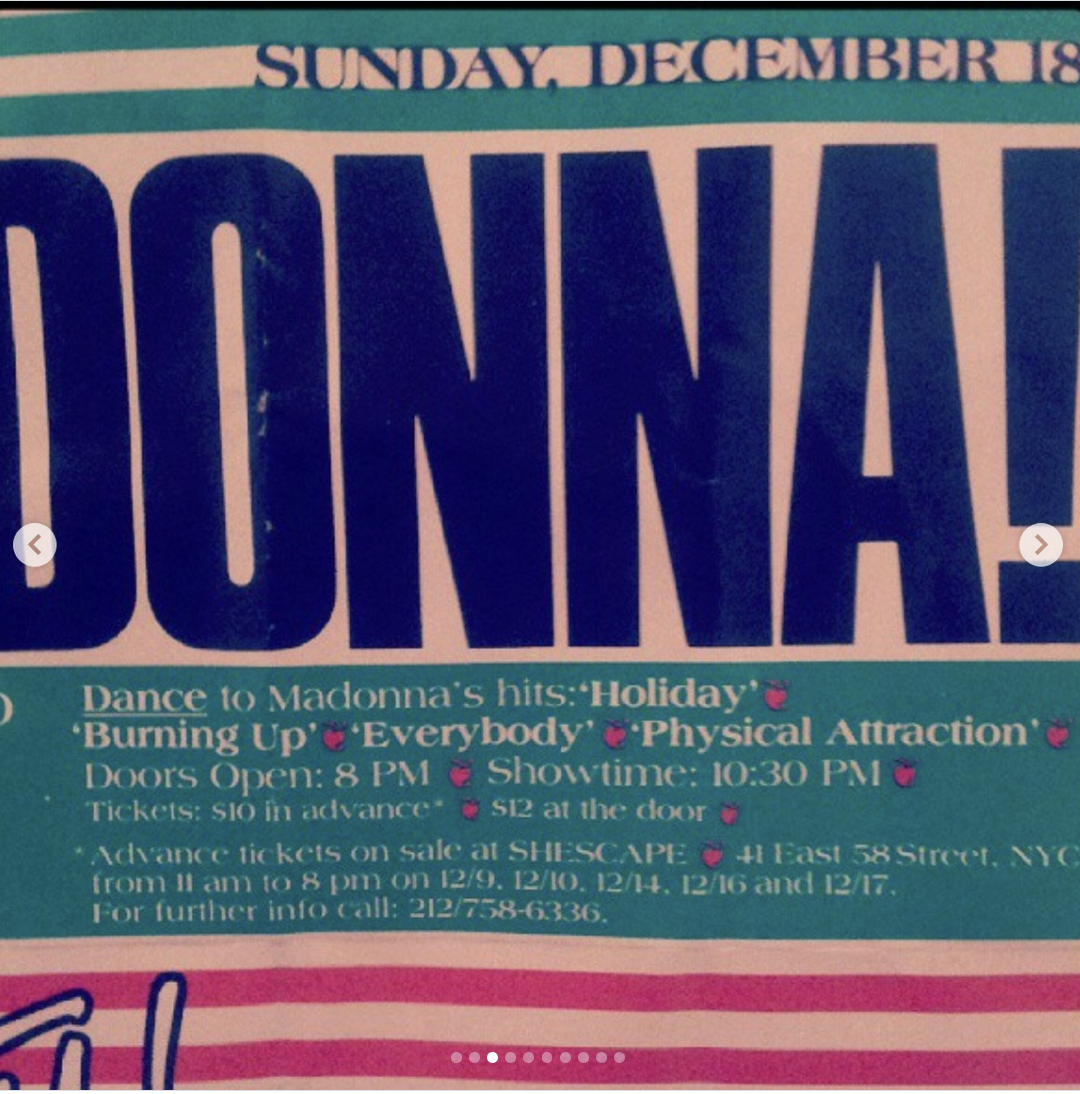
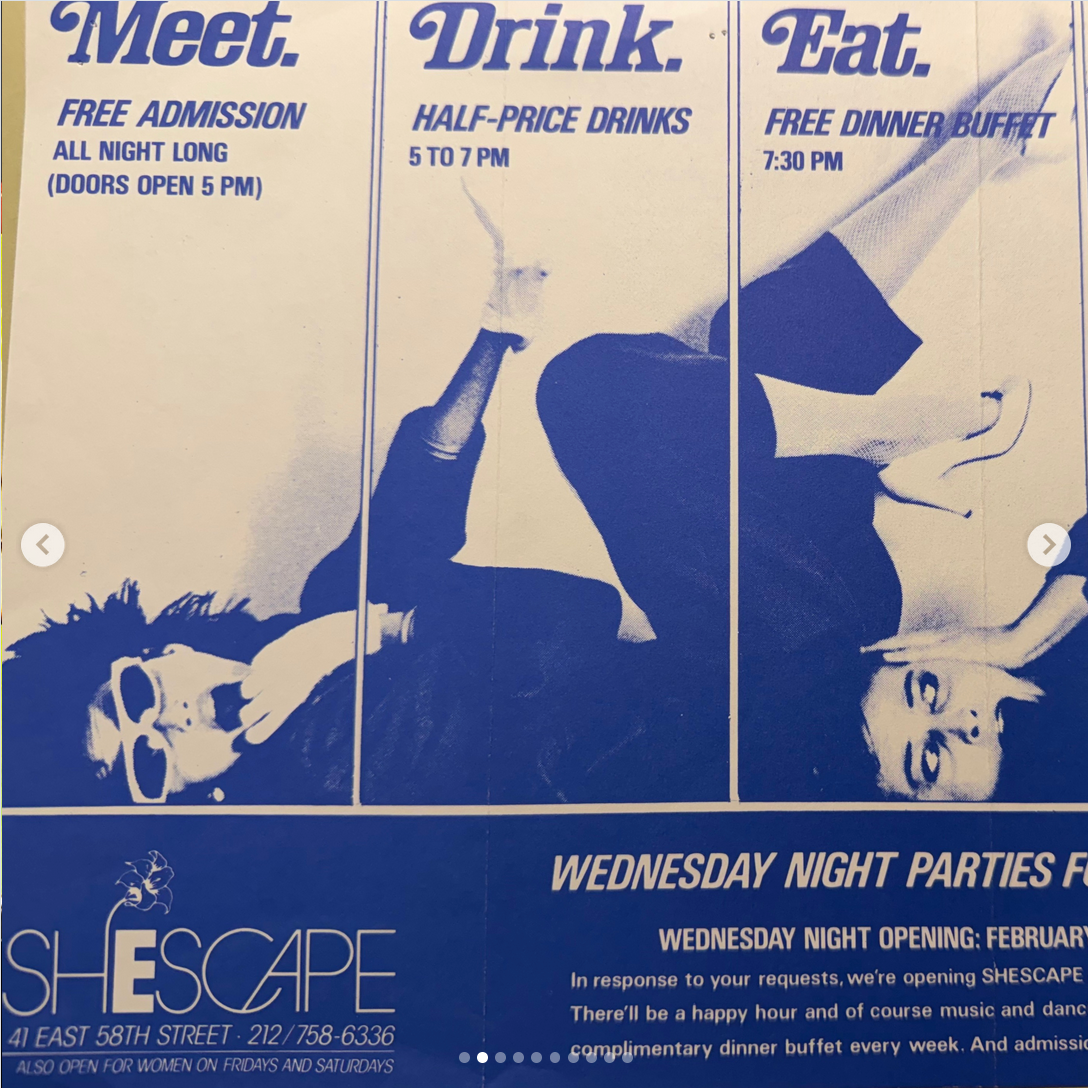
Flyers for the Shescape party, kindly posted on @queer_happened_here. We often celebrate these flyers without thinking of the racial, class, disability, documentation injustice that accompanied the radical project of meeting together in public.
June rates in her book about the Shescape Saga: bouncers and door staff were said to have consistently found fault with the forms of ID shown by women of color, claimed that they didn't meet the dress code even when white women wearing similar outfits were admitted and according to affidavits, repeatedly treated black and brown women with contempt.
While she escaped, the party denied these charges nine of the people involved put forward a complaint and as June points out, for some reason called the she Scape seven.
One of the complainants was none other than four time Newberry honor winner, former young people's poet Laureate and MacArthur fellow Jacqueline Woodson. Again, quoting June. It was only when Woodson and her teammates in Brooklyn's Prospect Park Women's Softball League were talking about their experience at cheese scape events that she says they noticed the pattern quote, we realized they were not letting black women in, especially black women who are coming in with other black women. Her friends have this realization in the eighties.
We've already talked about Parker and her friends, the women of color softball team in San Francisco figuring this out maybe even a decade earlier. If we don't have these daytime spaces where we can step away from the nightlife and take in what's really happening to us, we don't see the patterns of injustice that are [00:34:00] structuring who we are.
Absolutely this is still going on. In fact, there's been a long history of black people being turned away at the door. It's written into every queer history if you're paying attention.
What's important to know about DAR and Cool is that even though they happen after the 1970s, SaraEllen's, right. They're heavily influenced by the anti-racism that grows out of this moment. The other thing to know about them is they are protests by lesbians over lesbian space, and they're both pissed about the racism happening in bars and parties.
Bars and parties are those publics where we figure out who we are and how we can be. And if we can't all meet there, then what kind of lesbian are we?
Maxine Wolfe: But there's a history of, activism against bars also from lesbian feminists from the early seventies, from the beginning of the movement. Lesbians picketed all of these bars that were by the Mafia. Kooky's was one of them, right. We have actual footage of that, and, they were covered in the newspaper.
That was a, fairly typical thing. And you're right, it was a very central part of the politic for women who were politically active to focus on that issue in bars.
June Thomas: Just one other correction too, that COOL was in New York, um, and it it was when the, she skipped seven, even though there were nine of them, they, filed, it's not technically a suit, a complaint, with the New York com City Commission on Human Rights.
And I love that all of those things came when, women were talking like during, again, in softball. They were in the dugout of a softball game, just talking about where they've been and, notice this pattern that, hmm, when black women are together, they don't get let in.
Then they went to Brooklyn Women's Martial Arts, where many of them trained and did more organizing. So, these places are so interlocked. But yeah, a lot of, a lot of the activism starts in a bar and moves to these other places.
Maxine Wolfe: Yeah.
SaraEllen Strongman: Thank you both for those [00:36:00] corrections.
Maxine Wolfe: Marlene Colburn, who's a friend of mine, she and I started the Dike March committee, when the Avengers kind of folded.
Jack Gieseking: The Lesbian Avengers of the early 1990s. Yeah.
Maxine Wolfe: Yeah. We took it over. She is still an activist. She's also a black dyke. But she was one of the people.
Jack Gieseking - Narrator: Wow. We just covered a lot of dyke political history really quickly. the Lesbian Avengers are probably the most famous lesbian activist organization of all time. They were formally founded from 1992 and 1995 in New York City, and people will debate that with me about whether they found it and got back together.
And at some point in New York City, there's always a group of people identifying as the Lesbian Avengers, but that first early group that Maxine founded with none other than Anna Marie Simo, Ann McGuire, Anne-Christine D'Adesky, Marie Hoan, and you guessed it, Sarah Schulman.
They did credibly dope actions their first action was to go to a children's playground at a school that was absolutely homophobic and the kind of curriculum they wanted to extol. And I won't get into the details here, but people can guess what's happening. It's 1992 if you know this, and they were refusing what was called the rainbow curriculum.
So the Lesbian Avengers show up with a giant marching band and they give out balloons that say. Ask me what a lesbian is to all these little kids as they go to school. It was absolutely adorable. And you also have all these little kids saying, mommy, what's a lesbian? It's just a wonderful way to do queer education.
Jack Gieseking: So the Shescape Seven are 1986.
And what's exciting to me about all these things we're talking about in the early eighties is how much this whole political infrastructure is being set up.
I'll use Jed Samer's word, Lesbian Potentiality. That's a great book -- if you are into sci-fi or avant-garde film, this is your niche, my friend. I am into neither, but [00:38:00] I am into this book,, and one of the things Jed brilliantly, beautifully argues is there were so many types of lesbian feminism. We often reduce them today, but people were imagining ways of being and making space and worlds that are potentialities for us now that we're not living that way. We don't have all these bookstores and cafes and stuff, which sounds so cool and so fun and such a hard time to be out to be a dike when you can lose your kids, lose your housing, you can still be evicted until the 1980s. Lose your job, lose your sanity.
Jack Gieseking - Narrator: I admit we have to talk about the worst bummer of them all: the religious right. It's in the 1970s the nascent Christian right that's forming, including people like Jerry Falwell, and Pat Robertson come onto the stage, the literal state of Televangelism, and at that time, decide that LGBQ people are their target.
There's a great book I Love by Tina Fetner called How the Religious Right Shaped Lesbian and Gay Activism. It might be a bummer, but gosh, it's totally brilliant. She writes about how the religious right really couldn't galvanize people and organize them until they found the number one tactic they still use: fearmongering.
Sometimes queer activism is a pie in Anita Bryant's face.
The focus against LGBQ people really took off around 1977 when Anita Bryant, who will hear about more in a second, launched the Save Our Children Campaign to prevent gays and lesbians from teaching in the Miami-Dade school system. They told people that their children weren't safe from gay people who had long been deemed deviants. they were actually going to ferre it out or out people as if they were intentionally to hurt children.
Does it sound like anything familiar to you guys? Yes, it's exactly the same thing they're using against trans people today.
Jack Gieseking: We can still see this today, but we know it is very different. Time matters.
Which in this time of ever-growing fascism and authoritarianism reminds me, we must discuss one of the most powerful foes of the L-G-B-T-Q movement that blossoms in the 1970s [00:40:00] alongside all of these other radical movements. And that is the Christian right.
Maxine Wolfe: Yeah, that was a lot of the work that we did was around the right wing, had big rallies and demonstrations in the early eighties against the right to life.
Jack Gieseking: Like the Miami-Dade County refusing gays and lesbians as teachers.
Maxine Wolfe: Yeah,
Jack Gieseking: Who was the orange juice Princess? Her name just escaped me.
Maxine Wolfe: Oh, Anita Bryant. Oh, right.
Jack Gieseking: Oy vey Anita Bryant.
SaraEllen Strongman: There's, yeah, the, oh God. The brick cot actually stopped serving orange juice during a period of time to protest anita bryant.
Jack Gieseking: Oh, right. SaraEllen. Alex Ketchum writes about that in her book on Coffee Houses, cafes, and restaurants. Also a superb podcast by the same name, ingredients for the Revolution.
June Thomas: A lot of bars change their cocktails. Yeah.
Maxine Wolfe: We all, a lot of us had done that, with the lettuce strike. And, that stays in my mind.
I'll tell you a very funny short story. In 1978, went to the Gay Pride march, and it used to end in Central Park and everybody would sit down and there would be like speakers and stuff.
Somebody got up and said something like, boycott orange juice! And one of my daughters, around five or six, stood up and said, oh no. First it was lettuce, then it was grapes, and now it's gonna be orange juice.
but you could hear a ping drop because everybody was listening to the speaker. And so you heard it everywhere.
Jack Gieseking: And for those of you who don't know, Anita Bryant in 1977, she became really the kind of this spokeswoman of the religious right. The beginning of Jerry Falwell's rise to Power and Pat Robertson, and we were their number one punching bag and fundraising effort.
They raised a significant amount of their funds, by claiming that they were of course protecting kids. We still see this every day and it's getting worse and worse around anti-trans organizing. It's not just the [00:42:00] Christian right in the us it's the Christian right around the world that is vilifying and attacking us.
But back to the seventies, at the same time you have all these different lesbian feminist organizing, all these other groups organizing as well as dykes who aren't organizing at all in these different, spaces and places 'cause you can, a constellation one could say.
I keep thinking about Finn Enke’s amazing book, Finding the Movement. Seventies fans should check this out. One of the cities they talk, about is Detroit, there's finally, the lesbian feminists are gonna hang out together. There's finally gonna be racial integration.
And the black women, show up at the traditionally white lesbian bar and it's all lesbian folk rock, acoustic folk. And they're like, no, fucking Absolutely not. And they're like, this music sucks.
And then these black women in Detroit do open a bar called, I believe, the Gold Coast, which is open for a little while. When I talked to, to Kemi and Nikki Lane who are saying how much music and dancing defines black queer women's spaces.
And there's not enough written about or thought about yet how much lesbian feminism Is moving away from dancing.
Jack Gieseking - Narrator: In fact, one of my participants in the 1980s said that the big lesbian NYU dance party was affectionately called the lesbian Stand around. I'm gonna paraphrase, because everyone there would complain that everyone would literally just stand around.
She said she danced. Yes, she was white and people definitely danced by themselves. You didn't have to have a partner then. But, hmm. What a title.
Maxine Wolfe: The thing about the early seventies, Okay, was creating every institution that had lesbians had been deprived of Publishers, bookstores, clothing, music. You know, teaching each other how to do sound so you could create records. It was an an incredibly productive moment.
And each of those things was political because [00:44:00] they never existed before. There was no way to get that information or have that experience that people were having. It's really important to see how huge that covered every part of life, seriously, Just everything. That's when you could have restaurants besides the bars. But the bars always stayed. They stayed in the white community especially Parties, house parties were big in the African American communities for, for a long, long, long time. Yeah.
Jack Gieseking: A hundred years now
Maxine Wolfe: More.
Jack Gieseking: At least! Yeah. Rent parties, dollar parties, buffet flats, in fact, every single decade brings these up.
That's why you can't just ever talk about lesbian bars. The bars of course, don't go away. This idea that, as you said, Maxine, everyone is welcome in. Bonnie and Clyde's might have been true, but there are many black and brown women who have written about not experiencing that welcome in most spaces.
And not everyone was as welcoming as you, as you as you know. Parties are just as important than bars. They're our first public or even private sanity as, as ways to get together. And there are ways that most of us still connect now.
Jack Gieseking - Narrator: Okay, to wrap up, you might be wondering why there were boycotts.
Well, just like BDS today, there have long been boycotts. Many social movements, especially the LGBQ movement have focused on 'em. We boycotted Colorado in 1992 when,, there was an amendment to prevent municipalities from enacting anti-discrimination laws against LGBQ people. We see this stuff happening today, but we shut down so much tourism to the state that entire conventions were canceled.
There's also the longstanding gay ass boycott against Coors Beer. It resolved technically in the 1990s, but I know many queers who still don't drink any Coors [00:46:00] products. There's tons of products we know about and we're conflicted about much like all of capitalism.
Thank you again. I hate to tell you, but we're gonna pause right here. We're gonna jump in next week with more about fighting the religious right that we can still learn from today. We're gonna talk about bars, of course, as well as-- how can we stop ourselves-- coffee houses, softball, sagas, anti-racism and poetry, and it doesn't get any better: women of color, feminism, and consciousness raising! This stuff is so awesome! Where did This Bridge Called My Back come from? What was the magic that built it? You will find out next week.
Come back and join us next week. Bring your glove and your bat. You know that softball game is so on.
BIOS
Jack Gieseking - Narrator: SaraEllen Strongman is assistant professor in the Department of Afro-American and African Studies at the University of Michigan. She's editor of the recently published the Essential Poems by Pat Parker with Sinister Wisdom 2025, and her scholarship focuses on black feminist history and culture in the postwar us.
June Thomas is a journalist and podcaster who spent 27 years at Slate, including roles as foreign editor, senior managing producer, and founding editor of Outward Slate's, LGBQ section. Her 2024 book, A place of our own six spaces that shaped queer women's culture, tells the story of lesbian bars, clearly softball, feminist bookstores, and more.
Maxine Wolfe is one of the coordinators at the Lesbian Hearst Archives. A long time lesbian and feminist organizer. She was a member of Revolting Lesbians, one of the founders of the New York City Dyke March Committee, the Lesbian Avengers, the New York and National Act Up Women's Committees and Women for Women. She was on the National Board of multiple organizations for reproductive rights, fighting antisemitism, heterosexism, and racism. She's Professor Emerita of environmental psychology at the CUNY Graduate Center. Woo hoo. (That's where I went too.)
And she's written multiple publications on lesbian bars, including [00:48:00] probably the most well known, invisible Women in invisible Places, lesbians, lesbian Bars, and the social production of people environment relationships, which I'll absolutely have linked on queergeographies.com.