"Lesbian Chic, Dyke Politics: 1990s-2000s"
What actually makes a dyke bar a dyke bar?

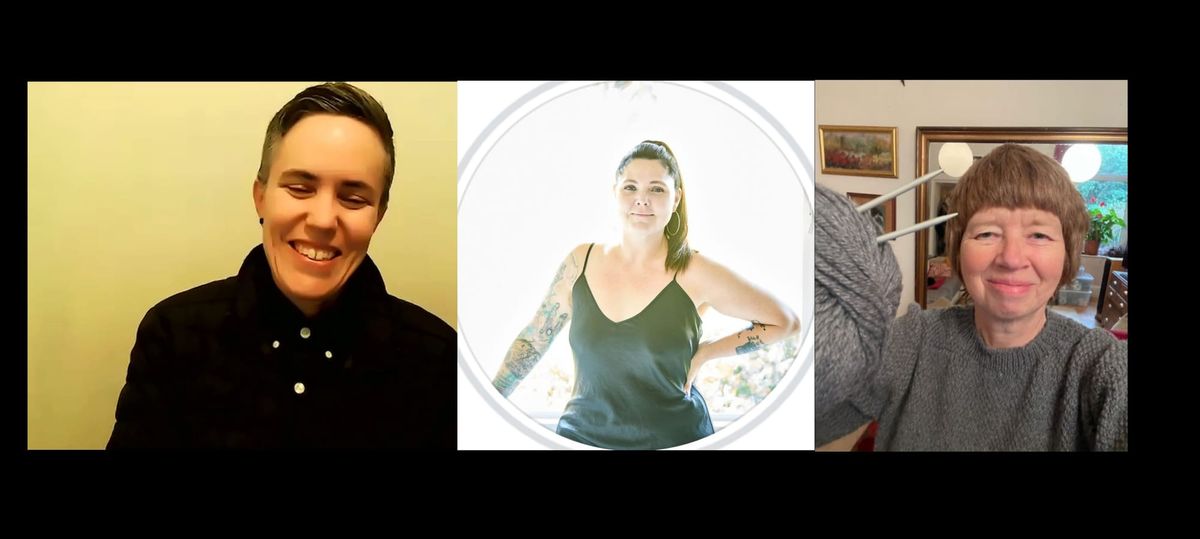
Welcome to our first episode on dyke bars* in the 1990s and the 2000s! Jack Gieseking joins Mairead Sullivan, Katherine Griffiths, and Trish Bendix to talk about queer parties, lesbian bars, identity, sex, music, and the changing geography of queer life. From My Sister’s Room in Atlanta and Tease in Chicago to London’s Royal Oak, San Francisco’s Lexington Club, and Boston’s Diesel Cafe, they ask what makes a space a dyke bar—and what makes it feel like home. The conversation moves through women’s nights, DIY parties, bookstores, health centers, dancing, trans inclusion and exclusion, aging, race, and the economics of keeping queer spaces alive. They explore how lesbian bars were represented in indie films including Chasing Amy, Go Fish, Bound, Boys on the Side, and The First Wives Club. The episode digs in to lesbian chic, the 1993 Dyke March on Washington, language, and the biomedicalization of “lesbian.” Through it all, bars emerge as spaces of possibility, projection, connection, and community.

Introductions
Katherine Griffiths: One, two, three, four. Hi, everyone.
Jack Gieseking: Hi, Katherine.
Trish Bendix: I'm a Sagittarius, I forgot to tell you.
Mairead Sullivan: That's- Oh,
Trish Bendix: I'm an Aries.
Mairead Sullivan: Oh my God. I forgot to tell you.
Jack Gieseking: Yes.
Katherine Griffiths: Libra, Leo rising, moon in Sagittarius.
Jack Gieseking: Uh, okay. Leo, yeah, Sag. Uh, uh, Leo, Cancer, Aries here, so there's just a lot of fire energy in the lead. I am too.
Mairead Sullivan: I'm a, I'm Aries, Sag, Cancer, so we are just pure fire around here.
Jack Gieseking: I'm almost positive we've talked about that before. Uh, Trish, do you wanna add to that at all, or, uh-
Trish Bendix: I am a Sagittarius, Sagittarius, Capricorn moon, so I'm double Sag, rising and sun. I'm like, we need applause for Sag Sag. Thank you.
Mairead Sullivan: I love it. Sags get everything done.
Jack Gieseking - Narrator: Welcome to Our Dyke Histories. I'm your host, Jack Gieseking, historian, geographer, and environmental psychologist. We dive into the past and present of lez, queer, trans, sapphic, enby communities decade by decade in collaboration with multicultural lesbian literary and art journal Sinister Wisdom. This season, we're all about dyke bars*, with an asterisk, lesbian bars, queer parties, and trans hangouts, the structures that made them necessary, the lives they made possible, and the worlds we made from them. Our Dyke Histories: come for the history, stay for the revolution, gossip, and desire that built us.
Welcome to the '90s and the aughts. Beyond hearing about the astrological signs of our three guests, you will hear a fabulous two-parter discussion on trans inclusion and exclusion, identity and language, including dyke versus/ and lesbian versus/ and queer. We'll get into the indie films. We'll never not talk about sex. It'll be incredibly cool because we'll be in LA, Chicago, [00:02:00] New York, Boston, San Francisco, and London, and we will hear how different London was in tiny spaces with big music and connections.
We'll talk about the bars versus the party scene and the incredibly important rise of more transitioned trans people in massive numbers and how that changed lezbiqueertrans space into the way we think about and experience it today. Finally, as one of our guests will ask, "Did 'The L Word' kill the lesbian bar?" You have to listen and find out, but I will give you one spoiler: thank goddess they killed Jenny. I am definitely, absolutely, never for a moment Team Jenny.
Now, here come our super-duper expert guests. What's awesome about this crew is that all for of us have lived through and gone to queer spaces in the '90s and the aughts, but we are also studying those times.
So folks asked me to read their bios, so you'll hear me reading them, and then you'll hear their voice.
Lez do it.
Jack Gieseking: Hi, everyone. Thank you so much for being here. We are talking about dyke bars in the 1990s and aughts.
Mairead Sullivan started going to dyke bars in Boston 20 years ago can, we can figure out your age, whether or not you had a fake ID through the course of this conversation. Uh, and they've since been enmeshed in the scenes in Atlanta, more recently LA. Their book Lesbian Death has a lot to say about lesbian bars. They cut their teeth at Diesel Cafe in Somerville, Massachusetts, ah, still a favorite, and recently made it to karaoke at Wildrose in Seattle.

Welcome, Mairead.
Mairead Sullivan: Thanks, Jack. I should probably really say 25 years ago, but probably my age shows that I'm no longer able to count backwards. The '90s continues to feel like it was 20 years ago.
Jack Gieseking: That's, that's perfect. Yep. Yes, me too.
Katherine Griffiths: Same here.
Mairead Sullivan: Katherine Griffiths will talk about London's dyke bars* in the '90s, the women's music club scene. She's taking [00:04:00] that to mean the places and spaces where women who loved women, lesbians, queer women got together around drinking, music, DJs, can meet and hang out away from the straight world.
Katherine Griffiths: Yeah. Well, I was a DJ, and because of the DIY kinda nature of the bars and the events, you just ended up doing a bit of everything, so designing flyers, distributing them, collecting music, that was my favorite bit, and, and dancing.
Mairead Sullivan: That's fantastic. And Trish Bendix probably wrote about maybe one of these spaces that you went to.
She came out in Chicago in 2004, so her dyke bar experience is very Midwestern from the jump, which is fantastic for us. She then moved to the Pacific Northwest in 2011 before moving to LA in 2015. She's a writer and producer with 20 years of experience researching and reporting on lesbian queer culture and community, and her last thing she wanted to add, which I loved, was you counted at least three dyke bars you've been to called Sisters: Portland, Maine--
Trish Bendix: Philadelphia- ahhh, and Austin, Texas. Yes. It's just funny. I love Sisters as a dyke bar name. I love Sisters in any just iteration, but specifically lesbian bars.
Mairead Sullivan: Well, the lesbian bar in Atlanta is called My Sister's Room.
Jack Gieseking: Yes, sister! We're gonna start by talking about our favorite dyke bars of the '90s and 2000s.
Mairead Sullivan: The first gay bar I went to was called the Male Box in Worcester, Massachusetts. Male, M-A-L-E, where there was only one other lesbian in the whole bar when I went there with the gay boys from my small Catholic college. It was my first time finding sort of like public lesbian camaraderie.
But I actually wanna talk about My Sister's Room, which, let me just say, is a phenomenal space. It changed locations while I was living in Atlanta. But my first night in Atlanta, one of my dear and best friends, Mary, drove me down to move me down there, and we went to My Sister's Room, and I cried on the dance floor like- ... "Do not leave me here." We soon moved three doors down to Mary's, which is the Atlanta sort of, uh, [00:06:00] more trans-friendly queer bar, and I felt like, "Okay. I can make it through." But ultimately, My Sister's Room came to be a great home for me in Atlanta.
This was in 2010. There was something too about lesbian spaces at that time that was really sort of contested. My Sister's Room was, in fact, a very trans inclusive space, but that night that I was there, it didn't feel like it.
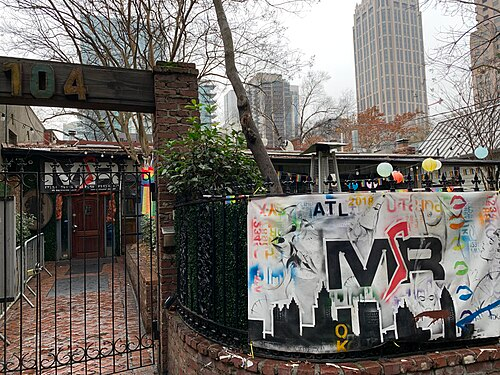
For years, could not remember that it was called My Sister's Room, and frequently called it My Sister's Closet.
Trish Bendix: The first lesbian bar I went to in Chicago was actually– it was one of those everyone knows it's a lesbian bar, lesbians go there constantly, it's owned by a lesbian, but it's technically does not bill itself as a lesbian bar. So it's like all the components are there at the same t- L Word watch parties on the weekends.
It's like- Yes! This is a dyke bar, but it's also a neighborhood bar, so anybody who happens to live in the dykiest neighborhood in Chicago of Andersonville is welcome, which of course, they always are. It was like my first lesbian bar. It wasn't technically billing itself as a lesbian bar, but that's the nature of lesbian spaces.
I will go with my down the street actual claiming itself as a dyke bar called Stargaze, which had regular karaoke, super divey. And what I loved about it was there was this lore that the butch bartenders would, like, had femme phobia, and they just would not really be very kind to femmes if you went in there.
You had to, like, challenge them and be like, "I belong here," you know? As soon as I came out and I realized that there were all these different dynamics at play, that I wanted to witness them or experience them. So I actually was bummed out when they were nice to me. I was like, "Oh, this isn't what I heard." But no. But I loved, like, honestly the divier the better.
It reminds me actually having just rewatched Bound, um, because Bound wasn't shot in Chicago, but it was based in Chicago. Um, I was thinking if there was anything even remotely close, it would be, like, a dive like Stargaze in the 90s would probably be-- although there was a little bit too much leather in that scene. It would be like The Eagle. So anyway, I'll go with Stargaze.
Katherine Griffiths: Wow.[00:08:00]
Jack Gieseking: That sounds like heaven, and I'm so, uh, sorry to miss it. Oh-
Mairead Sullivan: Wait, Trish, what was the name of the first bar you were talking about, though? 'Cause there is a dyke bar that I remember from Chicago.
I think I called Jack like every three weeks and asked him if he remembers, but I can't remember the name of it. So what... I know it was in Andersonville, and in my memory-
Trish Bendix: Yeah!
Mairead Sullivan: ... It had a back room with a fireplace.
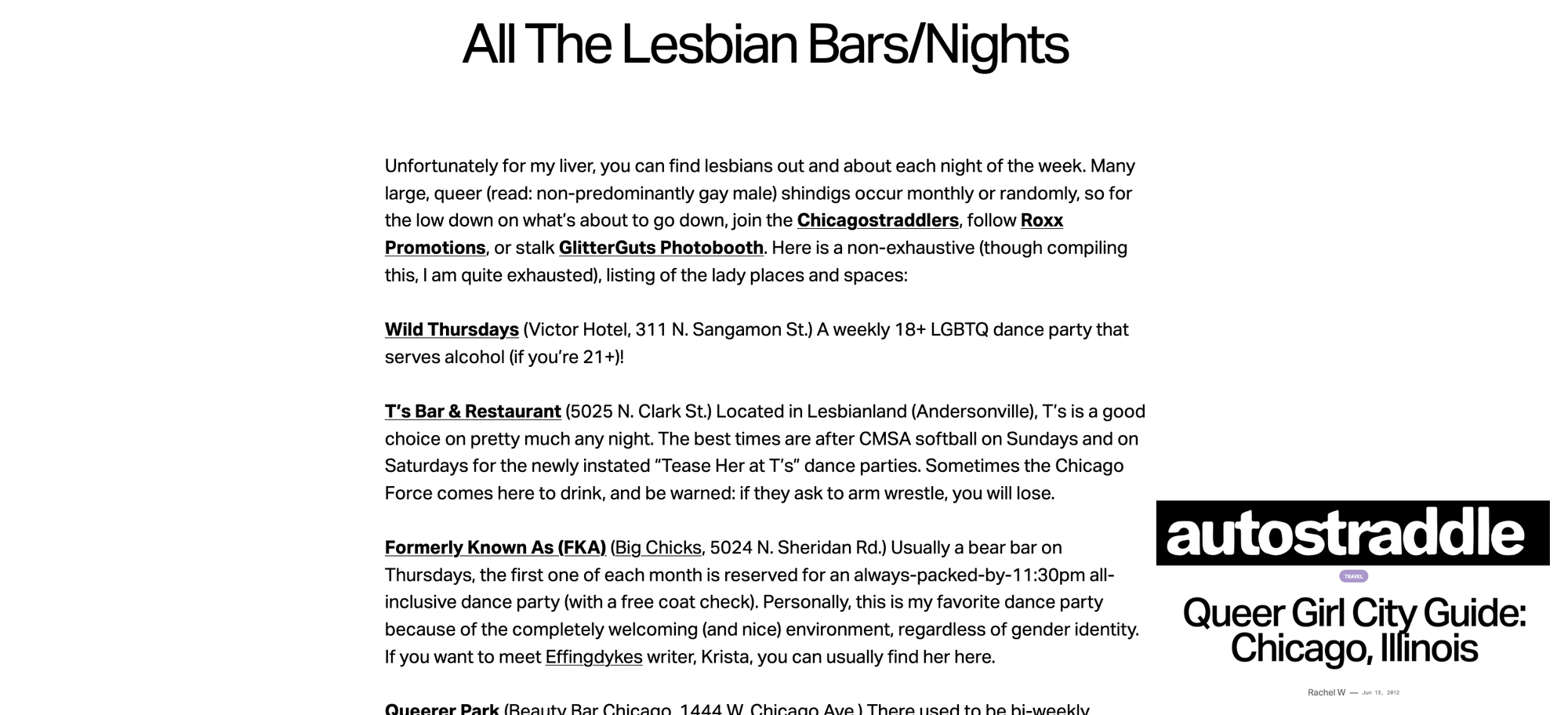
Trish Bendix: Mm-hmm. Yeah, it was called T's / Tease.
Mairead Sullivan: That's it!
Trish Bendix: Tease. Did you ever go to Tease? Yeah. That was it.
T's, my first lesbian bar, but not a lesbian bar officially.
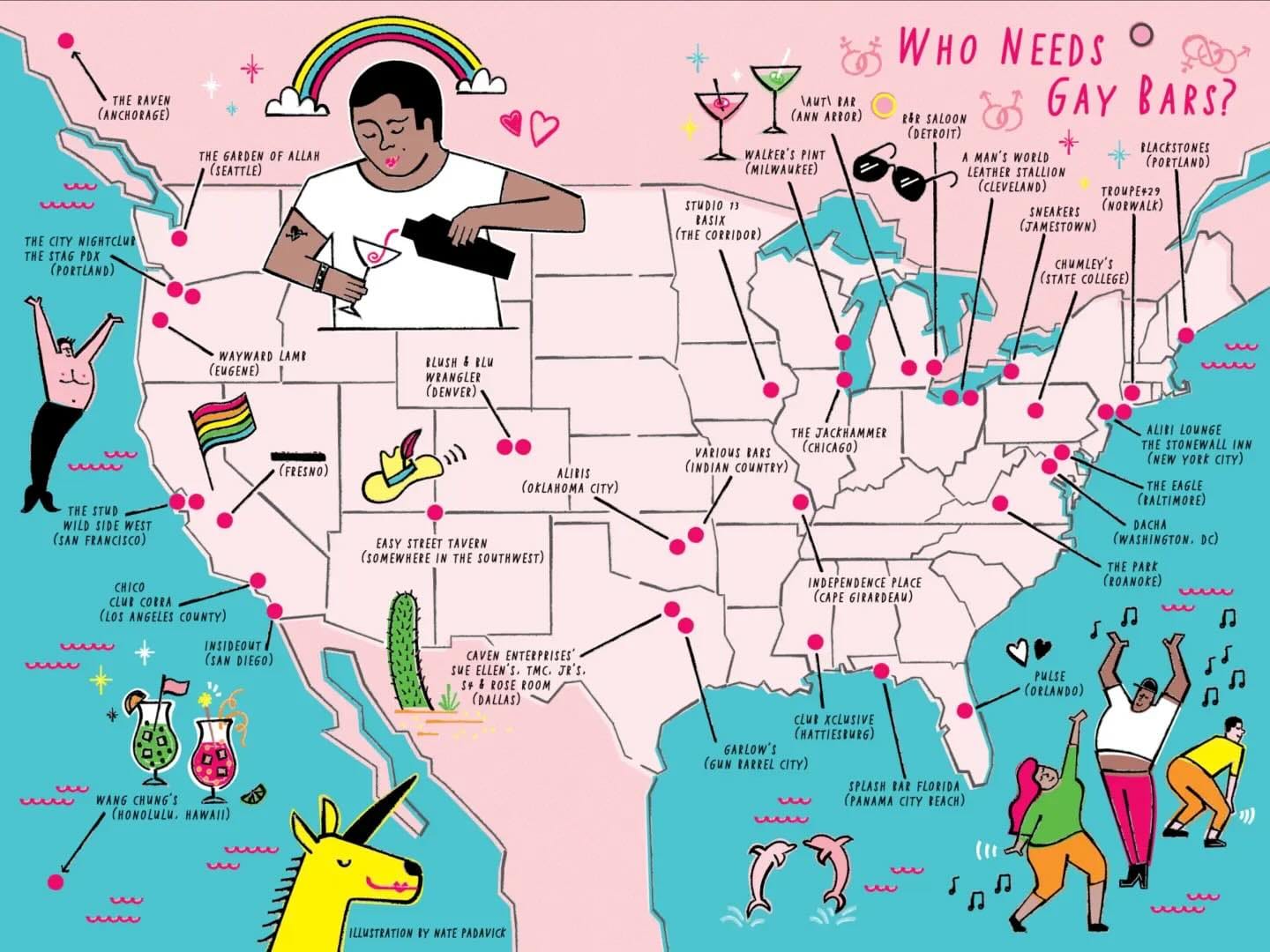
Jack Gieseking: Oh my God. So many of those. If you know Greggor Mattson's, Who Needs Gay Bars? Book, he goes to 300 small town gay bars, and he can't even have a lesbian bar section. It's just a lesbian-owned bar section, 'cause no one will agree, like, what is a lesbian bar?
And it, it, and this is-
Trish Bendix: Yeah!
Jack Gieseking: And but this, and this is starting in the '90s, too. Like, that's, that's like something that, like, really starts to pick up that we see, like, is it a lesbian bar? Is it not? And it goes back to what Mairead's talking about, um, about trans identities, gender non-conforming, femmephobia is happening.
Katherine Griffiths: Well, I'm gonna take you to the Royal Oak in Stoke Newington, which was Northeast London, part of Hackney. It was where there'd traditionally been a lot of lesbians living there, or dykes, as we refer to ourselves.
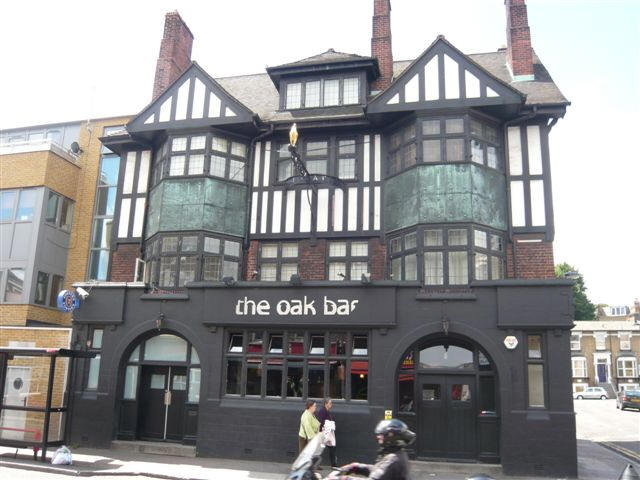
It's the early '90s, so it's kind of that point in time when there's the women's centers where we would kind of hang out. The public spaces were gradually going back into the hands of, well, the Tories was closing them down.
So we've got more women actually taking over pubs, which I don't know if that's a phenomenon in America, but we had public houses, places where usually men would go to drink, basically. But women, dykes started to take over quite a few of these places.
So the Royal Oak was taken over by a woman called Jackie, and it was a pub with a big public kind of bar. But at the back she had a function room where women could hire, hire the place out, bring in their own sound system, and put on nights. The night that I was involved in putting on with a DJ, Nicky Lucas, was called Fabric.
And I must, full disclosure here, that wasn't the big [00:10:00] Fabric super club that opened later, a few months later. I think they stole our name, actually. Anyway, we put on a night called Fabric, thinking about the way that fabric sort of intertwines, that music brings you together. We didn't make any money whatsoever, but we had great times, and we always featured other DJs that we knew to come along and play music and give them some exposure.
From what I remember, it was... it probably only opened from 8:00 in the evening till 12:00 midnight because of licensing laws. So you had to really get your entertainment kind of crammed in. Because of the location and the early '90s, there was quite a mix of different women that would turn up in terms of dress style.
The Dyke Geographical Imagination of '92-'93
Katherine Griffiths: I think we, we were still having a kind of a no SM kind of flavor, which, which was another kind of battle within the dyke scene in, in London, and particularly in the '80s
Jack Gieseking - Narrator: What Katherine was just talking about, about there being SM in the bar scene, in the U.S. it doesn't work that way in our imagination.
I'll say a little bit about the U.S. and we'll go right back across the pond to the UK. But in the U.S. we have this idea of a lesbian bar looking like a dive bar. Where does that come from? Well, in this period, so great to talk about this, in 1992, '91, three books come out. They're a textual canon that really feeds and formats the dyke geographical imagination of where dykes come from, where they gathered, and they're very much true.
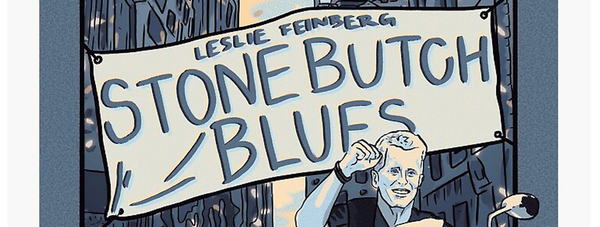
One is Boots of Leather, Slippers of Gold about the Buffalo dyke community from the '30s to the '60s, Black and white lesbians, mostly white lesbians, by the incredible Liz Kennedy and Madeline Davis. Stone Butch Blues, the incredible fictionalized memoir of the fabulous trans Lindsay Feinberg. And finally, Odd Girls and Twilight Lovers by the fantastic Lillian Faderman, who we've had on the show. So these books come out and they really front and center put the dyke bar.
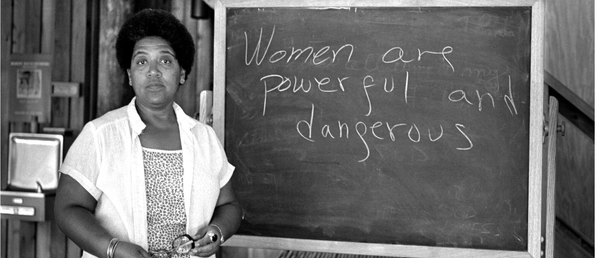
And this is building off of stuff that came before in the '80s. Joan Nestle, who we've had on the show, her book A Restricted Country [00:12:00] of course puts bars for us. Bars were part of her spaces. Audre Lorde's Zami also puts bars for us. We've talked about that in other episodes.
And so we have this idea of a dive bar, and a dive bar anywhere is not usually a place you, you show up in your leather and bring your whip. Fair enough. But in London, the British are so interesting. They seem so repressed, and yet they're having the most fun S&M scene in the '80s and '90s.
F*ck Article 28
Jack Gieseking - Narrator: And a huge part of that is this incredible punk radicality led by a lot of Black music that Katherine's gonna talk about, reggae, ska, house, funk, so many things, and it's pushing back against a thing called Article 28. Article 28 is, I guess the way to think about it is like the present day Russian anti-gay propaganda laws. You couldn't intentionally promote homosexuality. You couldn't publish about it. You couldn't promote it in teaching, so you couldn't say the word gay or lesbian in school. It would come into effect in 1988, and it would not be repealed until 2003.
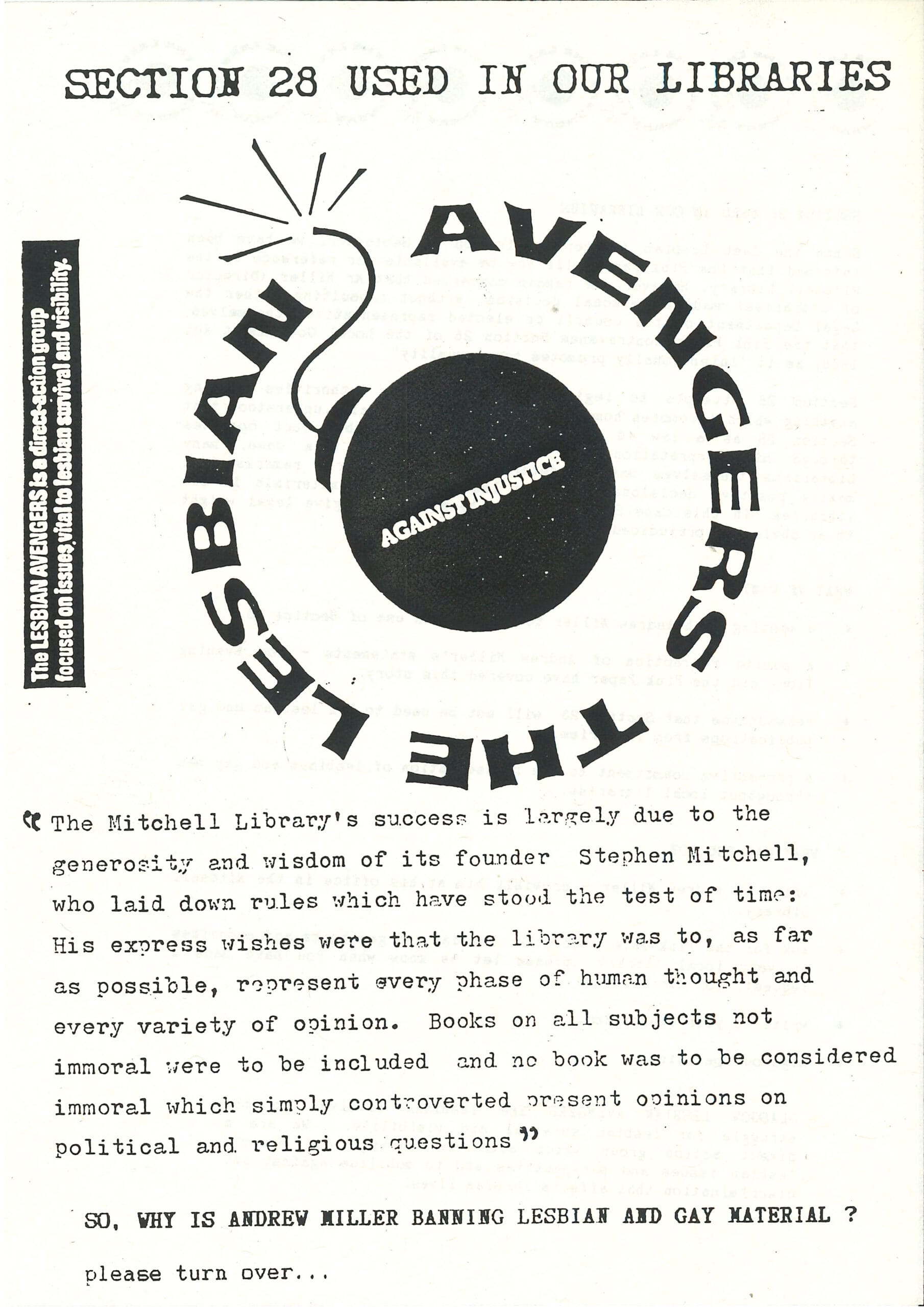
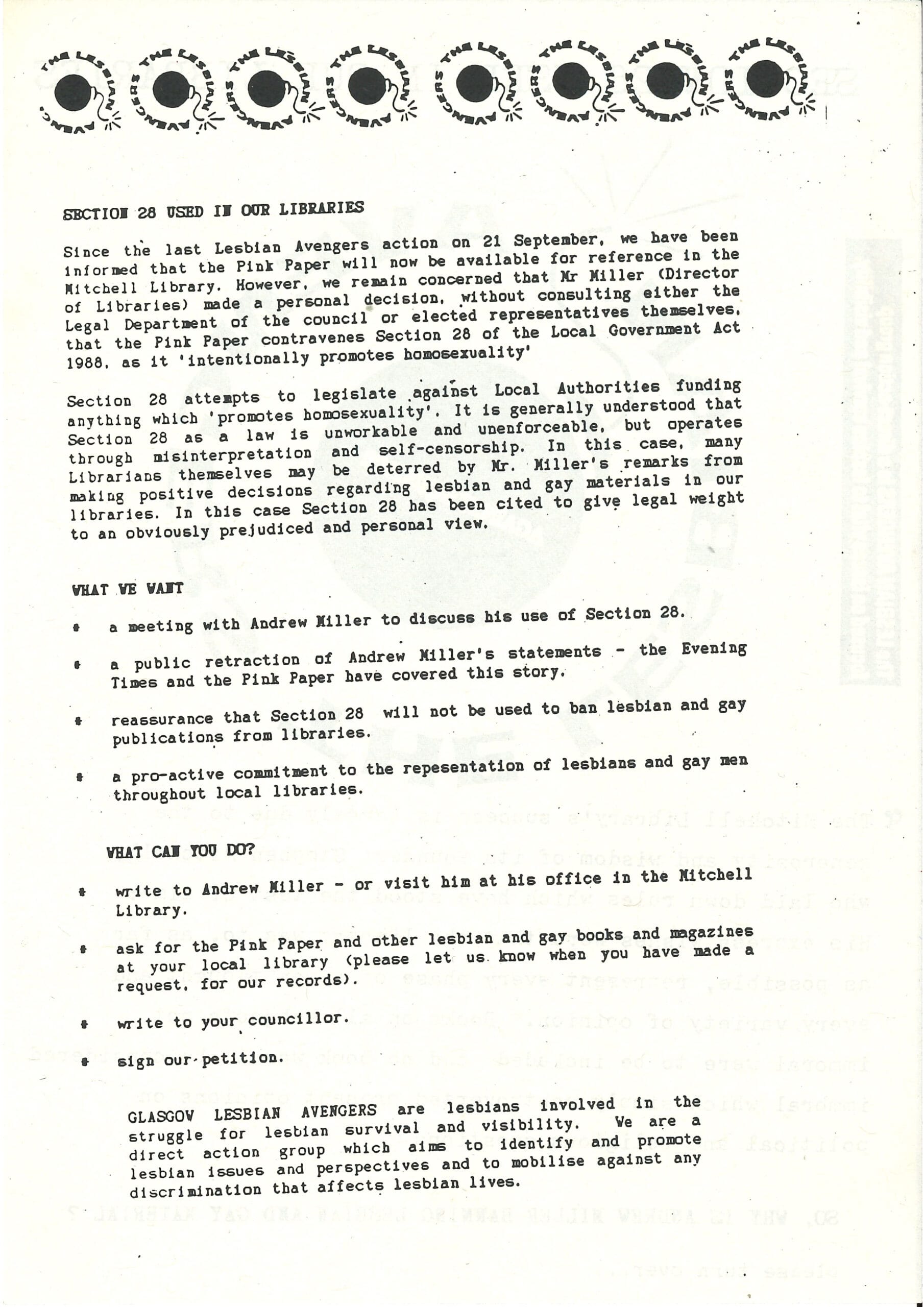
Lesbian Avengers 1995 Section 28 Protest flyer from Glasgow Women's Library.
The kind of activism that came out of this is also stunning, as much as the celebration of sex and different kinds of sex. So for example, the London chapter of the Lesbian Avengers captured one of those double-decker red buses and painted the whole thing pink in rebellion.
They did all sorts of incredible lesbian activisms. They performed a lesbian Romeo and Juliet in 1994. They took over a right-wing men's group conference. Ugh, goddess bless them for that. They invaded the Sunday Times to protest, saying that the Avengers hated men, which they didn't. They stood by the lovely Sandi Toksvig, you know, from, from British Bake Off, the lovely, petite, older lesbian, wonderful human being, comedian. She was kicked out of hosting Save the Children for the 75th anniversary because she not only came out as a dyke, but as a lesbian mom, and the charity later apologized [00:14:00] after they protest.
Anyway, this kind of activism, this claiming of sex happens at the same moment. It's important to think about when we do or don't claim sex and celebrate sex.
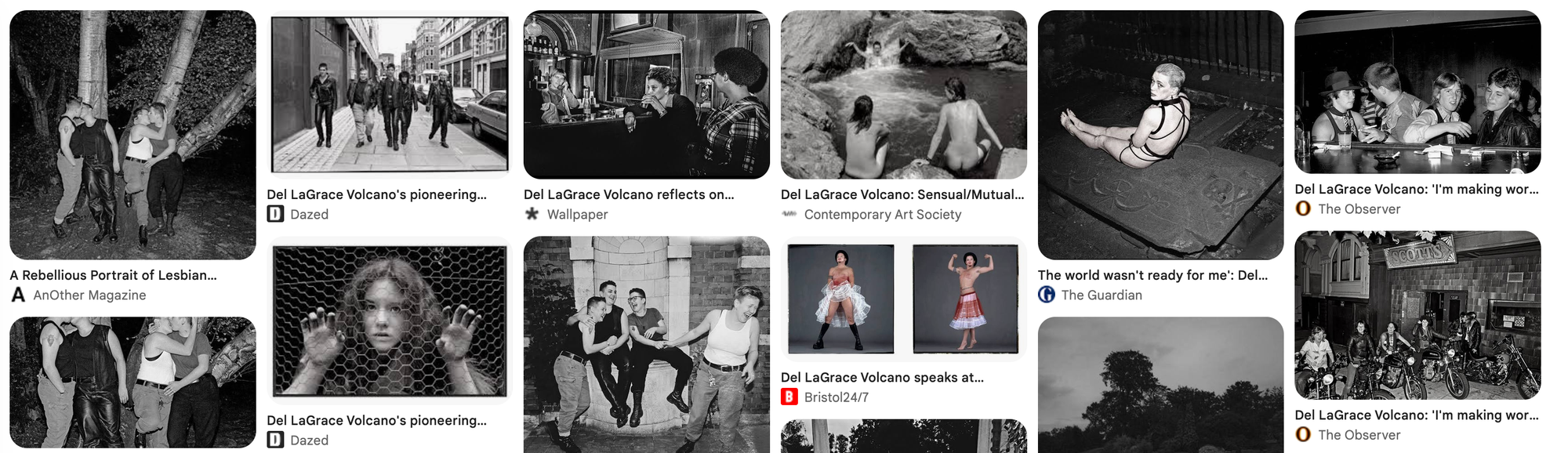
This is similarly happening, uh, over here in the US with the sex and porn wars that we talked about in our 80s episode. I will put these, this incredible selection of photos from this time, a lot of which were in bar spaces and of punk activists, just dyke punks walking on the street, captured by Del LaGrace Volcano, who was, who was also part of this scene, online on QueerGeographies. They were published in an incredible book in 1991 called Love Bites that no one would sell.
Katherine Griffiths: But then that kind of relaxed more when during the early '90s, the whole, the whole dress sort of style changed quite a bit, and there were more femme and femme and butch-femme couples would come along as well.
Bars and Clubs and Bar Takeovers, All
Katherine Griffiths: It was also a springboard for Nikki Lucas' nights that became more inviting and inclusive of Black women as well. So the kind of music that we played was Black music, reggae, soul, funk, garage. So, so it was a really good springboard for those other kind of elements of the, of the lesbian scene to start getting involved.
Jack Gieseking: And now I'm thinking of one, which is Doc Holliday's on the Lower East Side. So this was a biker bar, like a cis-het biker bar--
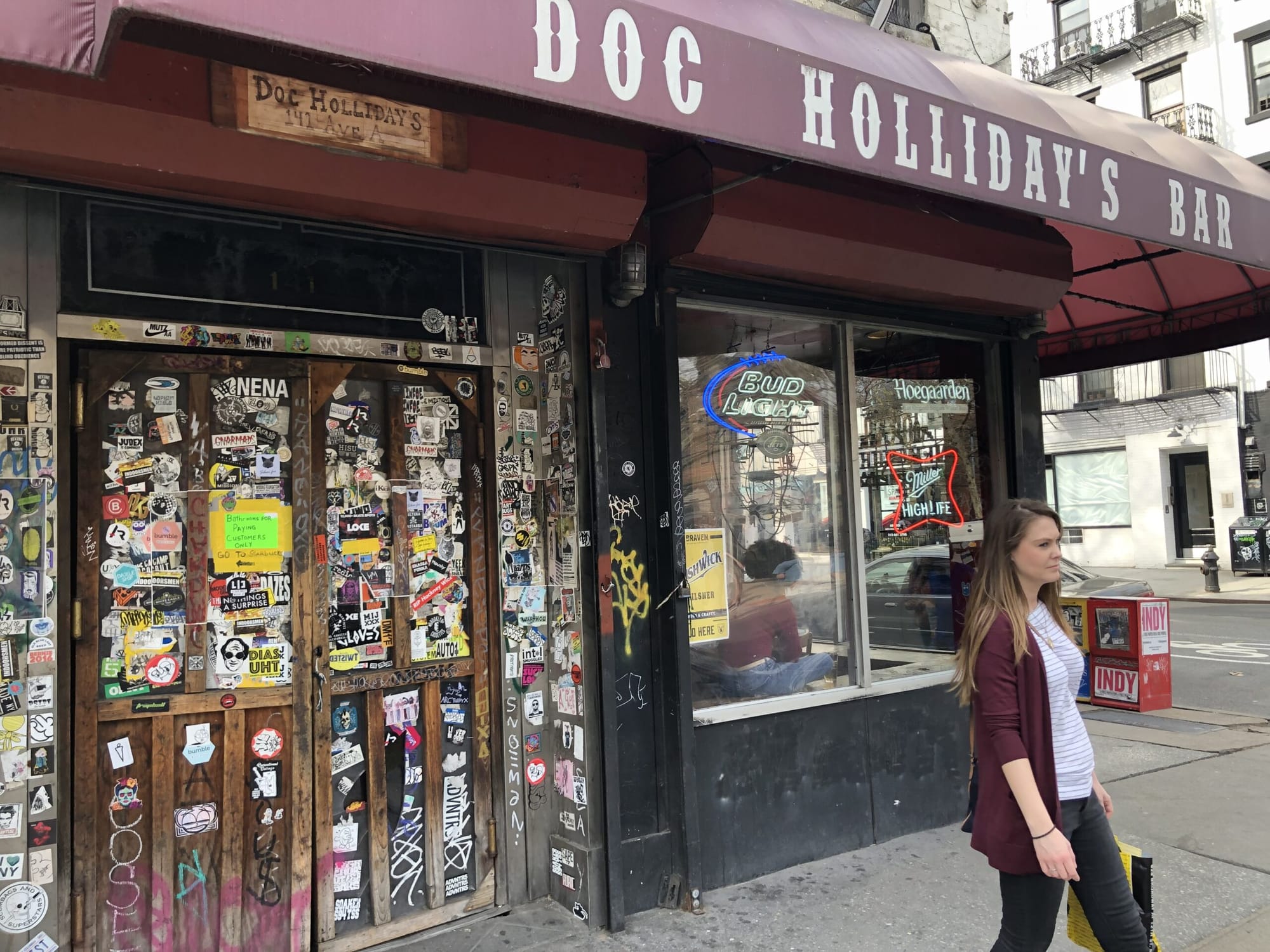
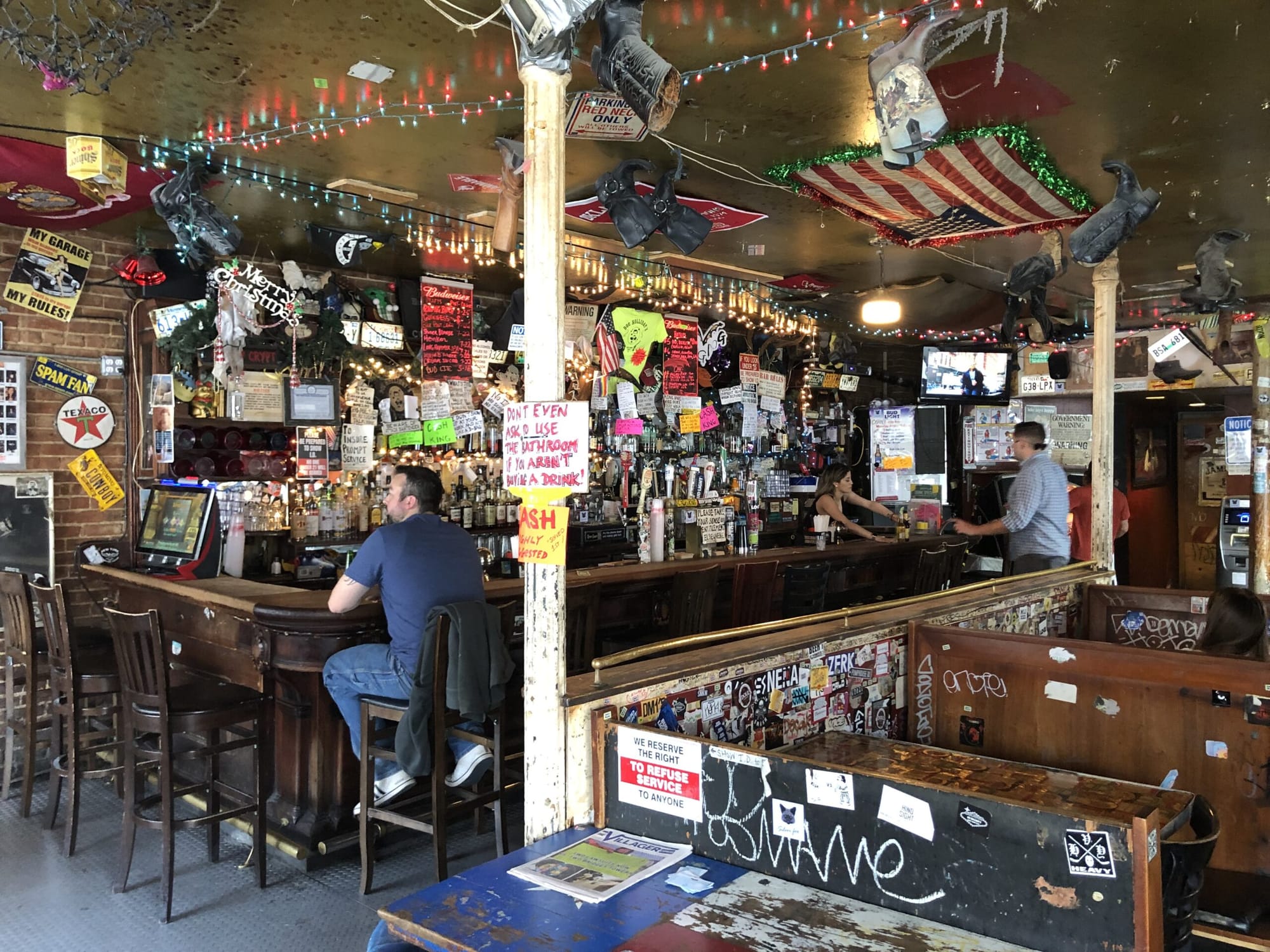
Front and interior of Doc Holliday's -- which is still very open in 2026 -- from the Scoundrel's Field Guide.
Mairead Sullivan: ooh.
Jack Gieseking: ... On Avenue A and 9th across from Tompkins Square Park, and someone heard there was a women's night where women, I'm making air quotes everyone, drink free, and this is 2000, 2001. And the softball team found out, the rugby teams found out, and then this huge amazing group called Pussy Power had all these, like, performance spaces.
They found out, and so we were, like, squished in there, all drinking for free-
Katherine Griffiths: Wow!
Jack Gieseking: ... well alcohol, and just paying tips. And these bikers who were very sweet to us, like, "What's with all these lesbians hanging out?"
It was a tiny place. It was just a small bar on the left side and there were some, some, some little all low tops. And if you played "The Devil Went Down to [00:16:00] Georgia" sometime around midnight- ... and danced on the bar, then you could kneel down, and the bartender in her leather-lycra bustier with her, with her hair braid down to her butt, would pour a shot of tequila down your throat, and then light the bar on fire and dance to something else.
And I was living in a magical world. I, I totally played it. I was always the one who played "The Devil Went Down to Georgia" 'cause I loved dancing on a bar. I always thought that was fantastic. Um, yeah.
Mairead Sullivan: You're of the Coyote Ugly generation, Jack.
Jack Gieseking: Well, I was watching that movie and I was like, "I could be a coyote. They have to have butch coyotes out there." Like, that was like a dream of mine. I was like, "Somebody will think that's hot."
Katherine Griffiths: Wow.
Trish Bendix: Well, that's something actually I've been thinking about in regards to this conversation about that sort... This time period to me also, maybe you guys agree with this, but, um, was an interesting mix of when the bars were like bars versus clubs, when the entertainment-
Jack Gieseking: Mm.
Trish Bendix: Part of it came in. Yeah. The live dancers- Yeah ... the sexy women. Yeah. Like the, you know, the Meow Mix of it all. Like, it's such an interesting, um, thing I think was happening. And maybe it was also in the late '80s, Katherine, I'm not sure. But it feels- Yeah ... like the '90s and early 2000s was when there was, like, a very much of a, is this a-
Mairead Sullivan: Yeah!
Trish Bendix: Is this a bar space? Is this a club space? Is this for dancing? Is this for meeting people? Definitely. Like, what is the intention here?
Katherine Griffiths: Yeah.
Jack Gieseking: Yeah. Club Q launches in San Francisco and Clit Club in New York City, and Clit Club even traveled as a party. But when I interview people for A Queer in New York, people would always say, "Oh, I went to the bar at Clit Club." But it was only open on Saturdays. I was like, "Well, that's not a bar. But who cares?" Like-
Katherine Griffiths: Yeah.
Jack Gieseking: We don't even know what things are anymore. And so there's more parties than ever are definitely happening, but the clubs and the bars was a huge thing, to have clubs.
Katherine Griffiths: Yeah.
Mairead Sullivan: Yeah. That shifted as well.
Katherine Griffiths: It's definitely a crossover phase for, for London as well, 'cause it was becoming sort of, I don't know, women, uh, had nights in more formal kind of clubs and, and we felt like, wow, it's not dingy! You know, the toilets work! You know.
There's really different kinda sense of it's a real place rather than down a back alley. Um, there was more things going on in Soho for women. Um, and I guess more mixed things as well, [00:18:00] particularly on the, on the Black scene, on the, on the Asian scene as well, where it'd be men and women would mix more than on the, the kinda, the white women scene.
Yeah. And I was just reminded there must be a tequila thing because, um, at the Royal Oak they used to have when they played, um, oh, was it "La Bamba"? A track like that. Then somebody would come out, um, very short shorts on roller skates with, with trays of tequila, and then everybody'd be getting the tequila shots. Yeah.
Jack Gieseking: What?
Katherine Griffiths: Yeah. These giant women on roller skates, wow. You know? Yeah. Yeah. Whizzing past.
Jack Gieseking: The one thing that stands out from all our descriptions, I think these spaces were big.
Katherine Griffiths: Yeah.
Jack Gieseking: Like physically there was room, like there's a fireplace in Tease and, you know, it's not all like Henrietta Hudson's and Cubbyhole, they weren't tiny spaces where we-- like, there's clubs. Um, Doc Holliday's was tiny, but it still fit hundred- hundreds of people.
Katherine Griffiths: Mm-hmm.
Mairead Sullivan: You know, Jack, when you say that, I mean, Trish just made this distinction that I hadn't really thought about. And so in my book, I tell the story of the first time I went to The Lex in San Francisco, and my friends and I had driven cross-country from Boston, the whole way getting excited about going to The Lex.
And in my head, not only because of the bars that I'd been going to in Boston, but I think also because I was very enmeshed in Queer as Folk and so in many ways, Babylon was like my touchpoint for, for queer bars in general.
Jack Gieseking: Yes.
Mairead Sullivan: And so I had this idea that The Lex was this just like thumper, thumper house club.
And to get there and discover that it's actually a dive bar no bigger than this closet that I'm recording in, uh, was a real shock. Yeah. But it's true.
In Boston in the early 2000s, there wasn't any dedicated lesbian bars, but there was dedicated lesbian nights- Yeah ... at specific bars. So, um, Toast was a bar that had a dedicated lesbian night. Kristen Porter ran Dyke Night, I think still does. It may have shut down in the last few years, but Dyke Night was-- at, I believe, The [00:20:00] Midway. Which in my mind comes the closest to that kind of like classic dyke bar for the nights that we had there, and was also teeny. I mean, the Midway in Jamaica Plain was a shoebox.
But every other night of the week when it wasn't Dyke Night, you know, it was like grizzled old Boston fishermen in there.
The Lex Lives!
Jack Gieseking - Narrator: Okay. We're gonna talk a lot about film and TV, things like Queer as Folk, of course The L Word, but first we need to talk about The Lex.
What is The Lex? The Lexington Club in San Francisco opened in '97 and closed in 2015. When it closed in 2015, it became such a famous bar in part because for so many years it was the only, quote, lesbian bar, end quote, in San Francisco. And when it closed in 2015, here is the gayest city supposedly, and they don't have a lesbian bar.
Everyone was writing about it. I wrote a piece about this that even trended on HuffPost, and it was a watershed moment because lesbians always have theories and, and I have to tell you that dykes are right. We're so smart. We're, we're brilliant. The thing is, friends, if we could actually sit and talk to one another, it would be profound. But we don't really have occasion or ability to gather in groups. I mean, if only we had something like a, you know, a bar!
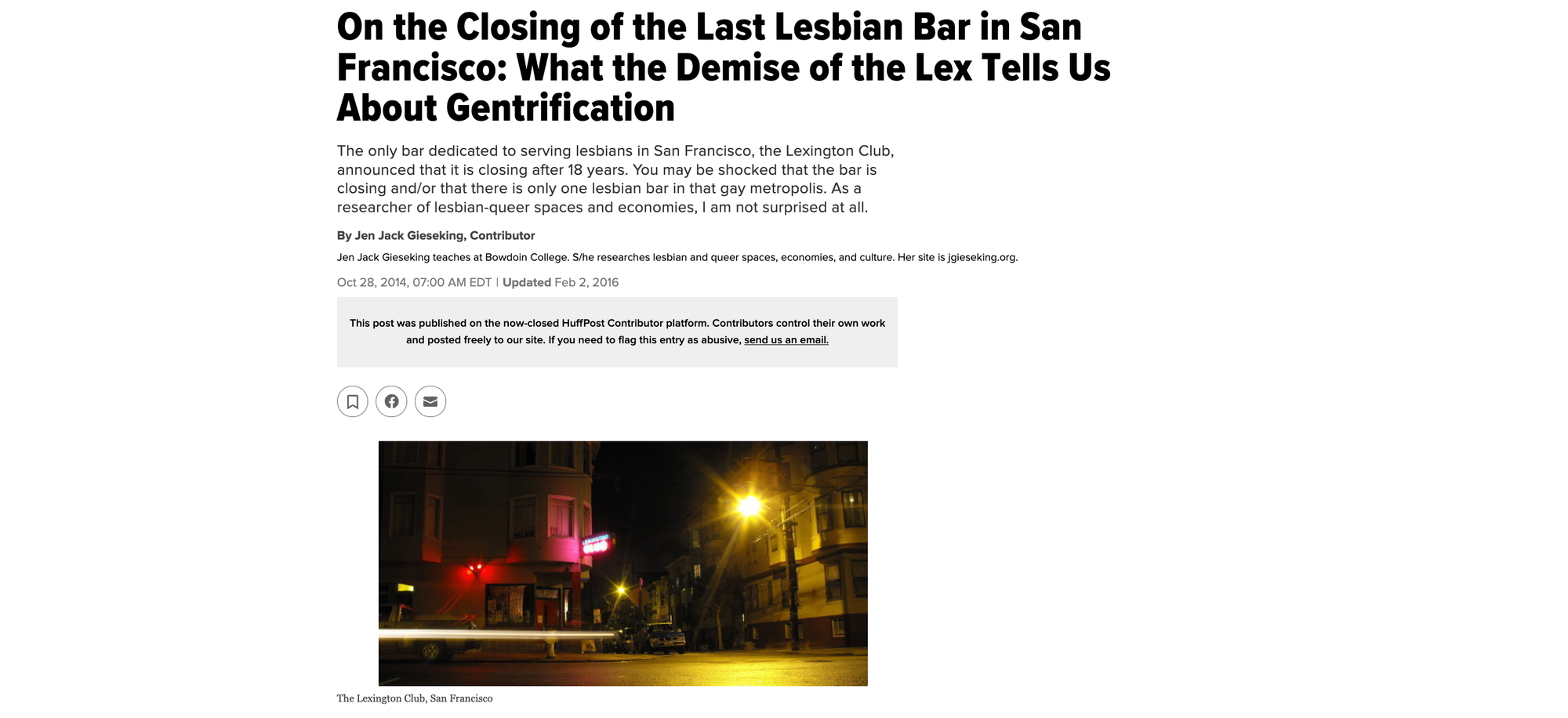
Anyway, to get back to The Lex, when The Lex closed, all these dykes all over the place, all over the world are like, "Hey, I keep seeing these lesbian bars closed in these cities that are supposedly queer and gay and dykey, but they're gone." The Lex gives us the ability to say, "Whoa, if we don't have one in San Francisco, do we have one anywhere?"
Mairead Sullivan's incredible book, Lesbian Death, thinks a lot about this moment of 2015 when things seemed to close, and I'll talk about that more when we get to the 2010s. The really sort of funny thing about the '90s is that in 1991, the last lesbian bar [00:22:00] closed in San Francisco. I'm laughing, but it was called Amelia's, and that's what every dyke said then . Although it didn't get national and even international exposure, there was even a plaque put down when the bar closed. But this earlier dyke bar, this "last lesbian bar of San Francisco," Amelia's, was attached to an incredible lesbian dyke ecosystem built in the '70s: the Women's Building, Old Wives' Tale Bookstore, the Osento Bathhouse, which actually closed pretty recently, and I'm still bummed I never got to go.
That said, it's really important to think in the 1990s that we already have this narrative of the last lesbian bar. This is when it starts, and it's just gonna continue to grow and grow through the '90s and the 2000s as, for real, the number of lesbian bars is in decline. I will even share Greggor Mattson's beautiful and tragic graphs about the closure of gay, lesbian, BIPOC, leather, cruisy bars over time.
Dykes! On! Film!
Jack Gieseking - Narrator: Now we're gonna go to the films that shaped us, but one that we don't talk about and I have to mention, of course, is Chasing Amy. One of the most famous scenes in a film about dykes takes place in the renowned Meow Mix of the Lower East Side. And if you haven't seen the film, it's baby Ben Affleck and baby Jason Lee, and Ben Affleck has this huge crush on Amy, Joey Lauren Adams, and he's, he's chasing her around. And then he winds up going to this lesbian bar with her, and, and then they sit down and he's like, "I don't know. Like, how can you have sex? Like, what's in it for you?" And then she does this sort of demonstration of what fisting is. However, anyone who's into fisting will tell you that is a bad representation.
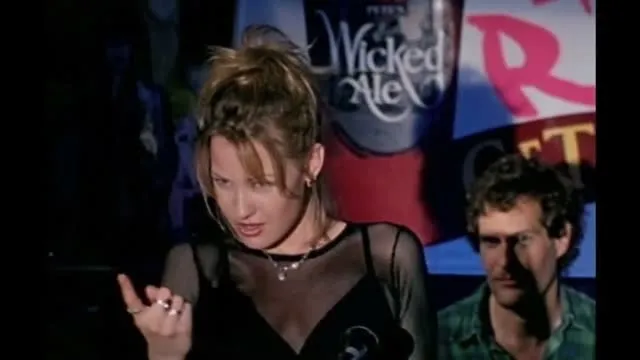
But that scene takes place at Meow Mix, which made Meow Mix a even more hugely popular bar.
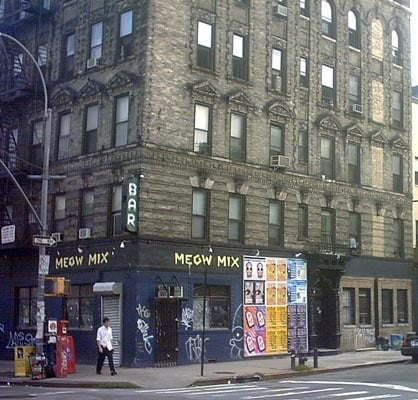
Now, back to the films that shape us that are still around, that people are still watching. Thank goodness for the indie movie industry, the technology, and the distribution that [00:24:00] allowed us to make new representations of one another.
Mairead Sullivan: So I think that that's an interesting distinction, and also that coming of age at this time in which we actually did have some, not great, but some media representation of what, what dyke nightlife looks like, it really sort of distorted what you thought a dyke bar was
Jack Gieseking: Right, 'cause we, we get our indie movies are kicking off. Go Fish-
Mairead Sullivan: Yep.
Jack Gieseking: The Incredibly True Adventure of Two Girls in Love. Bound. Thank you for mentioning that, Trish. Always a favorite of mine. There's a great book by Kelly Hankin. Have you guys ever read it? The Girls in the Bar.
Mairead Sullivan: Oh, no.
Jack Gieseking: This is the first book...
Oh my gosh, guys, so this is the first book everyone listening will probably be not shocked to hear, uh, on lesbian bars. It was written in 2000. There's only been four books. Uh, this was the first book for... It stood alone for 18 years.
Katherine Griffiths: Wow.
Jack Gieseking: And it was only about lesbian bar representation in film that-
Mairead Sullivan: That's right!
Jack Gieseking: Um, uh, Boys on the Side movie, and my favorite-
Mairead Sullivan: Yes!
Jack Gieseking: Uh, quote from Hankin, was something about Uh, Boys on the Side with Drew Barrymore, Whoopi Goldberg, and Mary-Louise Parker, and they are traveling cross-country, running from an ex-partner that is after them to hurt them in some way and, and they hide out in a lesbian bar in Arizona.
And all of these people just welcome them! And take care of them!
Hankin points out that all these representations, all the lesbian bars are totally multiracial, multi-class, totally welcoming, um, huge, wonderful spaces, and just men never walk into them! And never even notice them. It's a ... You know, there's some sort of mirage power that we have to, to keep from the rest of the world.
Trish Bendix: Also, the Indigo Girls are just playing there.
This Bonnie Raitt song from the movie isn't on Spotify and it's amazing. The Indigo Girls just put in "Power of Two" and goddess bless them but you cant find them anywhere.
Jack Gieseking: Yes!!
Trish Bendix: Like, the Indigo Girls are just, like- ... stopping by and, like, playing a set. It's just incredible. So sick. It's a dream.
Mairead Sullivan: I mean, having lived in Atlanta for six years, it's not uncommon for the Indigo Girls-
Trish Bendix: There you go!
Mairead Sullivan: ... To pop up and play a set somewhere.
Trish Bendix: Well, stop bragging.
Jack Gieseking: That was a-- I wish we all lived in Atlanta and had known this. Yeah. That would've been amazing.
Jack Gieseking - Narrator: Here's Kelly Hankin's actual quote:
"In a large number of film and television bar representations, from the earliest depiction to the present, the use of lesbian actresses or icons, the use of real lesbian bar space, or the use of particular editing and stylistic choices grant bar scenes documentary status."
So what Hankin is saying is these, the way we see these dyke bars on screen, even if they're fictional, or even if we're shot in a real space, like Chasing Amy, we feel like this is what real dyke life is like.
Getting to the movie Boys on the Side, 'cause this is the most amazing part: "The lesbian bar is also the backdrop to a crime narrative in Boys on the Side. After the accidental murder of an abusive drug dealer in Pittsburgh, three women temporarily evade the law by hanging out in a multiracial, multicultural lesbian bar in Tucson, Arizona."
Guys, what are we talking about? It's amazing.
Wait, I also gotta give you this one: "In The First Wives Club, three spurned middle-aged divorcees out to avenge their ex-husbands begin their work with a visit to a lesbian club in order to recruit the services of one of the women's lesbian daughter."
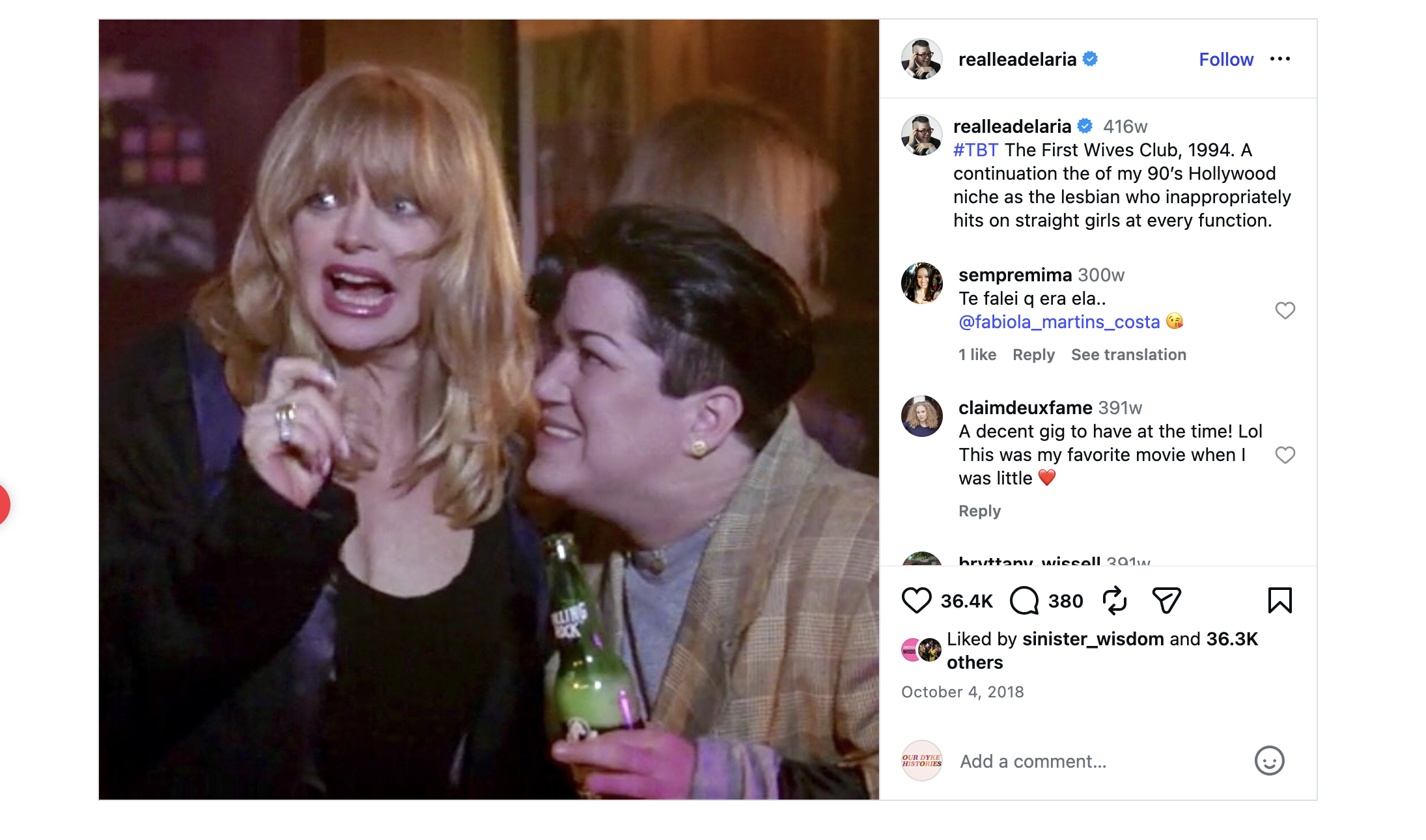
In fact, those three women are Bette Midler, Goldie Hawn, and Diane Keaton all hanging out in a dyke bar, and then Lea DeLaria just, like, happens to hit on Bette Midler. I mean, as one does.
And also something Hankin points out that we shouldn't lose sight of is that most of the people who are in dyke bars are criminalized in some way, or they're trying to enact criminal acts.
So that's happening in mainstream film, but in dyke indie films you have these dykes earnestly coming into themselves and having earnest sex with one another. Or in Bound they steal a lot of things, but, you know, whatever. I don't wanna give it away.
Our Desire for Ruby Fruit
Jack Gieseking - Narrator: Next up, you will hear us mention the fabulous Ruby Fruit of LA. We were so sorry to see it go , and we recorded this just before it closed. Ruby Fruit was part of that 100% increase in the number of dyke bars in the US in the last few years of, the [00:28:00] revival or renaissance, but you'll hear our love for the bar and how we wish to hang out there regardless.
Jack Gieseking: Since you're all writing about the landscape of the '90s and the 2000s and the lezbiqueertrans bars and clubs, what, like, what do you, what do you all see in your work too?
Trish Bendix: Well, I can talk about something that I've been noticing in LA because now we have two newish lesbian spaces, and one is a bar and one is kind of a club. And so it's been really interesting to see how the reactions of people to these different spaces and the complaints or what they enjoy. You know, I, I try to fi- figure out if somebody hasn't been to The Ruby Fruit, which is one of the, which is the more bar space here.
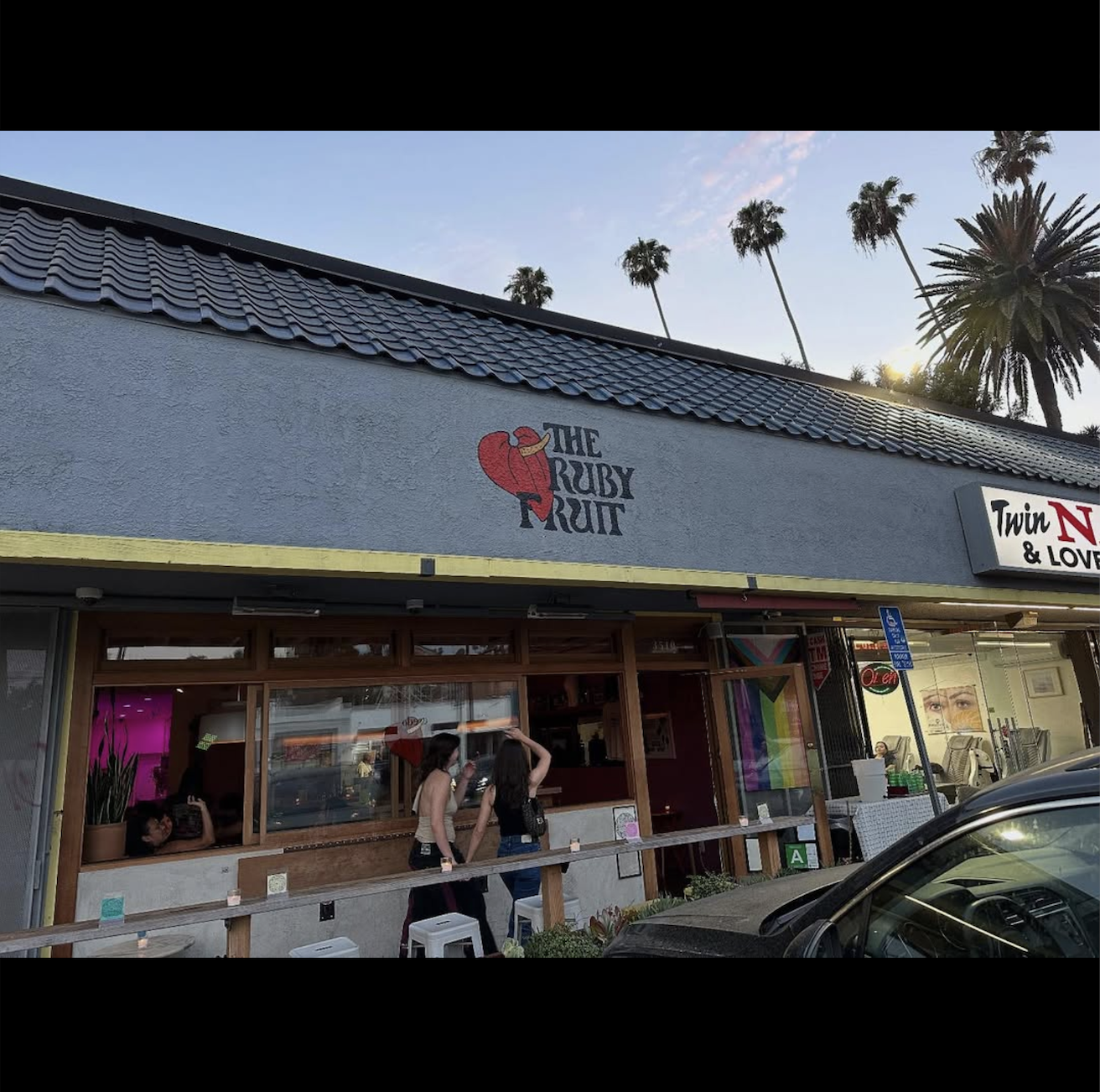
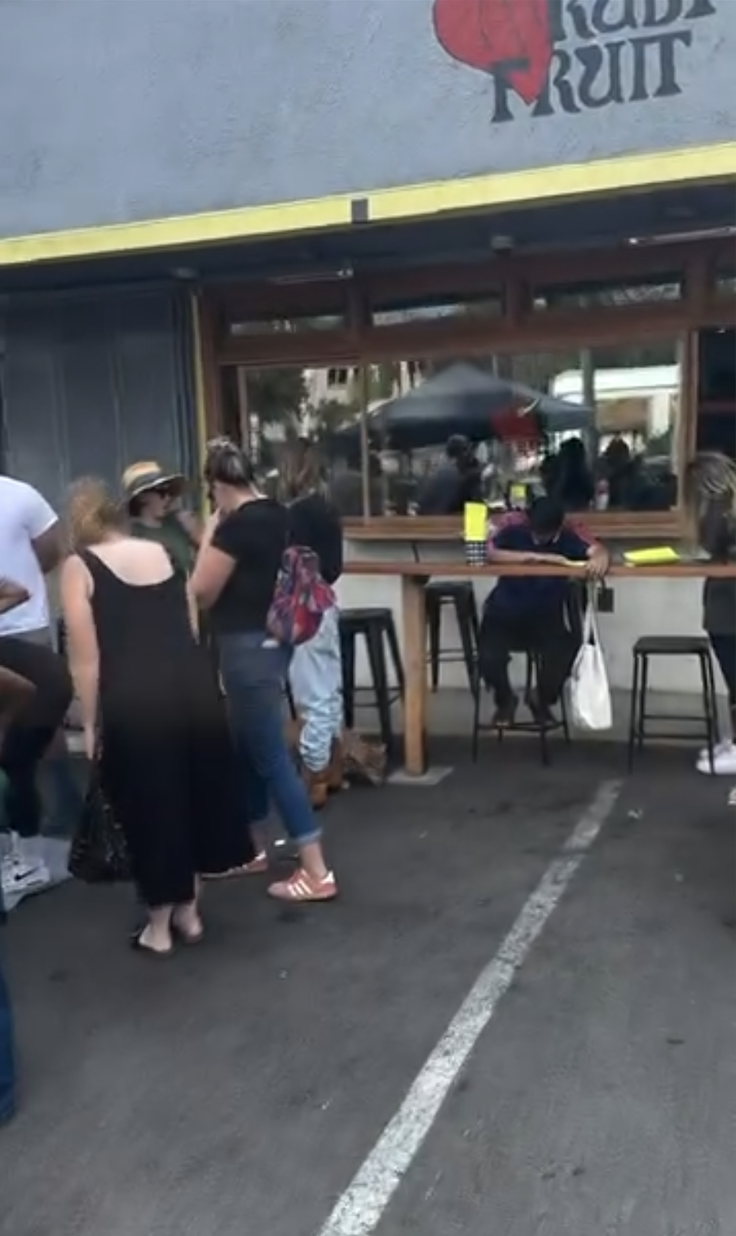
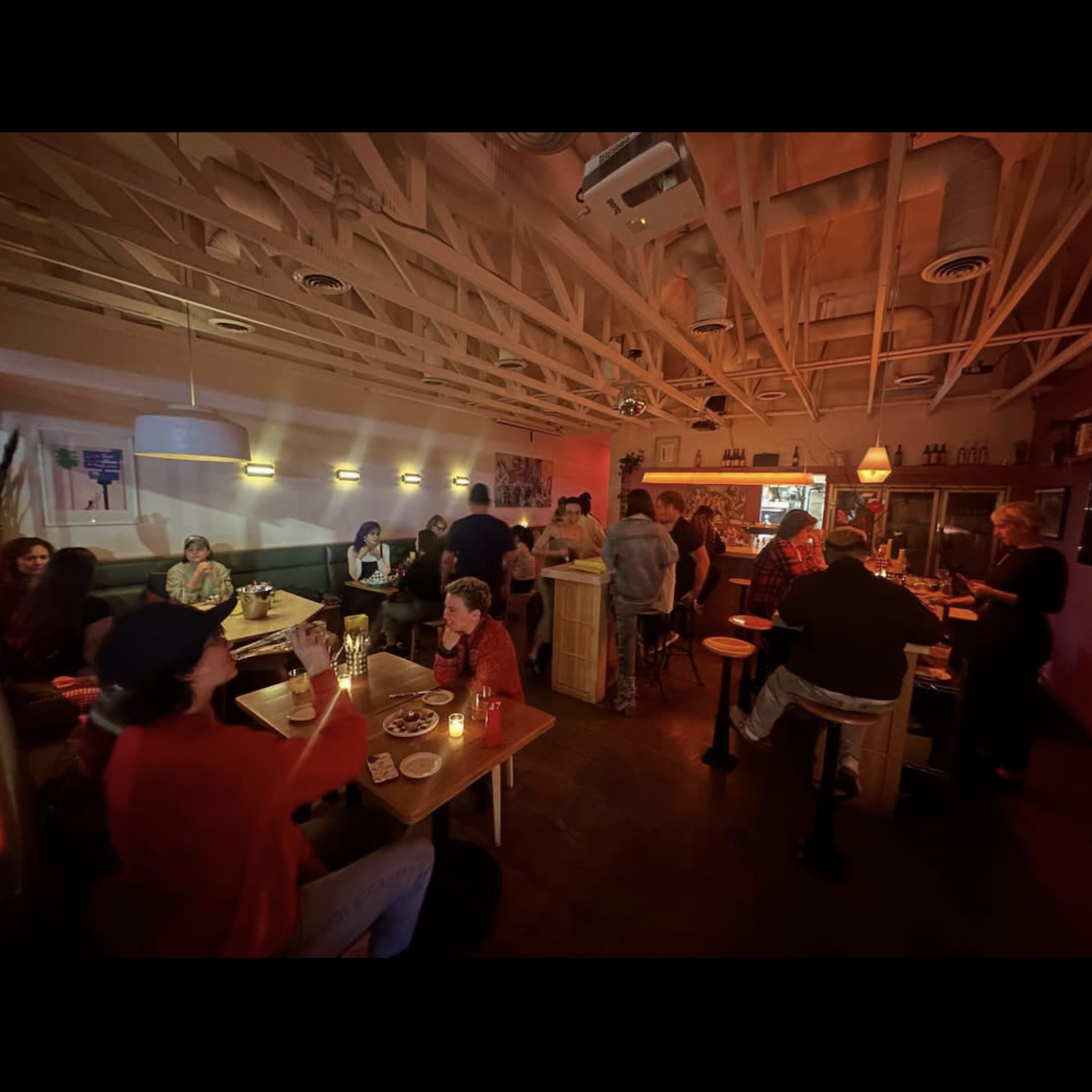
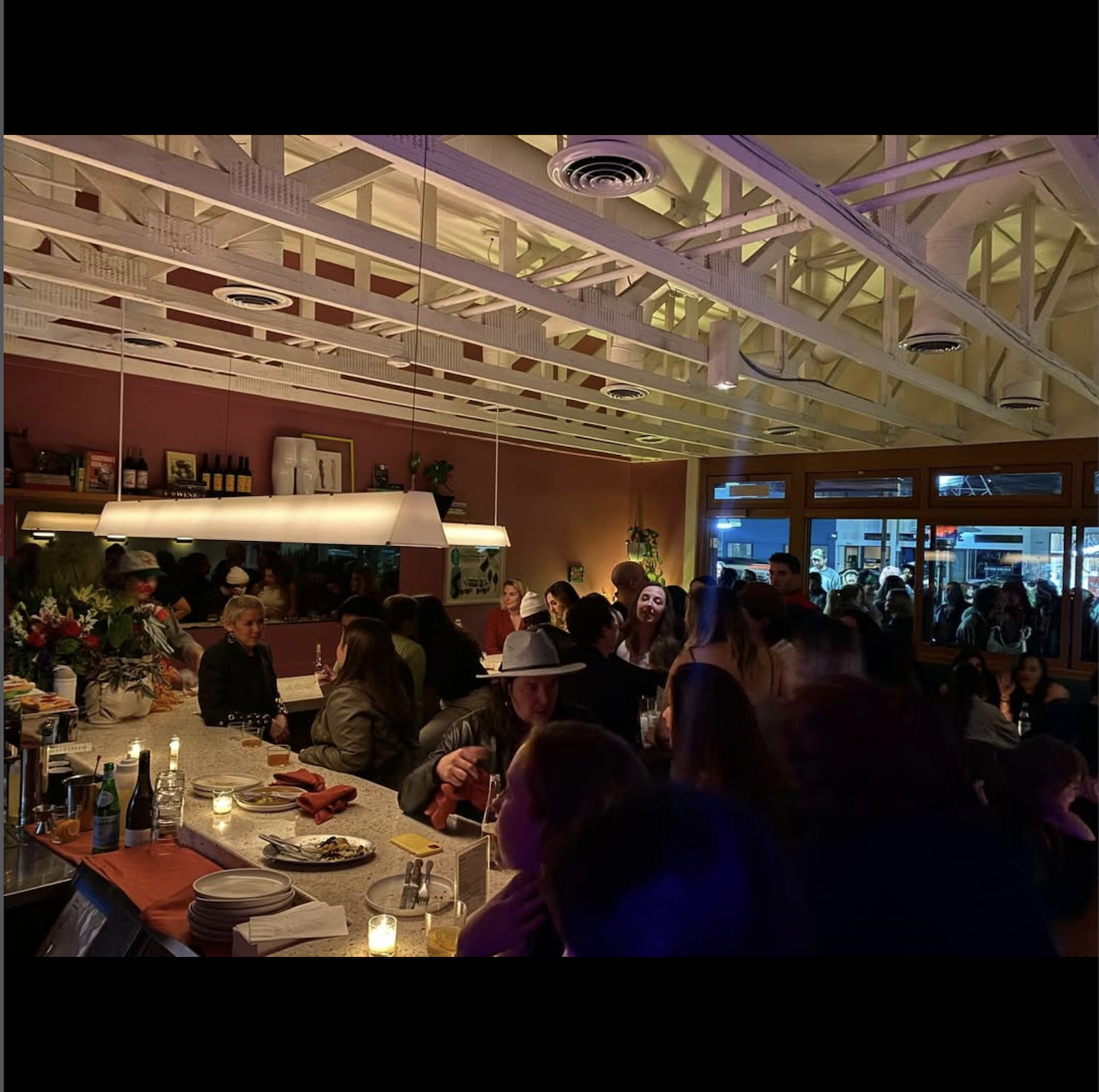
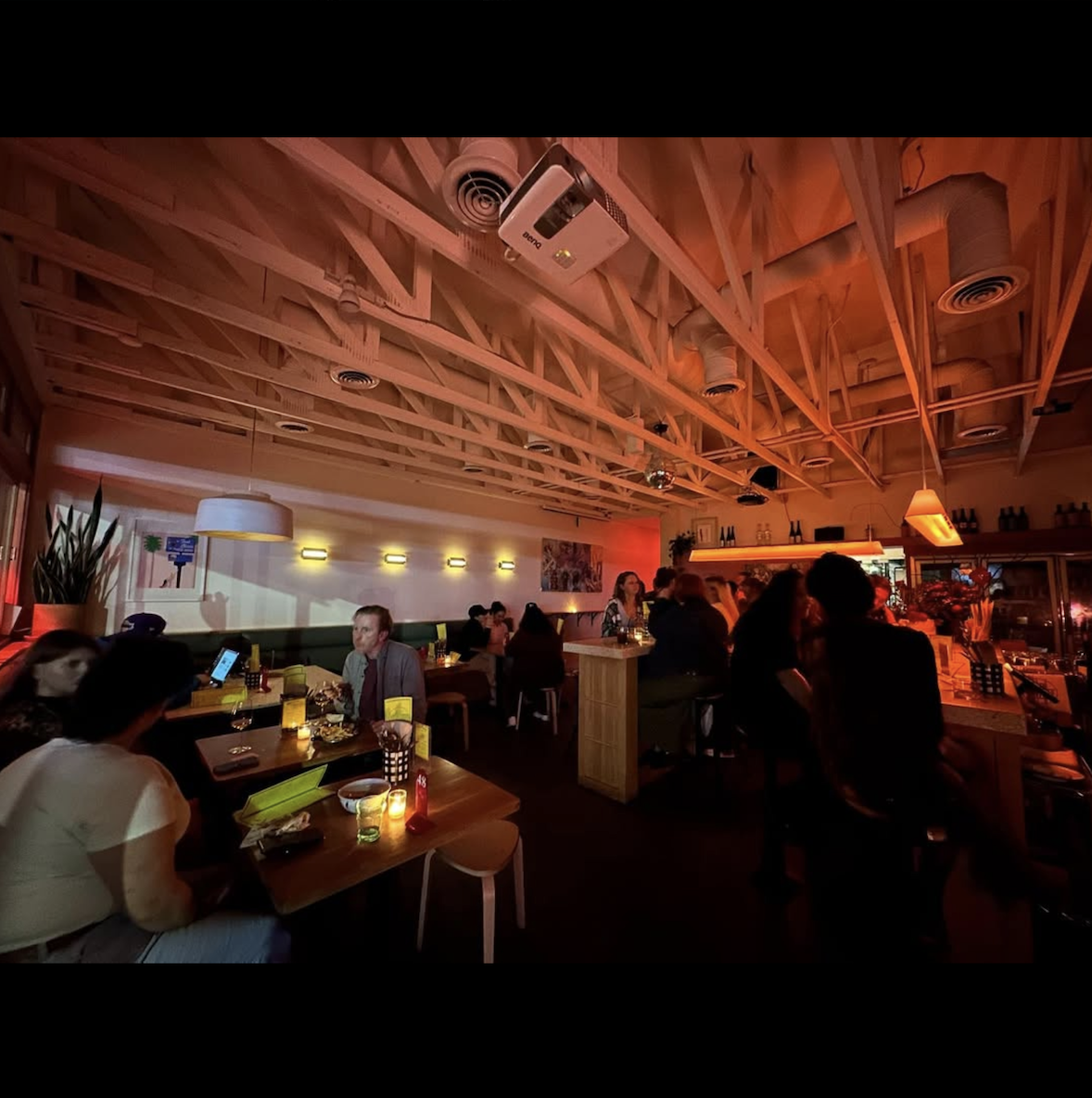
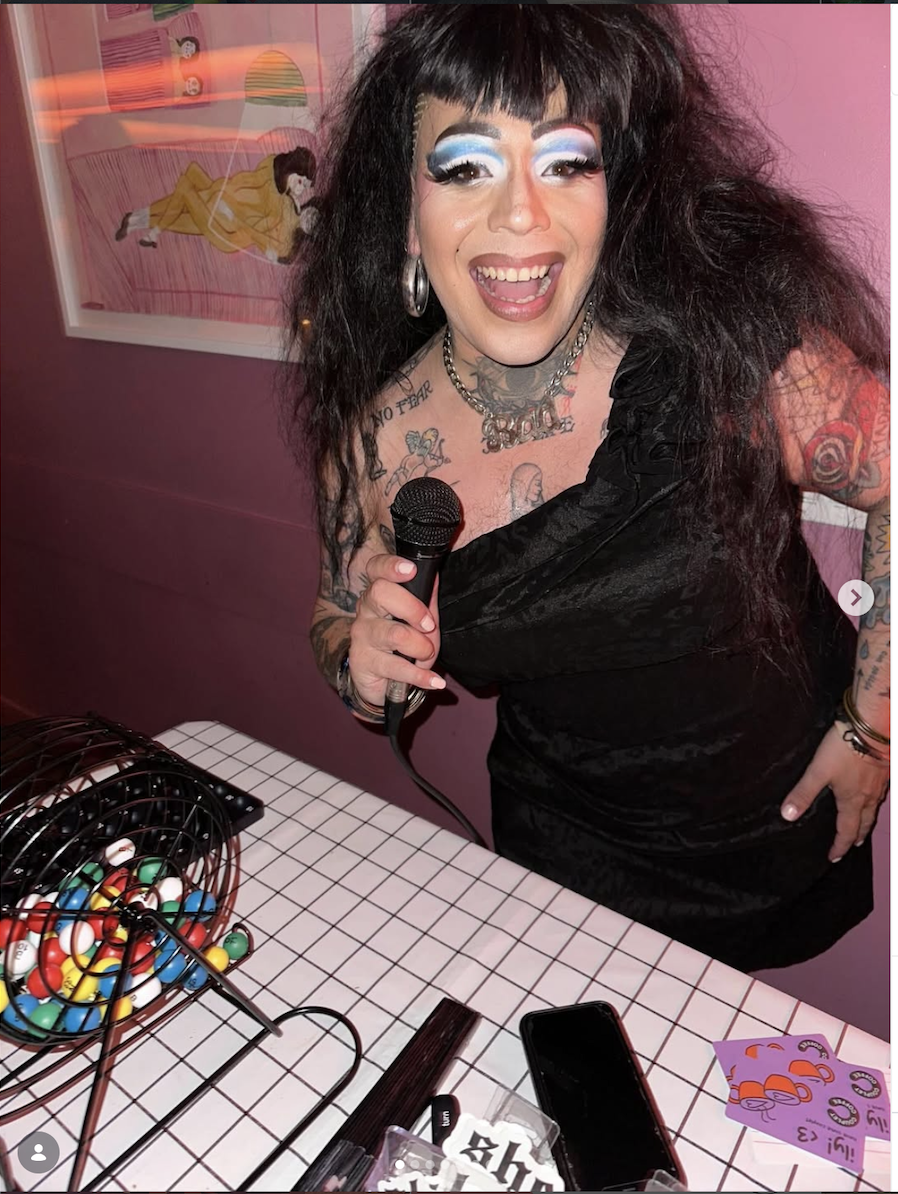
Answering the forever question of WHAT GOES INSIDE A LESBIAN BAR?!?!, Ruby Fruit Instagram generally showed you it was just a bar. Here are some screenshots from the last days. <3 RIP sweet RF. You did good work.
Well, it's not, I mean, it- I say bar, it's a wine bar. It's like a very- It's very pink. It's very small. Okay, it's very small, and that's a complaint I hear a lot about. It's very small. I don't wanna have to go, like, stand in a parking lot and, like, wait for an overpriced hot dog or whatnot. And then you hear from people that are just so grateful to have this space and they-
Mairead Sullivan: Right.
Trish Bendix: Mm-hmm ... you know, they, they need the overpriced wine. They'll buy the one beer that's available there. They'll make do. They'll buy a coffee. They just wanna be around other lesbians or queer people. And so I feel like it's ... I'm asking f- friends that worked in a, um, lesbian nightclub called Wall Street in Columbus, Ohio in the late '90s, early 2000s.
Mm-hmm. It sounded like the spot to be. And so now they in their 50s are, there's no way they're gonna go to The Ruby Fruit because that sounds like a classist nightmare. You know? Like, they're just like, "That's not- Right ... we don't, that's not, we don't associate with that." But I'm like, but as, I'm the kind of lesbian who's like, "But I wanna go to all the spaces and I wanna see all the spaces, and I wanna be around all the lesbians."
And you know, there's like this old joke- Mm ... like, and this might be the, the wrong price point, I never remember, but it always says: "What's the difference between a dyke and a lesbian? And the answer is $20,000. "
Katherine Griffiths: Ooh.
Mairead Sullivan: Huh. Yeah.
Katherine Griffiths: That's great. Yeah.
Jack Gieseking: Um, was that a '90s price point? Yeah, that was!
Trish Bendix: I, yeah, that's why I'm like, I don't remember the exact numbers.
But it's something like, you know, if you're a, a dyke you're poor, if you're a lesbian you got money, right? And so I see, like, a lot of [00:30:00] friends who I think just see Ruby Fruit as kind of like a little too bougie or something.
Mairead Sullivan: Mm-hmm.
Trish Bendix: And too small for what a dyke space should be. You know, there's just a lot of ideas of what a dyke- dyke bar should be.
And so it's like-
Jack Gieseking: Yeah .
Trish Bendix: .. Then you can go to Hollywood and go to Honey's and you can go dancing, and you can have more of a club experience, but you know, lots of complaints about how small that space is and how it's just not very convenient and in kind of a shady part of town, you know, at night. Yeah. And, uh, and, and lesbian bars are, like, famously across the street from, like, YMCAs and a shelter.
Like, quote-unquote, "unsafe parts of town," like neighborhoods that wouldn't be, or quote-unquote, "undesirable." So I think it's so interesting now that we have, like, a bar called Ruby Fruit, you know, which obviously has, like, a historic, you know, homage paid, paid to Ruby Fruit Jungle.
Katherine Griffiths: Yeah.
Trish Bendix: Um, and not the first of its kind to be named after that book.
But it's just a very different picture of what lesbian bars are from 20 years ago or 30 years ago.
Jack Gieseking: Yeah. I talked to both of these owners. And the Ruby Fruit owners, they couldn't get another space. They had this vision of wanting to have the quintessential dive bar. Like, this big space, have a dive bar.
Trish Bendix: Mm.
Jack Gieseking: And the only place they could get was the place they used to work, which was the wine bar, and they're like, "Not what we intended to do. Not the place we wanted to make, but we could make a space," right? And also these spaces being really small is all about our political economy and being angry and frustrated.
When I first talked to the bar owners who started launching new spaces. They said, "What have you found?" And I said, "If you would like to make your finances public, people would be very much kinder to you and probably stop complaining, because you are barely, if even, making ends meet in all of these spaces." As people have said forever, everywhere.
Trish Bendix: Mm-hmm.
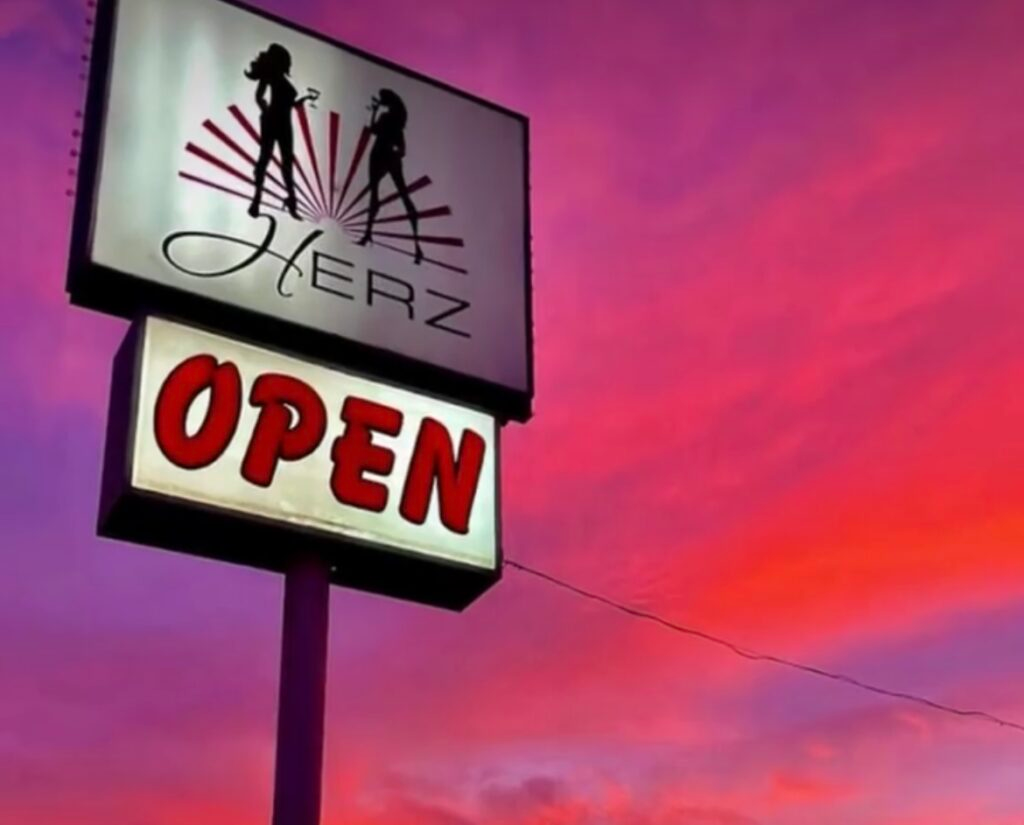
Mairead Sullivan: Even Herz that just closed in Alabama, a, a small bar, the only lesbian bar in Alabama, opened by-
Trish Bendix: Mm
Mairead Sullivan: ... two Black lesbians. They closed it. They're like, "We make more money and have more fun running the party version of this, which we used to run. Yeah. It was great to own the bar, but [00:32:00] then that goes away too."
Yeah, I mean, let me say, 'cause originally we were gonna record this on Zoom, and so as a way to show my love and dedication to Ruby Fruit, I was gonna have Ruby Fruit as my background.
Jack Gieseking: What? Aw.
Mairead Sullivan: Um, but, but I share some of the critiques that Trish is talking about, which is, like what I've said often about Ruby Fruit is like I love it.
I love it, and to the owners, if you're listening, I'd love to, to participate in things. I'd love to bring my book and put it on the shelf. But, uh-
Trish Bendix: Just bring it in. Bring it in! They'll love it right up there.
Jack Gieseking: You should just take- you should- A book on Lesbian Death will be very popular.
Mairead Sullivan: What I've been saying, though, is I can't go there and spend less than $100.
Katherine Griffiths: Mm.
Mairead Sullivan: And as a vegan, there's very little vegan options, and so it doesn't have that same kind of dyke bar flavor. But what I actually wanna talk about is that the first time I went there, well, one, the first time I went there, Lea Delaria was there.
Trish Bendix: Oh, wow.
Jack Gieseking: As one does, yeah.
Mairead Sullivan: But also, and you know, to our opening point, I'm, I'm very much on this cusp of a new of middle age-- I'm like deep into middle age-- but the youth are there. Like, people in their 20s are there. Mm-hmm. And so it's also one of those-
Trish Bendix: Yeah ...
Mairead Sullivan: experiences that I have where I'm like, well, maybe there's something I don't get about this. I mean, again, I love Ruby Fruit, but that like, it doesn't follow where I wanted to be when I was 24. But look, this is where LA's 24-year-olds wanna be.
"All You Had to Do Was Go & Start Hanging Out"
Mairead Sullivan: But to that and to the question about finances, I actually do wanna bring Diesel Cafe into the mix a little bit. Because Diesel, while not a lesbian bar, when I moved to Boston in 2003, and I actually was in central Mass starting in '98, and so it was probably sometime in like the around 2000 that I went to Boston. I was, you know, looking to find lesbian and queer community, and all I knew, and this is like pre-internet really, was that there was this place called Diesel.
And Diesel, to me, played the role that I think dyke bars played in the '70s and '80s, which is that like I just showed up and started going and [00:34:00] hanging out there, started making friends with the baristas, and it just became the like sort of central point of my social life for the eight years I lived in Boston.
And you didn't have to... All you had to do was go and start hanging out at Diesel, and they were open from 7:00 in the morning until like 11:00 or midnight. And so there even was a kind of night scene there even though it didn't revolve around alcohol.
Katherine Griffiths: Yeah.
Mairead Sullivan: And this is also, you know, at a time where, you know, I spent all of my 20s there and people were thinking differently about their relationships to alcohol, et cetera.
But it really was that kind of like community space. And I think that something that gets lost in all of these conversations and lamentations about the loss of lesbian space is, or the, of dyke bars, is like the lesbian cafes or even other community centers, se- uh, settings like the lesbian health center.
Or in Boston I was also really involved with the rape crisis center, which is like not, I don't wanna say like, "Oh, thank God we were all there for the rape crisis center." We'd rather there not be a rape crisis center. Mm. But it was, you know, a really community-oriented, community-run space where we al- we're all part of this project together.
And then went to Diesel to drink coffee and eat scones. I don't even remember what we ate.
Jack Gieseking: Yeah. I love the stories of people I interviewed for ACT UP. Like we, we did our organizing and then we went to hang out at the bar or we went, you know-
Mairead Sullivan: Yeah!
Jack Gieseking: ... If there, if there had been a Diesel Cafe.
Generational Possibilities & Lamentations
Jack Gieseking - Narrator: How much does age shift what we can do or imagine we can do or think we should do because of what's available to us?
Something I hadn't thought about when I was doing my research, I was around my mid-30s: is all of my participants, many who were in their 50s, some of whom were a mere 20 years old, saying to me that they noticed that dykes age out of bars in their mid-30s. What's interesting is 20-somethings just think that 30-somethings don't wanna come, but if you are a single 30-something like I was, you wind up walking into a bar and feeling both a bit creepy and a bit bored [00:36:00] when you're the only person there with lines on your face.
But also what happens is a lot of people seem to partner around then. You might have kids. You have a career, quote-unquote, that takes off. You have other devotions. You have elder care. You have friend care. You have crip care. You have childcare.
The key thing to think about is: actually what age do you want bars to be for?
Bars would be incredibly lovely spaces. One of my favorite bars in Western Massachusetts, Sub Rosa, opens a little bit earlier for what they call the silver scene, and a lot of older women and trans folks come in on that early side. Then they can go home and have a nice dinner and go to bed. That's lovely. Or stay up late watching their porn, whatever gives them happiness.
Regardless, we have to rethink those spatiotemporalities of dyke life, about how we share space and make space.
London: If Not Big Space, Then Big Music
Jack Gieseking - Narrator: Now let's talk about how myopic we are by continuing to talk about the United States. Thank goodness that Katherine is here to tell us about the UK, especially London.
Jack Gieseking: And Diesel Café is also a huge space still, has m- has maintained a-
Mairead Sullivan: Right!
Jack Gieseking: It's been there for a long time.
Katherine Griffiths: Yeah, I was just thinking about, I mean, I'm gonna use your word constellations, Jack, to come in on what, what you're saying, Mairead, about all those different other activities and spaces that we occupied, and whether that was coming after a football match for us, uh, softball for, for you guys, um, some, someplace that was safe to hang out in.
And I was just reading that there's a book that's just come out about the six lesbian places
Jack Gieseking: Yeah, June Thomas' book !
Katherine Griffiths: Yeah, yeah! So, so bookstores: the kind of comparison between the gay men scene where there's lots of bars, lots of clubs, and they don't have any bookshops, whereas the women scene, there's just loads of bookstores.
Mairead Sullivan: Mm-hmm.
Katherine Griffiths: And, and the-- you know, massive difference. But then I've also talked to a lot of women who are in their 20s now, 'cause I've been speaking at different conferences, and they have a real nostalgia for the '90s because this was, I think it was almost a heyday in London in particular, the '80s, '90s, where women [00:38:00] took over a lot of bars.
And I've just noted down, there was the Duke of Wellington that was owned by a woman that was a pub again, but had a women's night in the back room. There was the Royal Oak that I've just mentioned. There was a, a place called the Fallen Angel in Islington that again had a night that was, um, a women's night on a Tuesday, which would be packed.
The road outside would be just full of women. Del LaGrace would be there as. We had a place called Bar South right next to the police station in Stoke Newington where– that was run by women. Another place called Blush.
I mean, a lot of these would have women's nights, and they'd be mixed in the daytime, but then they'd have particular, you know, specific, um, evenings that were women's.
But they were the bars, but we didn't have any clubs. Nobody owned or ran a club. So we would do nights and try and get a night going. And another night that I managed to get going with a, with another friend was in a really nice club space in Camden where, called WKD, but we could only get the Wednesday, first Wednesday of every month. You know, really lovely swish place, restaurant upstairs, very ch- cool, trendy, and at the point in time where women, you know, who were more femme would go and dress up, and more Black women would go there because of the music that we played.
Yeah, and then there was other, other spaces and usually small spaces.
I'm thinking there weren't any massive spaces except for in the '80s there was, um, a club called Venus Rising, renamed after it had been called Eve's Revenge, which I, I prefer that, that name. Um, which was a enormous club and it, and it felt like one of those spaces, we're actually in the biggest space that we could be in with, with other women.
You know, we didn't get a lot of opportunities for that, to be in a really big space with big music-
Jack Gieseking: Yeah.
Katherine Griffiths: And really get into, into the sound and, and, you know, on- onto the dance floor. But we created that in smaller spaces as well, so y- where you'd kinda lose that feeling of the space as well through music and through, you know, either whether it was drink or drugs or just the, the vibe as [00:40:00] well.
Yeah, so I think I started off thinking about the nostalgia for the '90s and kind of appreciating that there was a lot on, but at the time I was se- searching for the right place 'cause I couldn't find a place where I necessarily felt comfortable either. And, and I think maybe that's a lesbian thing, you know, kinda you're always looking for something, particularly in your 20s if you're single. I- is this gonna be the space where I find someone, meet someone?
So all of these different places that I'm looking back at, uh, were somehow unsatisfactory as well.
Oh, Kemi Adeyemi talks about that as well, you know, from a Black woman's point of view about really making a massive effort to go out, to kinda navigate your way through the transport systems and the geography of a place.
But it's hard work, and you're not always content when you actually reach that destination.
Mairead Sullivan: Mm-hmm.
Jack Gieseking: Yeah. And there is that kind of projection of something amazing that's gonna happen at the lesbian bar. Like you, you c-
Mairead Sullivan: Yeah!
Jack Gieseking: Or something could happen. You might... You... There, there, there... Right? Is someone... Are we gonna, am I gonna have sex in the bathroom?
Am I gonna meet the love of my life? Am I gonna meet my, my best friend forever? Or those are the ideas that I had had projected onto things.
Jack Gieseking - Narrator: You can hear it, right? This dyke geographical imagination of so much that we put on bars. Are we gonna have sex? Are we gonna become good activists? Can I get a gynecologist? Will you be my best friend? Do I belong here? Am I a lesbian? All these questions that get projected onto dyke bars as spaces they can/'t answer, and then they start to hold those.
Because so many people have had those questions answered there, whether we read about it, we see it on film, we hear about it, we get it in a Reddit thread, and we continue to pass this on that the dyke bar is a place that offers us maybe solution, maybe connection, and it makes for a very empowered sort of space.
But ask yourself, what power should it have? How do we give that power to other spaces? Do we [00:42:00] want to? How do we build the lezbiqueertrans worlds that we want?
The Non-Profit Industrial Complex
Jack Gieseking - Narrator: Which brings me to the nonprofit industrial complex. In 1995-- I didn't know this was happening because I had just started college-- President Bill Clinton pretty much ended the welfare state. It was a lovely thing while we had it, and you think if it's bad to lose Obamacare now, it's just been a world that's been slashed and gutted away from us since the '90s.
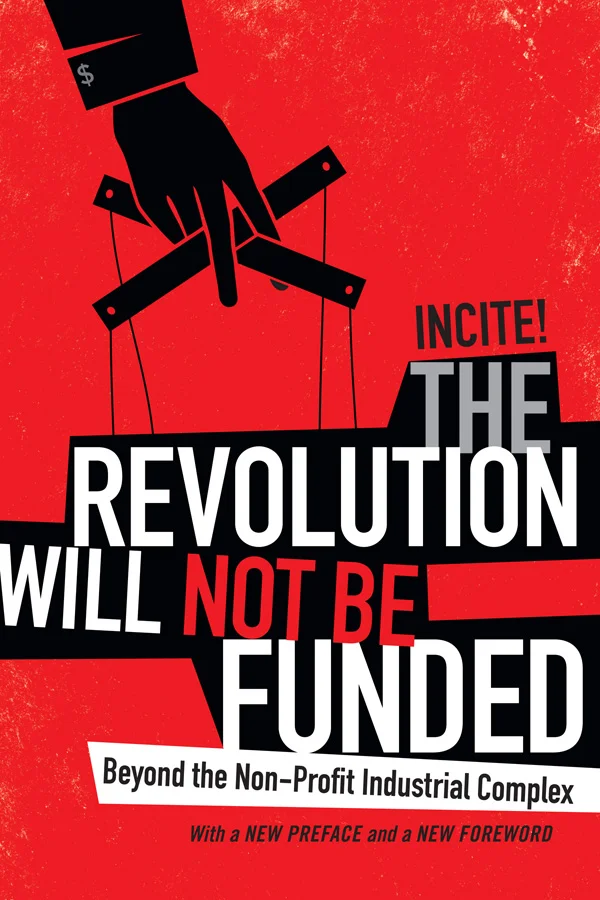
There was an incredible group of women and queers of color called INCITE! All caps, exclamation point, and they put out a book called The Revolution Will Not Be Funded, where they were looking at this thing that they named as the Nonprofit Industrial Complex. And the NPIC, we could call it, the NPIC is central to lezbiqueertrans life.
There was a mass of organizing in the early 1990s and the '80s. There were more and more organizations. People had to be activists because people were dying. I know I keep talking about ACT UP because it's the one that gets all the attention, but there were hundreds and hundreds of organizations in every city popping up, boom, boom, boom, building, building, building. Any place that LGBTQ people could organize, they were organizing 'cause they had to.
Then we came into the early '90s, and there was a massive amount of organizational infrastructure. Except! It was unpaid for the most part. People had donations, sure, but this was not a full-time working job.
So along comes the end of the welfare state, and they say, "You know what? The people who should be in charge of really supporting people should be philanthropists. I mean, philanthropists, these people who give money away, millions, millions of dollars, they'll help people. The government doesn't need to do that."
Now, what was great at the time in the 1990s is a lot of that money got poured into LGBTQ groups because we had this [00:44:00] huge organizing backbone. Because of the impact of groups like ACT UP and Lesbian Avengers and Queer Nation and so many others, there were so many organizations. And rich gays! That were willing to give their money to found LGBTQ groups. And so because we had some stability, we gained more stability and more funding.
But by the 2000s, a lot of those groups lost their funding. I remember there being multiple organizations in the late 90s and early aughts that supported queer youth of color, but the funding for those groups completely dried up by the end of the decade. By the 2010s, that funding was much more limited, and now that we have a government ... Do we even have a government? Um, that's being taken over by a fascist narcissist.
So much of the infrastructure and funding we had from the state is gone as well, and we're losing the backbone of the people we were. Which means in order to create the world we want, we have to go back to that volunteering.
So many of us are committed to mutual aid and supporting one another.
But that's how we got here.
Jack Gieseking: The one thing I don't wanna lose, too, is this, the early 90s, at least in the US, is, is the whole movement, um, late 80s, early 90s. So you have so many people, people I've always thought it was because of the, the massive, uh, organizing around AIDS, that so many people are hanging out together.
Katherine Griffiths: Mm.
Jack Gieseking: Mm. And there's so much death and loss anyway, and then they're, they can see in each other the other illnesses that they're, through structural violence about the drinking and, and the drugs. Yeah. And some people enjoy those things, and sometimes it goes too far and, and hurts them and hurts others.
The bar Maud's has, in San Francisco, which a really long time a lesbian bar, had closed I think in the early 90s.
Mairead Sullivan: '93, I think.
Jack Gieseking: Thank you, yeah.
I should know.
Yeah, you, yeah, you, you would know. You loved everything about 1993, so we'll talk about that in a second. Yeah. Um, and that when it closed, the movie that's made about it, I just was struck by someone saying, [00:46:00] "I think it closed 'cause so many of us were alcoholics, and we realized it."
Katherine Griffiths: Mm-hmm.
Jack Gieseking: "And now no one's continuing to come to the bar."
Trish Bendix: Mm-hmm.
Katherine Griffiths: Mm-hmm.
Jack Gieseking: "We're not sitting on the stool every night and spending our-"
Trish Bendix: Yeah.
Jack Gieseking: "... Most of our income here."
Mairead Sullivan: Yeah.
Jack Gieseking: And prices are starting to go up, and also all the activism and the organizing. Mm-hmm. People are meeting people in other ways. They've relied on bars for so long, and now it's so common.
My Bar Is a Fundraiser
Jack Gieseking: Like, the Lesbian Avengers are taking off in the early 90s too.
Mairead Sullivan: Mm-hmm.
Jack Gieseking: So all these factors are also happening and shifting and changing things.
Mairead Sullivan: But I think actually to pick up on that point, Jack, this question, the i- You've sort of just put it temporally that, like, The activism is happening and so people don't need dyke bars anymore. I know that's not what you're saying, but like-
Jack Gieseking: No. God, no.
Mairead Sullivan: But, um, but I mean, the Lesbian Avengers I think is a place to look for these nights. And much like ACT UP, which of course the Avengers came out of ACT UP, when you, you know, the Avengers are like, "We're, we're here for the party," you know? Their archives are just all party flyers.
Jack Gieseking: Yeah, they are.
Mairead Sullivan: But I think too, and I don't know, but this, that maybe part of what's happening in the '90s and 2000s is that dyke bars become the space not only of organizing, but actually of fundraising, especially in the sort of post dawn of the AIDS crisis and the rise of neoliberalism and sort of different kinds of economic collapse.
And I'm thinking not only the Lesbian Avengers would have their fundraisers, these blowout fundraisers, but actually Kristen Porter's Dyke Night in Boston got started, uh, as a fundraiser for the Lesbian AIDS Project in Boston.
Katherine Griffiths: Okay.
Mairead Sullivan: I can remember, you know, it was always the dyke bars or at least the dyke nights that were hosting fundraisers, and this was 20, 25 years ago before GoFundMe, et cetera.
Mm-hmm. You would have your top surgery fundraiser at the dyke bar-
Jack Gieseking: Absolutely!
Mairead Sullivan: ... At the dyke night, you know? So it wasn't we were fundraising for big community organizing events, and also fundraising for our friends.
Katherine Griffiths: Yeah. Yeah.
Jack Gieseking - Narrator: Next up we're gonna talk about the phenomenon of lesbian chic, and I should tell you now what the definition of lipstick lesbian is because my research [00:48:00] participants spent a long time defining it.
In the 1990s, people started to use the term lipstick lesbian, and they wanted to say that they were femme, but they didn't want to use the word femme. So this is the way that femme identities start to pry apart from one another, that femme doesn't have to be one specific, limited, coherent thing, but can exist in multitudes. This is a lesbian who happens to wear lipstick.
Soon after that, Ellen DeGeneres, who comes out in the 1990s on national television, major change in queer life, says that she's a ChapStick lesbian, and she's making a joke of it because she doesn't use lipstick. She's not exactly butch, but that gets picked up, too, and so many people are like, "Wait, I'm a ChapStick lesbian."
There's just a multitude of identities happening. There are granola dykes. This is way before cottagecore. Power dykes had come out of the '80s, but people are always trying to find a way to really better express themselves. That's always happening in lezbiqueertrans life.
Go Fish / Lesbian Chic
Jack Gieseking - Narrator: Trish is about to mention Guinevere Turner and Rose Troche and the movie Go Fish. If you haven't seen this, this was made as a black and white, artsy, indie film in the 1990s, and it was the first of those indie films. It also burned into my brain the idea that lesbians had a large tea selection, not just the kinds of testosterone, but the drinking kind.
Not mentioned in this moment of lesbian chic is that Vanity Fair put out a cover with Cindy Crawford, who was the world's top supermodel at the time, crawling over butch k.d. lang in a pinstripe pant and button-up shirt kind of thing and pseudo-shaving the butch singer.
It was hot as heck. I will absolutely have it on Queer Geographies.
Trish Bendix: There's something I'd like to point to on this also, that just thinking about this with Out of Chicago at this time in the early '90s. This is where Guinevere Turner and Rose [00:50:00] Troche were- Mm-hmm ... part of ACT UP and Queer Nation in Chicago creating video performance, you know, political activism, and then why aren't we using this to create a film about our lives? Let's go to these dyke spaces, let's cast people from the community, let's bring them in. Mm-hmm. Let's put a visual representation to it.
So it is so interesting that I think, you know, you know, to your point, to all of your points that, um, the political action, especially that lesbians and queer women were-
Mairead Sullivan: Yeah.
Trish Bendix: You know, getting so invested in around each other. Of course, we were there for cruising. I wasn't there specifically, but I consider my- them my ancestors. I would be cruising if I were there. Uh, I mean, Guinevere admits to this, so I'm not, uh- ... putting her, putting her on blast.
Um, no, but it's just like this confluence was so important, and I also just wanted to make a note that, um, you know, this is the whole like '92, '93 like lesbian chic era.
So lesbians-
Mairead Sullivan: Mm-hmm.
Trish Bendix: Are becoming very cool and hot. Yeah. And so now, oh, now suddenly Cafe Tabac is a lesbian night all of a sudden in New York City? You know, now it's becoming, oh, it's chic, it's cool, I can make money from this.
Katherine Griffiths: Mm-hmm.
Trish Bendix: Maybe we'll give you a Wednesday or a Tuesday or a not so hop at night at our bar or club, but now you can have this space, you know?
Jack Gieseking: Yeah. And I think you gotta jump in on lesbian chic and tell us what else happens in 1993.
Trish Bendix: I mean, '93 was a great year. I think everyone could agree. I wish I would've been not in third grade so I could've experienced it more!
Mairead Sullivan: I'm gonna forget all the details, but so Lesbian Avengers, you know, it's Sarah Schulman and Maxine Wolfe.
Jack Gieseking: Carrie Moyer.
Mairead Sullivan: It's coming out of ACT UP. It's all this street-based zap activism, but then it's also the Lesbian Avengers who are c- who are sort of drawn into part of this lesbian chic. So lesbian chic is the cover but then Trish, where... Is it, again, is it Variety? Is it Vogue that p- that pulls in the Lesbian Avengers?
Trish Bendix: It was Newsweek. Yes. Newsweek does this whole 1993, "Lesbians: What Are the Limits of Tolerance?" The headline, I love that. What are the limits? We still don't know. I like to joke. Um, so, [00:52:00] uh-
Yeah ... it's just a very whitewashed, like, "Lesbians, we're safe now."
Um, so the Lesbian Avengers are mentioned because It's, this is also such an interesting part of lesbian history too. I have a friend that's doing research into how the les- Okay, so the first Dyke March ever happens at the March on Washington in 1993, and it is, the Lesbian Avengers are a huge part of putting that together, but they are not the only lesbians that put that together. There were dykes in San Francisco. There were dykes from the West Coast. There were a lot of lesbians who had been, you know, getting together, organizing, wanting to have a lesbian-specific presence at the White House.
And so there's a lot of, there's a little bit of contention from the coastal dykes on, like, who actually had the idea and how it all came to pass? But the Lesbian Avengers kind of became the faces of it and are, you know, for better or for worse.
And this, this is just, like, the dykiest thing ever. Of course we can't decide who should get the credit. Like, that's-- we all get the credit! Um- So good ... we were all there. But it's about the- We're taking credit.
Jack Gieseking: We were all there in our hearts. Yes. We would've been-
Trish Bendix: Right.
Jack Gieseking: ... If we were old enough to!
Trish Bendix: So, but Newsweek uses this image obviously of, like, lesbians en masse, like gathering in the thousands for the first time ever at the March on Washington, the very first Dyke March, and then New York Lesbian Avengers bring it back to New York.
And so then of course now we have international Dyke Marches, you know, still happening to this day, as, whether it's a part of Pride or not.
But what's great about it is they've maintained for the most part, um, no sponsorships, no corporate, you know, no politicians, no advertisers. Mm-hmm. Like, it's just a completely no permits, you know, individual, um, dyke organized situations.
Anyway, so I think it's important too that 1993 was the beginning of this sort of, like, dykes all coming together under this banner of wanting to be visible specifically.
Dyke vs./& Lesbian
Jack Gieseking - Narrator: Next up, you will hear us on the big turn in language in the '90s and the aughts.
In the 2000s, we don't talk about the words people were not using, but people were not using the word homosexual. It was deeply identified as a medical term. It was wholly rejected. It would be even sickening to say it in the way that '70s people would hear the word queer.
[00:54:00] Our esteemed guests are gonna talk about the NIH, the National Institute for Health, and the study around that that shaped what we think of lesbians.
Mairead Sullivan: Mm-hmm. And in some ways you can then mark '93 as this split between dyke and lesbian because the other thing I talk about in my book, which it's not happening as overtly but it's sort of this seed, is that 1993 is also when the NIH basically says that lesbians have a higher risk of breast cancer and this sort of leads to-
Trish Bendix: Which I learned from you!
Jack Gieseking: Right!
Mairead Sullivan: Yeah.
Trish Bendix: I learned that from your book!
Mairead Sullivan: Which is not actually true!
But it's this kind of biomedicalization of lesbian. And I sort of say that this sort of defangs lesbian as a political claim and dyke sort of comes into that space. And so then, you know, the difference, what's the difference between a lesbian and a dyke? $20,000. I think there's also a, like, what's the difference between a lesbian and a dyke politics.
Jack Gieseking: Mm-hmm.
Katherine Griffiths: Mm.
Trish Bendix: Yeah!
Jack Gieseking: It's a very political word and it's very important. Um, I'm so glad you brought that up about the National Institute of Health r- uh, like claims all these other factors. There were dozens and dozens, over a hundred was it? Like, there's so many factors that, uh, create lesbian as the category of a health risk.
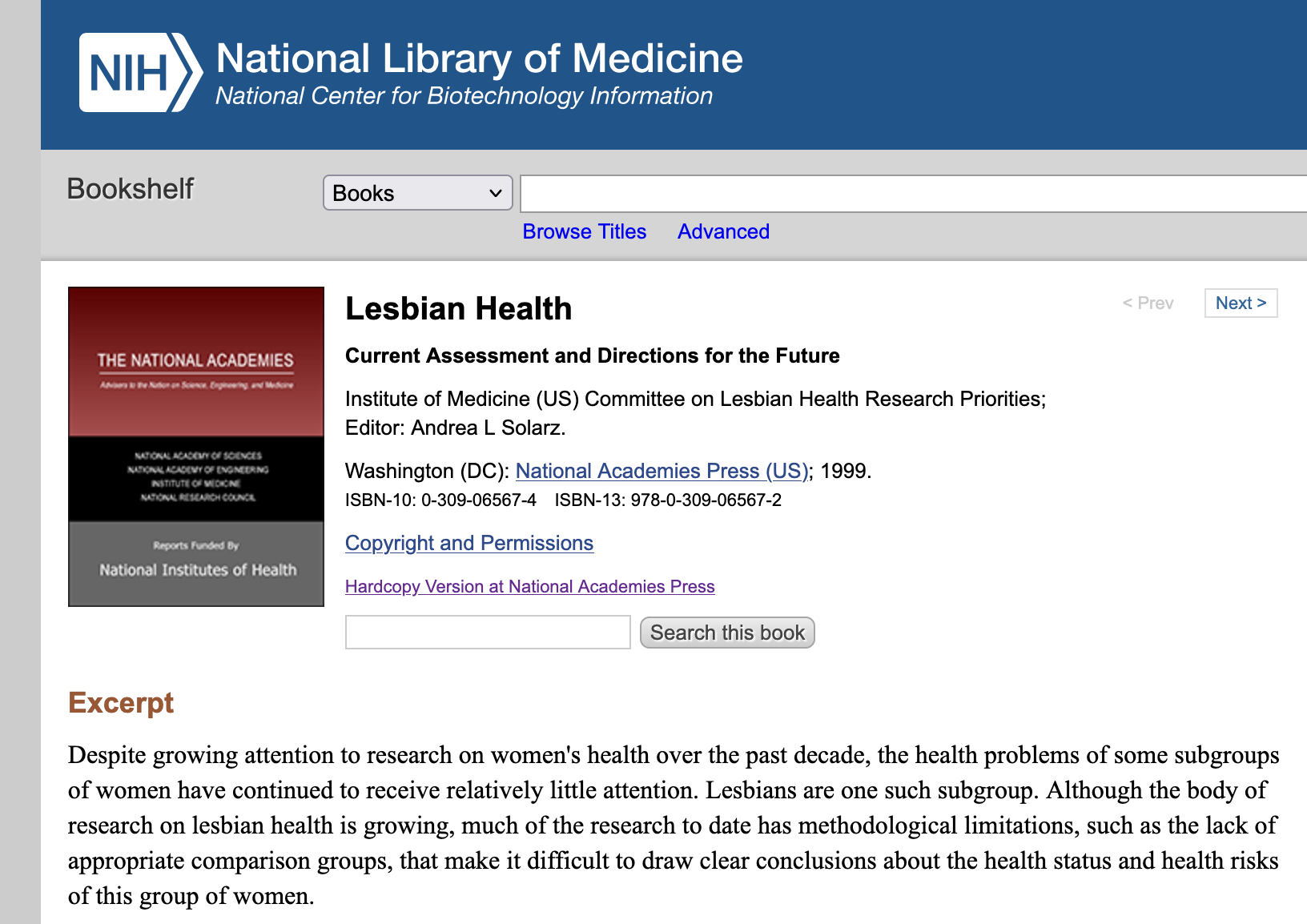
Mairead Sullivan: This is what's- Interesting ... they're working from the lesbian health study which took place across the 1980s and it was this hu- the first sort of huge data collection on lesbians and all sorts of things including these health factors.
But what happens to come to make this claim that lesbians are at a higher risk of breast cancer is that at the time, you know, breast cancer research is saying if you, uh, if you smoke, if you drink, if you haven't had children, so null parity if you've never experienced pregnancy, these things are risk factors for breast cancer.
And then the lesbian health survey says, "Oh look, lesbians, they smoke, they drink, they don't get pregnant so they're- Mm ... they're gonna have this higher risk for breast cancer."
The trick of it, and I, it might not have been exclusively happening this way, but for the most part the data was [00:56:00] collected at lesbian bars.
So they went to bars- Oh my gosh ... and asked people to fill out these surveys- Mm. Yeah ... and found a bunch of people who drank and smoke and had never been pregnant.
Jack Gieseking: Oh my Goddess, I can't.
Katherine Griffiths: Yeah. Yeah. Yeah. That's a big factor. Yeah.
Conclusion & Credits
Jack Gieseking - Narrator: What a mic drop. To be clear, there is a massive study by the National Institute of Health, and what Mairead Sullivan is saying is they mostly interview people coming out of dyke bars who were already smoking, already drinking, who were more likely to have all these illnesses.
And so we wound up thinking about what lesbian health was, and the world wound up thinking what lesbian health was because of this big, important National Institute of Health study because of what dykes in bars were doing. Whoa.
That said, we are going to pause this first episode here, and when we come back next week with these same brilliant queers, we are going to dive in why the heck lesbian bars started to close.
Until then!
Thanks for tuning in to Our Dyke Histories in collaboration with Sinister Wisdom. Do share Our Dyke Histories with your friends, colleagues, fellow students, exes, crushes, or heck, use it as a pickup line when you don't know what to say in a bar. Good luck to you, brother, sister, and themsir.
You can easily connect with us on Instagram or Facebook at ourdykehistories, and come and follow me, Jack Gieseking, via my newsletter, Queer Geographies at queergeographies.com, which is packed with all the images that accompany the transcripts from all of our episodes and many more tales of dyke bars, queer parties, trans hangouts, as well as a myriad of other queer spaces and queries like, "Do dykes cruise?"
I have data. Never stop loving on all things Sinister Wisdom. At sinisterwisdom.org, you can subscribe, buy their books, or make a donation.
Now on to our credits. We are a small but mighty team.
Dyke Histories is recorded, edited, and produced by Jack Gieseking and co-edited and co-produced by Cade Waldo.
Our social media is designed and [00:58:00] managed by Audrey Wilkinson. Our theme song, Like Honey, was graciously gifted to us from Kit Orion at kitorion.com. Interns for the show include Becca Moses and Sophie McLean, with additional input from Rachel Fagen. We're forever grateful to our co-producer Julie Enser and the entire team at Sinister Wisdom, publishing since 1976.
Sinister Wisdom recognizes the power of language to reflect diverse, multicultural lesbian experiences and to enhance our ability to develop critical judgment. As lesbians evaluating our community and our world, we share our dyke histories so we know more about who we are, how we were, and what we fight to never forget.
Lez keep doing it, y'all.